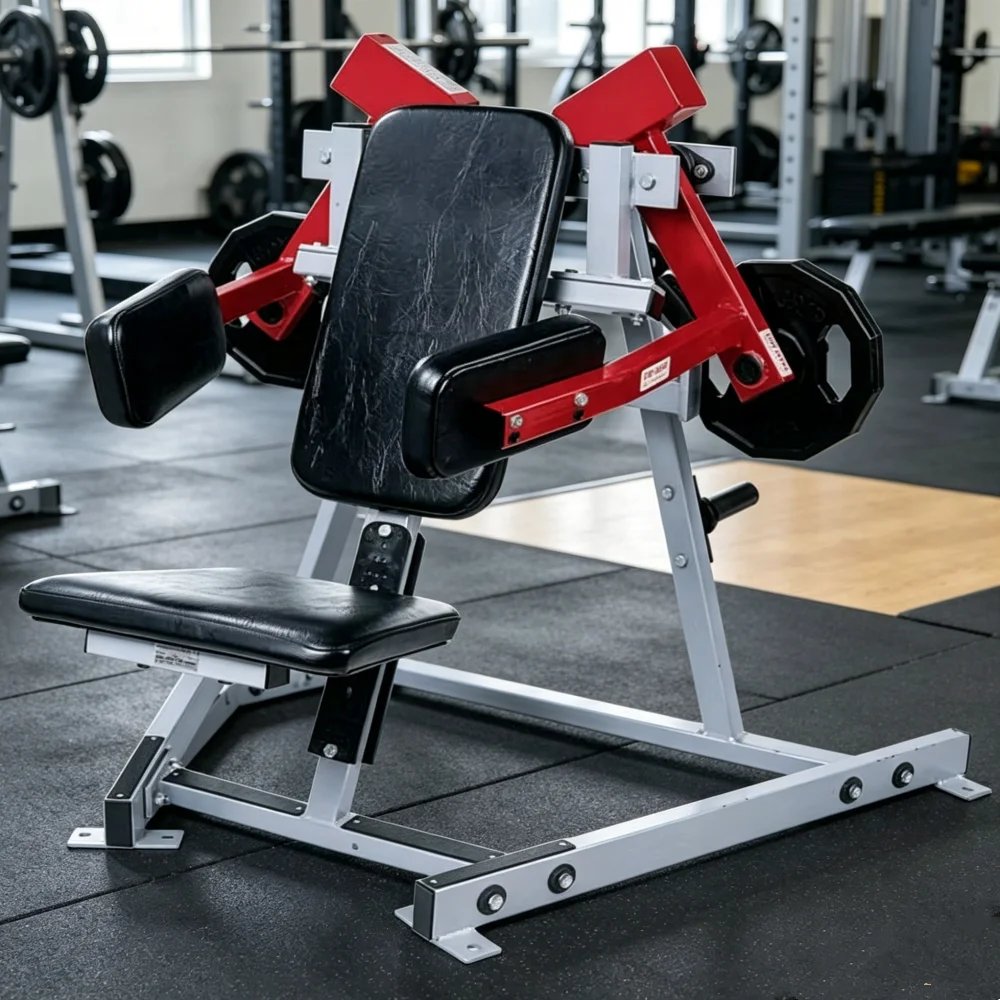
![Commercial Plate Loaded Bench Press Gym Equipment [WARN] draft identifier mismatch](https://bicksport.com/wp-content/uploads/2026/08/commercial-plate-loaded-bench-press-gym-equipment-warn-draft-identifier-mismatch-2572b3.webp)
Heavy-Duty Stability — Reinforced steel frame engineered for continuous high-frequency plate loading in commercial strength zones.
Technical Specifications
| Parameter | Value |
|---|---|
| Product Type | Plate Loaded Bench Press |
| Exercise Target | Chest |
| Frame Material | Steel |
| Resistance Type | Plate Loaded (Manual) |
| Product Dimensions | 1323 × 1599 × 1746 mm |
| Net Weight | 140 kg |
| Folded | Unfolded |
| Certification | ISO 9001, CE |
| Customization | OEM/ODM Available |
| Age Group | Adult |
| Gender | Unisex |
| HS Code | 9506911900 |
Application Suitability
| Deployment Scenario | Typical Use |
|---|---|
| Chain gym strength zone | Primary flat or incline bench press station for general membership |
| Corporate wellness center | Dedicated chest pressing movement within a compact free-weight area |
| Sports performance training center | Heavy compound lift station for athlete strength and conditioning programs |
| High-end residential home gym | Permanent pressing station for experienced lifters requiring plate loading |
| Community fitness facility | Durable bench press工位 for supervised group or open-gym strength sessions |
What Frame Weld Integrity Means When the Barbell is Loaded to Maximum
A commercial plate loaded bench press gym equipment must survive thousands of loading cycles without audible flex or visible seam fatigue.
I spent years watching lightweight commercial frames drift out of square after eighteen months of heavy use, the welds developing hairline cracks that nobody notices until a member hears grinding during a set. When you spec strength equipment for a busy floor, the steel gauge and the welding pattern determine whether the unit stays rigid under asymmetric loading or starts shifting on the rubber flooring. [NEED_CITE: structural fatigue testing standards for commercial strength equipment]
This frame addresses that by using full-perimeter welding at every load-bearing junction. The 140 kg net weight anchors the unit firmly during unracking and re-racking, eliminating the drift that plagues lighter benches. The plate loaded design itself removes the cable-and-pulley wear points found in selectorized machines, leaving fewer failure modes for facility maintenance teams to track.
Where This Bench Press Sits in the Strength Training Floor Plan
The commercial plate loaded bench press gym equipment fills the core horizontal pressing role in a free-weight zone, complementing squat racks, deadlift platforms, and selectorized chest machines. Plate loading allows experienced lifters to progress in small increments beyond what fixed-weight dumbbells offer, while the fixed unfolded structure provides a stable base that spotters can approach from any angle. The unit suits users across a wide anthropometric range given its standard bench geometry and floor-standing footprint. Deploy it in the high-traffic area of the strength zone where members expect to spend extended rest intervals between heavy sets, allowing adequate lateral clearance for plate handling.
Continuous Load Cycles and Floor Deployment Realities
Unlike motorized cardio units, a plate loaded bench press has no duty cycle rating, but the frame still endures thousands of load-unload sequences every month in a busy facility. [NEED_CITE: commercial strength equipment lifecycle benchmarks] The 1323 × 1599 mm footprint requires level flooring with adequate surrounding clearance for plate storage racks and spotter movement. No electrical supply or data connection is needed, simplifying placement anywhere on the gym floor. Rubber flooring beneath the unit absorbs plate-drop vibration and prevents the steel feet from migrating on smooth surfaces. Ventilation and airflow matter less here than in cardio zones, but sightline planning should keep the bench press visible from the main floor desk for safety supervision.
Reading the Steel Gauge and Weld Pattern Specifications
The frame relies on structural steel tubing with reinforced gussets at high-stress junctions where the bench upright meets the base. Plate loaded horns accept standard Olympic plates, distributing weight directly through the steel path rather than through cables or guide rods that stretch and wear over time. The unfolded fixed configuration eliminates hinge mechanisms that introduce play after repeated use, a common complaint with foldable or adjustable commercial benches. A 140 kg net weight indicates substantial material density, keeping the unit grounded when a lifter un-racks a heavily loaded barbell with lateral force. The bench pad mounting points use bolted connections that allow pad replacement without cutting or welding if the upholstery compresses after years of use.
The Hidden Cost of Underspec’d Strength Stations
Facilities that source bench presses based on lowest unit cost often discover frame drift within the first year, where the upright no longer aligns vertically and the barbell rests at an angle that compromises lifter safety. Weld failures on light-gauge frames occur at the base-upright junction, the highest torque point during re-racking. [NEED_CITE: field failure rates for under-gauged commercial bench frames] Members notice the wobble before management does, and word spreads that the equipment feels unsafe, driving attrition to competitors with heavier stations. Replacing an entire row of compromised benches costs far more than specifying adequate steel gauge from the start, and the downtime leaves the strength zone incomplete during peak membership months.
Why This Product Line Covers the Strength Zone Reliably
The reinforced steel frame and plate loaded architecture eliminate the cable and pulley maintenance that selectorized machines demand monthly in high-traffic facilities. ISO 9001 manufacturing ensures weld consistency across production batches, so every unit arriving at a multi-site rollout performs identically. The OEM and ODM capability allows facility operators to match frame color and branding to existing strength zone aesthetics without compromising structural specifications. The fixed unfolded footprint simplifies 3D layout planning because there are no moving parts to account for in clearance calculations. Full documentation including EN 957 test reports and structural load records accompanies each shipment, giving procurement teams the verification they need for insurance and liability compliance. 24/7 technical support covers weld inspection guidance and pad replacement procedures long after installation.
Documentation & Test Records
- CE declaration of conformity covering structural safety requirements
- EN 957 test report validating static and dynamic load performance
- ISO 9001 certificate confirming manufacturing quality management
- Structural load and fatigue test records for the welded steel frame
- Material specification sheet detailing steel gauge and weld procedures
- Installation guide with floor anchoring and clearance specifications
Installation, Commissioning & Maintenance
- Position on level rubber flooring with clearance on all sides for plate loading and spotter access around the 1323 × 1599 mm footprint.
- Verify frame squareness after uncrating; no electrical or data connections required for this plate loaded unit.
- Inspect all bolted pad mounting connections and retighten after the first month of heavy use.
- Clean steel surfaces with non-corrosive cleaner to prevent sweat-induced oxidation on the plate horns and frame.
- Check weld seams visually during quarterly maintenance rounds for any signs of stress or surface cracking.
Planning Your Strength Zone Equipment Inquiry
Provide your strength zone square footage and equipment count to receive a 3D layout that accounts for plate storage, spotter circulation, and adjacent rack spacing. Specify whether the deployment is a new facility or a retrofit to confirm floor anchoring requirements and delivery access. Indicate your target market so documentation and labeling match local regulatory expectations. State whether you require OEM color and branding customization to align with an existing equipment color scheme across the strength floor.
Frequently Asked Questions
Q: How does plate loaded differ from selectorized chest press for commercial deployment?
A: Plate loaded units like this bench press have no cables, pulleys, or weight stacks to maintain, reducing monthly service calls. Lifters load Olympic plates directly onto the horns, allowing unlimited weight progression beyond fixed stack limits. Selectorized machines offer quick pin-selection convenience but require regular cable tensioning and guide rod lubrication under high-frequency use.
Q: What steel gauge and weld standards apply to commercial bench press frames?
A: Commercial strength frames typically use heavy-gauge steel tubing with full-perimeter welding at load-bearing junctions. The EN 957 standard defines static and dynamic load tests that verify the frame can withstand repeated maximum loading without deformation. Always request the manufacturer’s structural test record to confirm compliance before procurement.
Q: How much floor space and clearance does this bench press station require?
A: The unit footprint is 1323 × 1599 mm, but safe deployment requires additional lateral and rear clearance for plate storage racks, lifter approach, and spotter positioning. Plan for a minimum envelope that allows a spotter to stand behind the bench and move freely. A 3D layout can confirm exact spacing relative to adjacent racks and platforms.
Q: What OEM customization options are available for this plate loaded bench press?
A: OEM and ODM customization covers frame color, branding logos, and bench pad upholstery to match existing facility aesthetics. Minimum order quantities apply and vary by customization depth. Specify your requirements during the quotation phase so production tooling and paint scheduling align with your project delivery timeline.
Q: Can the bench press integrate with facility management or member tracking systems?
A: This plate loaded bench press is a purely mechanical strength unit with no electronic console or data connectivity. Member usage tracking in strength zones typically relies on manual logging or separate wearable-based systems. If data integration is a priority, discuss how the overall floor plan can incorporate connected cardio equipment alongside mechanical strength stations.
![Full Rack Power Rack Machine Crossfit Gym Equipment [WARN] draft identifier mismatch](https://bicksport.com/wp-content/uploads/2026/08/full-rack-power-rack-machine-crossfit-gym-equipment-warn-draft-identifier-mismatch-ad0ad7.webp)
![OS-H5002 Hot Hammer Strength Lateral Chest Back Machine for Gym [WARN] draft identifier mismatch](https://bicksport.com/wp-content/uploads/2026/08/os-h5002-hot-hammer-strength-lateral-chest-back-machine-for-gym-warn-draft-identifier-mismatch-553bdf.webp)