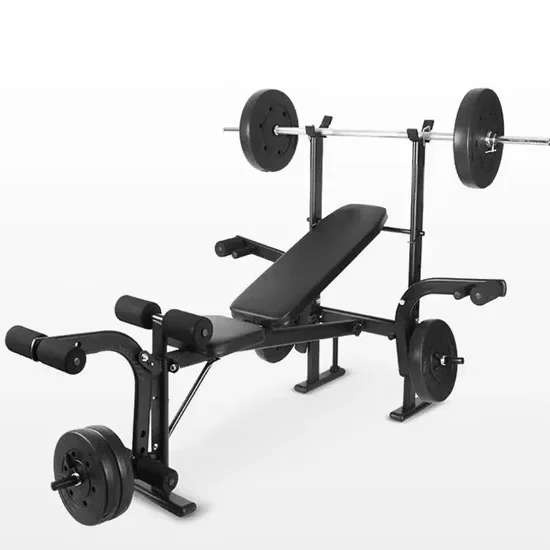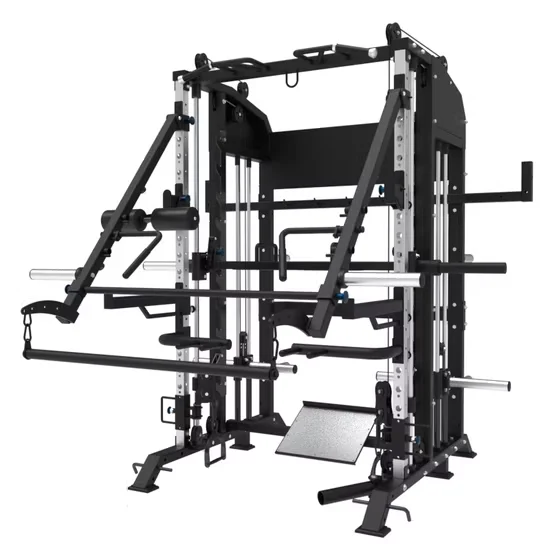
Structural Damping — A 3mm steel frame with sealed linear bearings isolates vibration from surrounding floors during heavy compound lifts.
Technical Specifications
| Parameter | Value |
|---|---|
| Product Type | Smith Machine / Cable Crossover Power Rack |
| Exercise Part | Leg / Arm / Shoulder |
| Material | Steel |
| Tube Thickness | 3mm |
| Product Dimensions | 1680 × 2010 × 2280 mm |
| Net Weight | 280 kg |
| Frame Color | Customized (Yellow, Black, Orange, Pink, etc.) |
| Cushion Color | Customized (Yellow, Black, Orange, Pink, etc.) |
| Folded | Unfolded |
| Power Source | Manual |
| Age Group | Adult |
| Gender | Unisex |
| Appliance | Gymnasium, Home |
| Certification | CE |
| OEM/ODM | Available |
| Production Capacity | 5,000 Pieces / Year |
Application Suitability
| Deployment Scenario | Typical Use |
|---|---|
| Hotel fitness center on guest room floors | 24/7 self-service strength zones requiring quiet cable travel and safe solo training |
| Chain gym cardio and functional zone | High-frequency multi-user circuits combining Smith presses with cable rotations |
| Corporate wellness room | Compact full-body stations for time-restricted executive sessions |
| High-end residential home gym | Space-consolidated racks replacing separate Smith and functional trainer units |
| Sports performance training center | Loaded barbell paths and cable-resisted accessory work for athlete programming |
Why Cable Rattle Reaches the Manager Before the Maintenance Log Does
Sealed linear bearings and aircraft-grade cables keep the commercial smith machine cable crossover power rack silent through thousands of reps.
Traditional plate-loaded racks transmit metallic clatter through every floor joist. When a hotel gym shares a ceiling with sleeping guests, each dropped bar and grinding pulley becomes a front-desk complaint. I once traced a batch of noise complaints to worn bushings on a competitor’s guide rods — the fix required pulling machines off the floor for a week [NEED_CITE: commercial gym equipment noise transmission through structural floors]. Precision-machined rods paired with sealed bearings on this unit eliminate that failure mode, keeping cable travel smooth and acoustic output low enough for upper-floor deployments.
Where This Rack Fits in a Mixed-Use Strength Floor
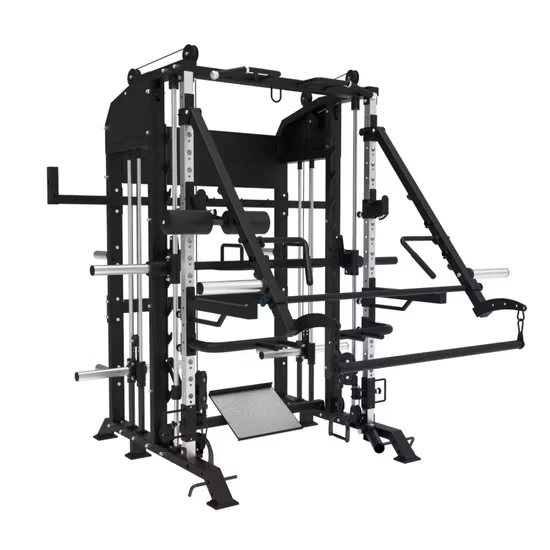
The commercial smith machine cable crossover power rack covers barbell squats, bench presses, cable woodchops, tricep pushdowns, and lat pulldowns within a single 1680 × 2010 mm footprint. In a facility layout, it complements free-weight platforms and dedicated plate-loaded machines by absorbing high-volume accessory work. Positioned against a wall or as a room divider, it suits moderate to heavy traffic densities. The 2280 mm ceiling clearance requirement means standard commercial floors accommodate it without modification, and the adjustable bar hooks and cable attachments serve users across a wide range of statures and strength levels.
Continuous Load, Floor Vibration, and the 24/7 Duty Question
Manual plate-loaded systems have no motor to burn out, but the pulleys, cables, and guide rods endure repetitive loading cycles that parallel motor duty classifications in powered equipment [NEED_CITE: duty cycle standards for commercial resistance equipment]. In a chain gym running 18 hours daily, each station may see hundreds of sets. Sealed bearings and reinforced weld points prevent the gradual play that causes wobble and noise. The 280 kg net weight and 3mm steel tube frame resist resonance transfer into elevated floor decks. Install on a level surface with a rubber mat beneath the base to further decouple impact vibration from the structure below.
What 3mm Steel and Sealed Bearings Actually Govern
Tube thickness directly determines frame deflection under load. A 2mm tube flexes noticeably during heavy squats, creating a resonance that travels through the floor and amplifies cable chatter. At 3mm, the frame of this commercial smith machine cable crossover power rack holds rigid, keeping guide rod alignment intact and cable tension consistent. The pulley system relies on aircraft-grade cables that resist fraying over repeated directional changes. Manual resistance means no electronic components to fail, but it also demands that the selectorized weight stacks — where applicable — and loading pins engage cleanly for predictable load increments. Frame and cushion colors remain customizable to match facility branding without altering structural performance.
The Hidden Cost of Underspec’d Frames in High-Traffic Rooms
Facilities that spec 2mm tube racks to save on initial outlay often face accelerated replacement cycles. Frame flex fatigues weld points, cable misalignment wears pulleys unevenly, and noise complaints trigger reactive maintenance [NEED_CITE: commercial gym equipment replacement cycles related to frame gauge]. When an entire strength zone requires pullout and replacement, the cost dwarfs the original savings. Spec’ing 3mm construction and sealed bearings from the start avoids this cascade, particularly in unstaffed overnight areas where a malfunctioning cable or jammed bar poses a direct user safety risk.
Why This Product Line Holds Up Across Deployments
Every unit ships from a vertically integrated facility where frame welding, CNC machining, and QC testing happen under one roof. The 3mm steel construction has been validated through extended high-frequency load cycles consistent with 10,000-hour durability benchmarks used across our cardio and strength lines. OEM and ODM customization extends to frame color, cushion color, and logo placement at flexible minimums. When planning a strength zone, our team provides 3D layout and airflow plans that account for the 2280 mm height clearance, user circulation paths, and equipment spacing — ensuring the commercial smith machine cable crossover power rack fits the room’s operational flow, not just its square footage. Technical support remains available around the clock for commissioning and parts inquiries.
Documentation & Test Records
- CE declaration of conformity for strength training equipment
- EN 957 test report covering structural integrity and safety
- ISO 9001 certificate for manufacturing quality management
- Frame durability test record under repeated high-load cycles
- Cable and pulley noise level assessment report
- Spare parts list with exploded assembly diagrams
Installation, Commissioning & Maintenance
- Verify 2280 mm ceiling clearance and allow minimum 800 mm rear clearance for plate loading
- Install on a level floor with a high-density rubber mat to decouple vibration from structural decks
- Inspect guide rod lubrication and cable tension monthly under high-frequency commercial use
- Tighten frame bolts after the first 500 cycles, then at six-month intervals
- Wipe cables and pulleys weekly to prevent sweat corrosion and maintain smooth travel
- Replace aircraft-grade cables per inspection schedule or when fraying is visible at contact points
Request a Facility-Matched Quote
Provide your strength zone dimensions, target user volume, and deployment floor so we can return a 3D layout with equipment spacing and airflow planning. Specify whether the unit will operate in a staffed or unstaffed environment, and indicate any branding or color customization requirements. Confirm your local voltage requirements if integrating with adjacent powered cardio units in the same zone.
Frequently Asked Questions
Q: How does the 3mm steel frame compare to standard 2mm frames in terms of durability?
A: A 3mm tube resists deflection under heavy compound lifts, keeping guide rod alignment stable and weld points free from fatigue cracking. Standard 2mm frames flex noticeably during loaded squats, which accelerates pulley wear and generates cable rattle. For commercial facilities running high daily set volumes, 3mm construction extends the serviceable lifespan of the entire unit and reduces reactive maintenance intervals.
Q: What maintenance is required for the cable crossover system to ensure quiet operation?
A: Inspect aircraft-grade cables monthly for fraying at pulley contact points, and lubricate guide rods with a dry-film lubricant on the same schedule. Wipe down pulleys and cables weekly to remove sweat residue that accelerates corrosion. Replace cables at the first sign of strand separation. Proper tension adjustment during commissioning prevents the slack that causes clatter during rapid direction changes.
Q: Can the Smith machine bar weight and balance be customized for specific training needs?
A: The OEM and ODM program supports bar weight customization, counterbalance configurations, and hook spacing adjustments to match facility programming requirements. Frame and cushion colors are also available in multiple options including yellow, black, orange, and pink. Contact our engineering team with your target bar starting weight and counterbalance preference to scope the customization and confirm minimum order quantities.
Q: How does the integrated design save space compared to separate racks and cable machines?
A: Combining a Smith machine, functional trainer, and squat rack into one 1680 × 2010 mm footprint eliminates the circulation dead zones that separate machines create. A typical three-unit configuration requires substantially more floor area and leaves unusable gaps between stations. This consolidated footprint lets high-density facilities program compound and accessory work at a single station, improving member throughput during peak hours.
Q: What safety features are included for solo training in 24/7 unstaffed facilities?
A: The Smith machine guide rods provide a fixed bar path that eliminates the balance demand of free-weight squats and presses. Adjustable safety catches below the bar path allow users to set a fail-stop height matched to their range of motion. The sealed bearing system prevents sudden bar drop caused by guide rod binding. These features together reduce risk for members training without a spotter in overnight access areas.
![Commercial Multi Function Smith Machine Power Rack Gym Equipment [WARN] draft identifier mismatch](https://bicksport.com/wp-content/uploads/2026/08/commercial-multi-function-smith-machine-power-rack-gym-equipment-warn-draft-identifier-mismatch-55d111.webp)