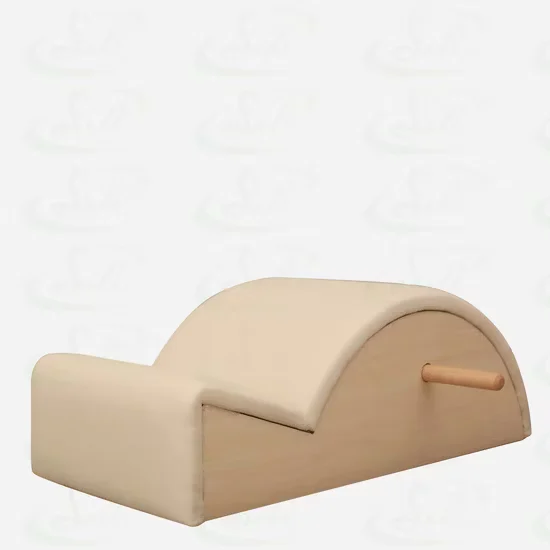
Mechanical Silence — Solid beech wood frame and spring-resistance carriage eliminate motor noise entirely, fitting naturally into shared residential and studio spaces.
Technical Specifications
| Parameter | Value |
|---|---|
| Product Type | Pilates Reformer |
| Material | Beech Wood |
| Accessory | Long Box / Jump Board / Platform |
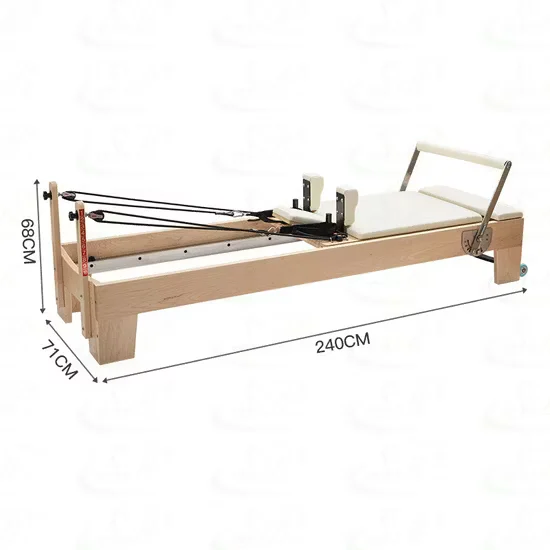
| Product Dimensions | 2460730680mm |
| Net Weight | 100kgs |
| Color | Solid Color |
| Attachment | Tower and Half Cadillac |
| User | Adult / Unisex |
| Logo | Customized |
| Customization | Available |
| Warranty | 3 Years |
| HS Code | 9506911900 |
| Production Capacity | 80 Pieces/Month |
| Transport Package | Standard Wood Case |
Application Suitability
| Deployment Scenario | Typical Use |
|---|---|
| Boutique Pilates studio in shared commercial buildings | Group reformer classes with noise-sensitive neighbors |
| High-end residential home gym | Daily personal practice without motor hum or electronic interference |
| Wellness center and rehabilitation facility | Low-impact movement therapy in multi-use treatment rooms |
| Hotel spa and guest fitness area | Quiet apparatus placement on guest-room-adjacent floors |
| Corporate wellness room | Employee sessions during breaks without disrupting open offices |
Why Studios Above Guest Rooms Choose Mechanical Resistance Over Motorized Alternatives
A wood-frame mechanical reformer generates zero motor noise, removing the single largest source of acoustic complaints in shared-floor deployments.
When cardio or motorized equipment operates above occupied rooms, low-frequency vibration transmits through structural slabs and triggers guest complaints faster than front desk staff can respond. A beech wood Pilates reformer with tower half Cadillac avoids this entirely — the carriage runs on solid wood rails under spring tension, producing only the sound of controlled breathing and carriage roll. Studios operating in mixed-use buildings or above hotel guest corridors eliminate acoustic liability at the equipment level rather than trying to solve it with soundproofing after installation [NEED_CITE: acoustic transmission standards for fitness equipment in mixed-use buildings].
Where This Reformer Sits in a Studio Floor Plan
A beech wood Pilates reformer with tower half Cadillac covers full-body resistance training across supine, prone, seated, and standing positions without requiring adjacent apparatus. The tower attachment adds vertical resistance vectors for arm and leg work that would otherwise demand a separate wall unit or chair. In a studio layout, this unit occupies a single footprint while serving the exercise range typically spread across three machines. It pairs with mat stations for warm-up flow and complements high-intensity cardio zones by offering controlled eccentric loading. The 180kg-capacity frame accommodates users across body types, and the solid-color beech finish adapts to varied interior palettes without visual clash.
Continuous Use in Noise-Sensitive Environments
Unlike motorized fitness equipment that accumulates heat and requires forced-air cooling, this mechanical reformer has no thermal management requirement — the springs and carriage generate negligible friction heat during extended class blocks. Studios can schedule back-to-back sessions without duty-cycle limits or cooldown intervals between classes. The beech frame dampens vibration naturally, so overhead and adjacent rooms experience minimal structural transmission. Deployment on upper floors, above treatment rooms, or beside quiet zones does not require isolation pads or floating floors. Ambient room conditions — temperature and humidity within standard indoor ranges — are sufficient, and no dedicated electrical circuit is needed since there are no powered components [NEED_CITE: environmental requirements for mechanical fitness apparatus in commercial settings].
Spring-Resistance and Wood-Rail Mechanics Explained
The mechanical spring-resistance system delivers progressive tension: as the carriage travels further from the anchor point, resistance increases proportionally without electronic calibration. This contrasts with motorized systems where resistance curves can drift as sensors age or firmware updates alter response profiles. The solid beech carriage rails provide a rolling surface that avoids the metal-on-metal contact noise common in aluminum-track reformers. Beech wood’s density and grain structure absorb micro-vibrations at the contact point, keeping carriage movement below ambient conversation levels. The tower and half Cadillac attachment mounts directly to the frame’s reinforced uprights, maintaining structural rigidity even under loaded bar and strap work. Spring replacement follows a simple tension-rating schedule, and carriage wheels require only periodic bearing inspection rather than belt alignment or motor brush servicing.
The Cost of Underspecifying Mechanical Apparatus
Studios that source reformers with particleboard frames or thin veneer over composite cores encounter surface delamination within months of high-frequency use, particularly where carriage wheels track repeatedly across the rail surface. Metal-frame reformers without adequate damping transmit carriage impact through the floor structure, generating the same low-frequency complaints that motorized equipment causes. Spring sets rated below intended user weight lose tension consistency mid-class, forcing instructors to compensate verbally rather than relying on equipment response. Facilities that skip material-grade verification during procurement end up replacing entire units rather than servicing components, doubling capital outlay within the first year [NEED_CITE: material fatigue testing standards for wood-frame fitness equipment].
Why This Product Line Addresses the Specification Gap
Biketon Sport’s engineering approach to this beech wood Pilates reformer with tower half Cadillac starts with the same acoustic discipline applied across our cardio range — every deployment scenario is evaluated for noise transmission before equipment selection. The solid beech construction and mechanical drive eliminate the motor burnout and electronic failure modes that plague continuously operated powered equipment. OEM customization extends to logo engraving, upholstery color, and wood finish tone, matching facility branding without structural compromise. Our team provides 3D studio layouts that account for carriage travel clearance, instructor sightlines, and airflow around grouped units — this reformer’s 2460mm length requires specific front and rear spacing to avoid wall interference during full-extension exercises. Documentation includes material grade certification, spring load-test records, and EN 957 compliance reports, so procurement teams can verify specifications before container loading.
Documentation & Test Records
- CE declaration of conformity for mechanical fitness apparatus
- EN 957 test report covering load-bearing and structural integrity
- ISO 9001 certificate for manufacturing quality management
- Material grade verification for solid beech components
- Spring tension and fatigue test records
- Assembly and commissioning guide with torque specifications
Installation, Commissioning & Maintenance
- Maintain 600mm rear clearance for full carriage travel at 2460mm frame length
- Level the beech frame on solid flooring using adjustable foot pads to prevent rail twist
- Inspect carriage wheel bearings and spring anchors quarterly under high-frequency studio use
- Wipe wood surfaces with damp cloth and avoid solvent cleaners that degrade beech finish
- Rotate spring sets annually to equalize fatigue across resistance positions
- Check tower upright bolts and half Cadillac mounting hardware after initial 30-day break-in
Equipment Selection and Deployment Inquiry
Provide your studio floor dimensions and target unit count to receive a 3D layout addressing carriage clearance, instructor sightlines, and ventilation flow. Specify whether deployment floors are above occupied spaces so acoustic requirements can be confirmed against the mechanical drive profile. Indicate target market for upholstery and finish compliance documentation. State whether console integration or facility management data sync is planned for adjacent powered equipment in the same zone.
Frequently Asked Questions
Q: How does beech wood compare to aluminum frames for acoustic performance in shared buildings?
A: Beech wood provides inherent vibration damping through its grain density, absorbing carriage impact rather than transmitting it through floor structures. Aluminum frames conduct vibration efficiently and often require isolation pads to achieve similar noise reduction. For studios above guest rooms or adjacent to quiet spaces, solid beech construction eliminates the need for secondary acoustic treatments.
Q: What maintenance does the mechanical spring system require compared to motorized reformers?
A: Spring-resistance systems need periodic tension verification and replacement on a fatigue-cycle schedule, typically measured in thousands of compression cycles. There are no motors to cool, no belts to align, and no electronic sensors to recalibrate. Maintenance intervals are longer than motorized equivalents, and service requires basic mechanical tools rather than specialized electronic diagnostics.
Q: What exercises does the tower and half Cadillac attachment enable beyond standard reformer work?
A: The tower adds vertical resistance vectors for standing leg work, overhead arm patterns, and assisted stretching that require anchor points above the carriage plane. The half Cadillac provides a stable overhead frame for trapeze and strap exercises. Together they expand the exercise repertoire without requiring separate wall units or additional floor space beyond the reformer footprint.
Q: What customization is available for studio branding and interior matching?
A: Logo engraving on the beech frame, upholstery color selection across standard and custom ranges, and wood finish tone adjustment are all available under OEM scope. Accessory configuration — long box, jump board, platform — can be specified per unit to match class programming needs. Minimum order quantities apply for custom finish and upholstery runs.
Q: What does the warranty cover for springs, carriage wheels, and upholstery?
A: The 3-year warranty covers structural frame integrity, spring tension retention within rated specifications, carriage wheel bearing function, and upholstery seam construction under normal commercial use. Consumable items like spring replacement due to fatigue-cycle exhaustion and surface wear on upholstery contact points follow documented replacement schedules provided in the commissioning guide.

![Senrui Fitness Aluminum Alloy Reformer with Tower Pilates Machine [WARN] draft identifier mismatch](https://bicksport.com/wp-content/uploads/2026/08/senrui-fitness-aluminum-alloy-reformer-with-tower-pilates-machine-warn-draft-identifier-mismatch-e52269.webp)