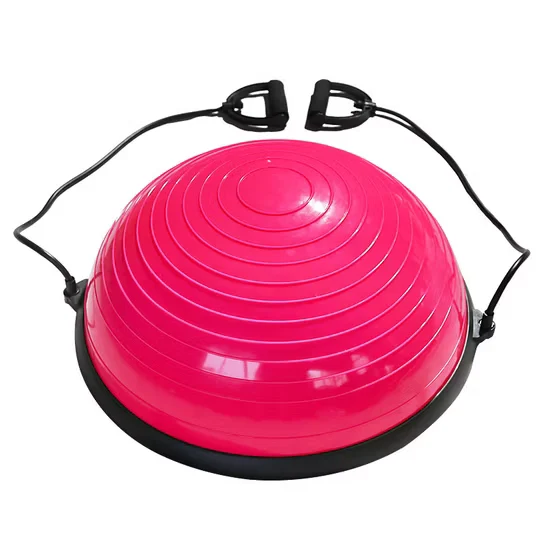
Stable Dome Structure — Engineered to maintain shape under repetitive loading in high-traffic group fitness environments.
Technical Specifications
| Parameter | Value |
|---|---|
| Product Type | Balance Trainer |
| Specification | 58×25cm |
| Weight | 3kgs |
| Color | Red (customization available) |
| Logo | Customized Is Allowed |
| Age Group | Adult |
| Gender | Women |
| MOQ | 2PCS |
| Production Capacity | 1000PCS/Month |
Application Suitability
| Deployment Scenario | Typical Use |
|---|---|
| Boutique yoga and Pilates studios | Daily group balance and core stabilization classes |
| Hotel guest fitness centers | Functional training tools for wellness-focused travelers |
| Physical therapy and rehabilitation clinics | Balance recovery protocols and proprioception drills |
| High-end residential home gym | Compact balance and flexibility training in limited space |
| Corporate wellness rooms | Functional movement sessions during employee wellness programs |
Why Surface Degradation in Shared Studios Becomes a Safety Liability
The non-slip dome surface must hold grip through hundreds of sweat-intensive sessions per week.
Balance trainers in commercial group studios experience relentless foot traffic, and surface wear on inferior domes creates slippage that members notice immediately during dynamic movements [NEED_CITE: commercial fitness equipment surface durability standards for group training]. When grip consistency fails under high-sweat conditions, the equipment moves from asset to liability, and facility operators face member complaints or injury reports. The non-slip balance trainer half pilates ball addresses this through a surface material formulated for consistent traction across repetitive use cycles, reducing the risk of slippage during high-intensity balance routines.
Where This Balance Trainer Fits in a Functional Training Layout
This half pilates balance trainer supports dynamic balance work, core stabilization, and controlled movement patterns across low to moderate intensity intervals. In a commercial cardio or functional zone, it complements larger equipment like treadmills or rowing machines by occupying the transition space between high-output cardio and recovery-focused movement. The compact 58×25cm footprint allows deployment in group studios, rehab corners, or hallway fitness nooks without obstructing member flow. It accommodates adult users of varying body types performing controlled balance drills, with the dome structure bearing repetitive loading across diverse weight ranges. The non-slip balance trainer half pilates ball performs reliably in spaces where full-size balance equipment would dominate the floor plan.
Continuous Deployment Considerations for High-Traffic Studio Floors
A balance trainer in a busy group fitness studio may see dozens of users per day, requiring materials that withstand repetitive compression without permanent deformation. The reinforced dome structure maintains shape under daily class schedules, though deployment surfaces must be level and free of debris to prevent base shifting [NEED_CITE: EN 957 requirements for stability in commercial balance training equipment]. Facilities placing this unit on hardwood or tile floors should verify adequate friction between the base and surface, particularly in humid environments where condensation can compromise stability. The 3kgs unit weight allows easy repositioning by instructors between classes, but storage protocols should prevent stacking loads that exceed the dome’s structural tolerance. Ambient temperature and UV exposure in sun-facing studios may also affect surface material longevity over extended deployment periods.
Surface Material and Structural Integrity Under Commercial Cycles
The non-slip surface on this balance trainer addresses a failure point common in shared fitness environments: grip degradation under continuous sweat exposure and shoe contact. Material composition determines whether the dome surface maintains friction coefficient through months of daily classes or develops smooth patches that compromise user confidence [NEED_CITE: friction coefficient retention testing for commercial fitness surfaces]. The reinforced dome structure distributes loading across the unit’s base rather than concentrating stress at contact points, which prevents localized deformation that would destabilize users during single-leg balance work. At 58×25cm, the platform provides sufficient surface area for bilateral and unilateral exercises while remaining portable for instructors who reconfigure studio layouts between sessions. Customization options for logo and color allow facilities to maintain brand consistency across mixed-equipment deployments.
The Hidden Cost of Specifying Below Commercial Grade
Balance trainers specified for light commercial or home use degrade rapidly when subjected to group class frequencies, with surface wear and structural fatigue creating safety concerns that force premature replacement cycles. Facilities that purchase based on unit price alone often face total cost of ownership that exceeds commercial-grade alternatives once replacement labor, member disruption, and potential injury claims are factored in. Noise from degraded dome structures that have lost their shape consistency can also create acoustic disturbances in quiet zones like hotel fitness centers operating adjacent to guest rooms. Deploying equipment that does not match the actual duty cycle of the facility creates operational friction that manifests as maintenance tickets and member dissatisfaction.
Why This Product Line Matches Facility Requirements
The non-slip surface formulation is verified across studio deployments where grip consistency directly affects user safety during dynamic movements. The reinforced dome structure undergoes durability testing that simulates repetitive loading patterns typical of daily group class schedules. Customization options including logo placement and color selection allow brand integration across hotel fitness centers, studio chains, and rehabilitation facilities without extending procurement timelines. The compact footprint enables 3D layout planning that maximizes functional training capacity within constrained floor areas, with sightline and member flow considerations built into the deployment consultation [NEED_CITE: commercial fitness space planning standards for functional training zones]. OEM capabilities cover aesthetic customization while maintaining structural specifications that match commercial duty requirements. Documentation support includes full technical specifications for facility compliance review and procurement records.
Documentation & Test Records
- CE declaration of conformity for balance training equipment
- EN 957 test report covering stability and load-bearing requirements
- ISO 9001 certificate for manufacturing quality management
- Surface material non-slip performance documentation
- Structural durability test record for dome integrity
- Customization specification sheet for logo and color options
Installation, Commissioning & Maintenance
- Deploy on level flooring with adequate friction to prevent base migration during use
- Maintain clearance around the 58×25cm footprint for safe exercise execution and instructor access
- Inspect dome surface weekly for wear patterns that may indicate grip degradation
- Clean non-slip surface after high-sweat sessions to prevent residue buildup affecting traction
- Store units flat without stacking loads that could deform the dome structure
- Verify base-to-floor contact stability when relocating between studio zones
Equipment Selection and Deployment Consultation
Provide your functional training area dimensions and existing equipment list to receive a 3D layout plan that positions this balance trainer within your member flow pattern. Specify daily usage frequency and class scheduling intensity to confirm the dome structure matches your facility’s duty cycle requirements. Indicate whether deployment occurs on upper floors adjacent to occupied rooms so acoustic considerations can inform placement decisions. State your target market requirements for branding customization to align OEM lead times with your facility opening or renovation schedule.
Frequently Asked Questions
Q: How does the non-slip surface perform under high-sweat commercial conditions?
A: The surface material maintains consistent friction coefficient through repeated exposure to sweat and shoe contact typical of group fitness classes. Regular cleaning prevents residue buildup that could otherwise compromise grip over extended deployment periods, ensuring user confidence during dynamic balance drills.
Q: What is the expected lifespan of the dome structure under daily group class use?
A: The reinforced dome is engineered to maintain shape integrity under repetitive loading from multiple daily sessions. Lifespan depends on usage intensity and maintenance protocols, with regular inspection recommended to identify early signs of material fatigue before structural performance degrades.
Q: Can the balance trainer be customized with facility branding and color schemes?
A: Logo customization and color options are available to match facility brand standards across hotel fitness centers, studio chains, or rehabilitation environments. MOQ requirements and lead times for custom orders align with facility rollout schedules to prevent procurement delays.
Q: How does this half ball compare to full balance balls for core and rehab training?
A: The half ball provides a stable flat base that eliminates the rolling instability of full spheres, making it suitable for controlled balance work and rehabilitation protocols where predictable platform behavior supports progressive training advancement without requiring constant stabilization corrections.
Q: What storage and maintenance practices extend product life in high-traffic gyms?
A: Store units flat without stacking heavy objects on the dome surface, and clean after high-sweat sessions to prevent material degradation. Regular inspection of surface texture and structural integrity allows proactive replacement before worn units create safety concerns during member use.