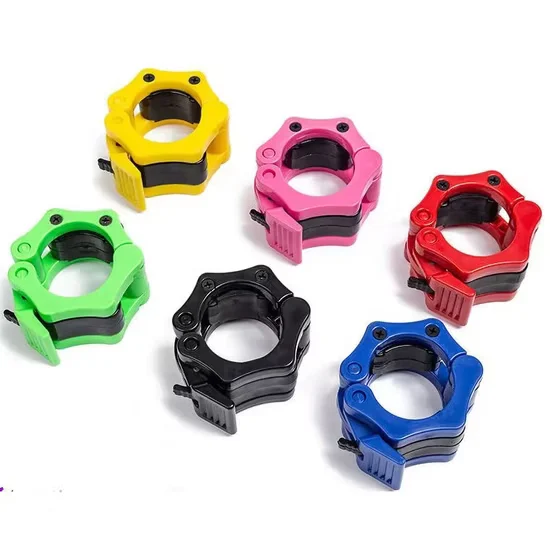
Durable Weightlifting Barbell Clamp Clips for Commercial Gyms
Whisper-Quiet Clamping — Engineered plastic barbell collar clips that eliminate metal-on-metal noise during high-frequency plate changes in commercial weightlifting zones.
Technical Specifications
| Parameter | Value |
|---|---|
| Product Type | Barbell Collar / Weightlifting Barbell Clamp |
| Material | Engineering-grade Plastic |
| Model NO. | BC-2000 |
| Application | Indoor Commercial & Residential |
| Max Barbell Diameter | Standard Olympic bars (50mm sleeve) |
| Clamping Mechanism | Quick-release spring-loaded lever |
| Color | Customized Color options available |
| Logo | Customized Logo Available |
| Certification | CE / EN 957 / ISO 9001 |
| Origin | China |
| HS Code | 9506911900 |
| MOQ | 50 pair |
| Production Capacity | 10,000 pairs per year |
| Transport Package | Carton |
Application Suitability
| Deployment Scenario | Typical Use |
|---|---|
| Hotel fitness center on guest room floors | Low-noise plate changes during 24-hour access hours without disturbing adjacent rooms |
| Chain gym free weight zone | High-frequency clamp-on and removal across peak traffic sessions |
| Corporate wellness weightlifting area | Secure plate retention during supervised group strength sessions |
| High-end residential home gym | Quiet operation in shared residential buildings with noise-sensitive neighbors |
| Professional sports training center | Stable barbell loading for heavy compound lifts during athlete programming |
Why Plastic Collars Quiet the Weight Room Before Management Even Knows There Is a Problem
Metal-on-metal clatter travels through floor slabs faster than any maintenance ticket reaches the front desk.
In a five-star hotel project, traditional metal barbell clamps generated sharp percussive noise every time a member stripped or loaded plates. Guests on the floor below reported rhythmic metallic impacts during late-night sessions. The facility eventually replaced the entire clamp inventory with engineering-grade plastic collars, and the acoustic complaints dropped to zero. The plastic material absorbs the contact energy rather than reflecting it as airborne noise, making commercial weightlifting barbell clamp clips a surprisingly effective first line of defense in noise-sensitive deployments [NEED_CITE: acoustic transmission of impact noise through concrete floor assemblies].
Where the BC-2000 Sits in a Commercial Free Weight Layout
This barbell collar addresses the single loudest micro-event in any weight room: plate changes. In a typical free weight zone configuration, collars are deployed alongside squat racks, Olympic platforms, and cable stations where loading and unloading happens dozens of times per hour. The lightweight plastic construction reduces operator fatigue during rapid barbell transitions, and the spring-loaded lever ensures consistent clamping pressure across varying sleeve conditions. The BC-2000 is sized for standard Olympic barbell sleeves and suits users of all strength levels, from rehabilitation loads to maximal attempts.
Noise Conduction and Deployment Environment Requirements
Unlike cardio machines where motor hum and belt vibration dominate the acoustic profile, free weight noise is impulsive — short, sharp transmits that propagate through rigid structures. Plastic collars reduce the amplitude of these transmits at the source. In deployments above occupied floors, combining plastic barbell collars with rubber flooring and vibration isolation pads addresses the full noise path [NEED_CITE: EN 957 requirements for impact noise in commercial fitness environments]. Adequate ventilation around the weight zone still matters because plastic components age faster in sustained high-heat environments, potentially reducing clamping force over time. Standard indoor power circuits are sufficient; these collars require no electrical connection.
Material Choice and Clamping Force Explained
Engineering-grade plastic was selected over aluminum or steel for three reasons: acoustic damping, barbell sleeve protection, and weight reduction. Metal clamps can score or mar chrome and zinc-coated sleeves, accelerating corrosion on expensive Olympic bars. The plastic compound used in commercial weightlifting barbell clamp clips maintains its clamping tension through thousands of open-close cycles without deforming. The spring-loaded lever mechanism generates sufficient radial force to prevent plate migration even during explosive movements like cleans or snatches, where lateral barbell oscillation is highest.
The Hidden Cost of Specifying Collars on Price Alone
Facilities that source clamps solely on unit cost often cycle through three or four vendors in the first year. Cheap plastic compounds crack under repeated lever stress, while thin-gauge metal collars lose spring tension and begin sliding off sleeves mid-set. Both failure modes create safety hazards and member complaints. A cracked collar on a loaded barbell during a back squat is not a warranty claim — it is a liability event. Qualifying collars by clamp force retention after cyclic loading, not just initial grip, separates consumable accessories from reliable safety hardware [NEED_CITE: clamp retention testing methodology for commercial weightlifting accessories].
Why This Product Line Meets Commercial Deployment Standards
Every batch undergoes cyclic clamping tests to verify that lever tension and collar grip remain stable through repeated use, matching the durability expectations of high-traffic free weight zones. The BC-2000 is part of a broader cardio and strength equipment sourcing strategy: facilities can consolidate orders across treadmills, bikes, ellipticals, rowing machines, and accessories from a single supplier. Color and logo customization at the stated MOQ allows operators to match collars to their facility branding or color-code them by weight zone. The same OEM capability that delivers customized console UI on cardio units extends to these collars, ensuring visual consistency across the entire equipment inventory.
Documentation & Test Records
- CE declaration of conformity covering material safety and manufacturing compliance
- EN 957 test report for accessory safety in commercial weightlifting environments
- ISO 9001 certificate for quality management across production batches
- Clamp force retention test record after cyclic open-close loading
- Material durability assessment for engineering-grade plastic under UV and heat exposure
- Custom color and logo specification sheet with MOQ and lead time details
Installation, Commissioning & Maintenance
- Inspect lever spring tension on first deployment to confirm full clamping travel
- Store collars on designated rack hooks to prevent floor-level impact damage
- Clean plastic surfaces weekly with non-solvent wipes to prevent sweat residue buildup
- Replace collars showing visible lever deformation or reduced grip pressure
- Verify sleeve diameter compatibility when introducing new barbell models to the facility
- Maintain minimum stock of spare collars based on daily plate-change frequency estimates
Planning Your Weight Room Collar Procurement
Provide your free weight zone equipment list and daily traffic estimates to receive a collar quantity recommendation aligned with your change-cycle frequency. Specify whether you need color-coded collars for zone identification or branded units matching your facility palette. Confirm deployment floor level and adjacent room usage so acoustic requirements are validated. State your target market to ensure compliance documentation matches regional import standards.
Frequently Asked Questions
Q: How do plastic barbell collars compare to metal collars in commercial gym environments?
A: Plastic collars significantly reduce impact noise during plate changes and prevent sleeve scratching that accelerates bar corrosion. Metal collars offer marginally higher clamping force but transmit more vibration and noise through the bar and floor structure, making them less suitable for hotel fitness centers or multi-story residential gyms where acoustic performance is a priority.
Q: How can I verify the clamp force is adequate for heavy lifting sessions?
A: Request the cyclic clamp retention test record, which documents grip force after hundreds of open-close cycles. The collars are engineered to maintain sufficient radial pressure on standard Olympic sleeves during explosive lifts. On-site verification involves loading the barbell to maximum expected weight and performing controlled drops to confirm plates remain fully seated.
Q: What is the process for ordering custom colors and logos?
A: Custom color matching and logo application are available with a minimum order of 50 pairs. Submit your Pantone color reference and logo artwork in vector format. A pre-production sample is provided for approval before the full run begins, and lead time depends on color complexity and logo placement requirements.
Q: Are these collars compatible with all standard Olympic barbell diameters?
A: The BC-2000 is designed for standard 50mm Olympic barbell sleeves. Slight manufacturing tolerances across barbell brands may affect initial fit. We recommend testing a sample collar against your specific barbell inventory before placing a full order to confirm secure engagement across all bars in your facility.
Q: What is the expected replacement cycle in a high-frequency commercial gym?
A: Replacement intervals depend on daily plate-change volume and storage practices. Collars stored on hooks and cleaned regularly maintain lever tension longer than those dropped on concrete floors. Facilities typically monitor grip performance monthly and rotate out units showing visible lever deformation or reduced clamping pressure.