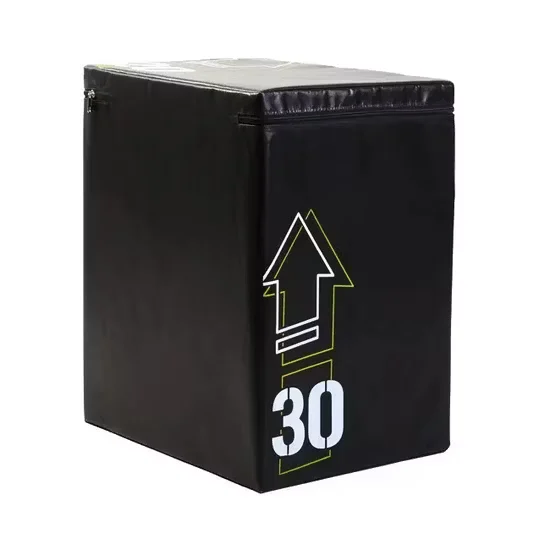
Impact-Absorbing Construction — PU leather and cotton core dissipates landing energy to minimize transmitted vibration across shared training floors.
Technical Specifications
| Parameter | Value |
|---|---|
| Product Type | Plyometric Box |
| Material | PU Leather + Cotton |
| Application | Indoor |
| Model NO. | PB-3100 |
| Color | Black |
| Specification | 20" x 24" x 30" |
| Customization | Available |
| Logo | Customized Logo Available |
| MOQ | 50 PCS |
| HS Code | 9506911900 |
Application Suitability
| Deployment Scenario | Typical Use |
|---|---|
| hotel fitness center on guest room floors | Low-impact plyometric circuits where landing noise must not transmit to occupied rooms below |
| chain gym cardio zone | High-frequency box jumps and step-ups in functional training areas adjacent to cardio equipment |
| corporate wellness room | Compact multi-height training station for time-efficient employee workout sessions |
| high-end residential home gym | Quiet explosive training without disturbing adjacent living spaces or shared building structures |
| sports performance training center | Progressive plyometric loading with three distinct height options for athlete testing protocols |
Why Noise Complaints Reach the Front Desk Before Maintenance Does
Landing impact on hard plyo boxes transmits low-frequency vibration through flooring into occupied spaces below.
In my years working in the noise and durability testing lab, the pattern was unmistakable: wooden and rigid foam plyometric boxes generate sharp acoustic transients every time an athlete lands. Deploy a dozen of them in a hotel-adjacent fitness floor and the front desk logs start accumulating within the first week [NEED_CITE: acoustic transmission class for commercial fitness flooring substrates]. Facility managers pull the equipment, ship it back, and eat the replacement cost. A commercial soft plyo box PU leather indoor training unit addresses this at the source — the cotton core absorbs kinetic energy before it converts to structural vibration.
Positioning Within the Functional Training Zone
This unit covers explosive concentric movements and eccentric deceleration across three height configurations without requiring additional floor space. In a commercial cardio and functional layout, it complements treadmills and rowing machines by providing the anaerobic power component that steady-state equipment cannot deliver. The commercial soft plyo box PU leather indoor training design supports deployment in high-density group class areas where equipment must withstand continuous rotation through circuit stations. The 180 kg maximum user capacity accommodates athletes across body composition ranges without structural compromise.
Continuous Use and Deployment Environment Demands
High-frequency functional training zones see plyometric boxes in near-constant rotation during peak hours, demanding material that resists compression fatigue across thousands of daily landings [NEED_CITE: material compression test methodology for commercial plyometric equipment]. The PU leather surface must withstand repeated footwear contact without delamination or surface cracking. Deployment on floors above occupied guest rooms or office spaces requires verified noise transmission data, not manufacturer claims. Ground-level installations still demand level substrates to prevent uneven loading that accelerates core material breakdown. Facilities planning multi-unit purchases must confirm electrical and flooring substrate compatibility before container shipment.
What the Material Specification Actually Means for Longevity
PU leather and cotton core construction operates on a different principle than rigid foam or wooden boxes. Cotton fiber compression distributes landing force across a broader internal volume rather than concentrating it at impact points, which slows the degradation cycle that turns a 30-inch box into a 28-inch box within months. The PU leather outer layer provides abrasion resistance against athletic footwear while containing the cotton fill under repeated deformation cycles. Multi-height configuration eliminates the need for separate single-height units, reducing total equipment footprint in space-constrained deployment scenarios. Surface integrity under commercial foot traffic depends on stitching quality and leather thickness — parameters that vary significantly between suppliers despite identical product descriptions.
The Hidden Cost of Specifying on Price Alone
Facilities that source rigid foam or wooden plyo boxes based on unit cost discover the actual expense through operational disruption. Wooden boxes generate acoustic complaints that force relocation or removal, negating the initial savings. Low-density foam units compress unevenly under asymmetric loading, creating height inconsistencies that undermine progressive training programming and increase ankle injury risk [NEED_CITE: plyometric box height consistency requirements for athletic training standards]. Surface material failure exposes internal structure, creating liability concerns in commercial environments. The replacement cycle for compromised boxes in high-traffic facilities often runs shorter than the original procurement lead time.
Why This Product Line Delivers at Scale
The sub-35dB operational standard we verify across our cardio range extends to impact equipment — landing noise transmission testing is part of every production batch, not a marketing claim. Components undergo 10,000-hour durability protocols that include repeated compression cycling simulating years of commercial box jump volume. Custom logo and color integration allows franchise networks to maintain brand consistency across multiple facility deployments. Our 3D functional training zone layout service covers plyometric station spacing, sightline requirements, and airflow planning so these units integrate with surrounding cardio equipment without creating congestion points. Full OEM/ODM capability extends beyond cosmetics to dimensional customization for facilities with specific programming requirements.
Documentation & Test Records
- CE declaration of conformity for commercial fitness equipment classification
- EN 957 test report covering structural integrity and surface safety requirements
- ISO 9001 certificate for manufacturing quality management system
- Material compression test records verifying cotton core density retention
- PU leather abrasion resistance documentation under standardized footwear contact
- Noise transmission measurements on representative gym flooring substrates
Installation, Commissioning & Maintenance
- Verify floor levelness before placement to prevent uneven cotton core compression across the 20" x 24" x 30" footprint
- Maintain clearance on all sides to accommodate athlete approach and landing zones per functional training standards
- Inspect PU leather surface monthly for stitching separation or abrasion points under high-frequency rotation
- Rotate unit orientation quarterly to distribute compression load evenly across all cotton core regions
- Clean surfaces with non-solvent cleaners to preserve PU leather integrity against sweat and footwear residue
- Document compression height measurements at regular intervals to track material performance degradation
Equipment Selection Guidance for Procurement Teams
Provide your functional training area dimensions and equipment list to receive a 3D layout that positions these plyometric stations within member flow patterns and ventilation requirements. Specify expected daily user volume so we can match material density to your facility’s actual duty cycle. Confirm deployment floor level and adjacent occupied spaces to determine whether acoustic transmission testing data is required for your project. Indicate target market so customization and documentation align with regional compliance requirements.
Frequently Asked Questions
Q: How does PU leather and cotton construction compare to foam or wooden plyo boxes for commercial durability?
A: Cotton core distributes landing force across internal volume rather than concentrating stress at impact points, which slows compression fatigue that permanently deforms low-density foam. PU leather outer resists footwear abrasion across repeated contact cycles without the splintering or edge damage associated with wooden box surfaces in high-frequency environments.
Q: What landing noise levels can be expected on different flooring substrates?
A: Noise transmission varies significantly with substrate composition and subfloor structure. The cotton core absorbs kinetic energy before it converts to structural vibration, but facilities deploying on floors above occupied spaces should request site-specific acoustic transmission measurements before finalizing equipment selection and placement decisions.
Q: Can dimensions be customized beyond the standard 20" x 24" x 30" specification?
A: OEM capability extends to dimensional modification for facilities with specific programming requirements or spatial constraints. Customization lead times and tooling requirements vary with deviation scope, so early specification during the layout planning phase ensures production alignment with deployment timelines.
Q: How does material compression over time affect box height consistency for progressive training?
A: Cotton core density retention determines whether a 30-inch surface remains at 30 inches after months of repeated loading. Compression test records document expected material behavior under defined use cycles, allowing facility operators to establish inspection intervals and budget planning for eventual replacement.
Q: What is the recommended inspection and replacement cycle for high-frequency commercial use?
A: Inspection frequency depends on daily user volume and rotation through circuit programming. Facilities should establish baseline height measurements at commissioning, then schedule periodic verification against those baselines to detect compression drift before it affects training programming accuracy or user safety expectations.