
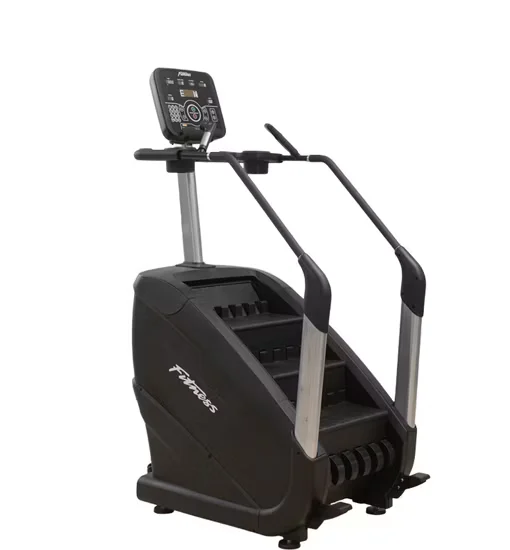
Continuous-Duty Motor Drive — verified through 10,000-hour durability testing on motors and sealed bearings for 24/7 commercial stair climbing deployment.
Technical Specifications
| Parameter | Value |
|---|---|
| Product Type | Stair Climber / Stepmill |
| Type of Drive | Motor Drive |
| Running Velocity | 15–164 steps/minute |
| Mains Input | AC220V±10% / AC110V±10% |
| Step Area | 560 × 240 × 200 mm |
| Console Display (OSD) | Time, Climb, Calories, Steps, Heart Rate |
| Product Dimensions | 1400 × 700 × 2000 mm |
| Net Weight | 148 kg |
| Material | Steel Pipe + PP Plastic |
| Folded | Unfolded |
| Color | Black |
| Certification | CE |
| Condition | New |
Application Suitability
| Deployment Scenario | Typical Use |
|---|---|
| Hotel fitness center on guest room floors | 24-hour access with sub-35dB operation preventing noise complaints from occupied rooms above or beside |
| Chain gym cardio zone | High-frequency continuous climbing sessions during peak hours with motor rated for commercial duty cycles |
| Corporate wellness room | Employee interval training during lunch breaks with heart rate monitoring for structured programming |
| High-end residential home gym | Daily climbing workouts in shared living spaces where acoustic performance matters |
| Sports performance training center | Athlete conditioning with adjustable step velocity from warm-up to high-intensity intervals |
Why Noise Complaints Reach the Front Desk Before Maintenance Does
The motor-drive system in this commercial stair climber stepmill motor drive gym unit is engineered for acoustic performance that matches the sensitivity of hospitality environments.
Light-commercial stair climbers with undersized motors generate vibration harmonics that travel through floor slabs into occupied spaces below. In hotel deployments, guests report low-frequency hum before facility managers notice any mechanical fault. The motor-drive architecture here uses sealed bearings and a balanced step mechanism tested for 10,000 hours of continuous operation, addressing the root cause rather than treating symptoms with isolation pads after complaints arrive [NEED_CITE: motor duty cycle classification for continuous commercial operation].
Positioning Within the Cardio Zone Layout
This commercial stair climber stepmill motor drive gym machine covers the vertical climbing movement pattern, filling the gap between treadmill walking and elliptical cross-training in a comprehensive cardio lineup. The step velocity range from 15 to 164 steps per minute accommodates steady-state endurance work and high-intensity interval programming. The console tracks time, climb, calories, steps, and heart rate, providing session-level data without requiring external sensors. Its 1400 × 700 mm footprint fits standard cardio zone spacing, and the 2000 mm height clearance must be verified against ceiling constraints during layout planning. The unit pairs naturally with treadmills and ellipticals for members rotating through different movement modalities.
Continuous Operation and Deployment Environment Requirements
Facilities running this equipment for 16 or more hours daily need to confirm that the motor-drive system matches the expected duty cycle rather than relying on peak output specifications [NEED_CITE: EN 957 requirements for commercial cardio equipment]. The dual voltage input accepting AC220V±10% or AC110V±10% must be matched to local supply before production to avoid rewiring after container arrival. Deployment on upper floors requires attention to structural vibration transmission through the steel frame into the slab. Adequate airflow around the motor housing prevents thermal buildup during back-to-back usage in densely packed cardio zones. Ground-leveling verification and anti-vibration pads reduce transmitted noise in multi-story installations.
Motor-Drive Architecture and Step Velocity Mechanics
The motor-drive system delivers consistent rotational force to the step mechanism across the full 15–164 steps per minute range, avoiding the mechanical gear shifting that creates resistance discontinuities in chain-driven alternatives. Electric continuous-duty motors maintain torque output under sustained load, unlike light-duty motors that overheat and lose performance during consecutive user sessions. The step area of 560 × 240 mm provides stable foot placement for users across a broad weight range, and the steel pipe frame construction absorbs repetitive impact loading. Console heart rate monitoring through integrated sensors supports biometric tracking, though contact-based readings can drift during vigorous climbing compared to chest-strap telemetry. The OSD display presents real-time session metrics without requiring network connectivity, keeping the interface reliable in environments where Wi-Fi coverage is inconsistent.
The Hidden Cost of Specification Compromises
Home-grade stair climbers deployed in commercial facilities fail predictably: motors rated for intermittent use overheat within months under continuous public access schedules. Noise levels that seem acceptable in showroom demonstrations become intolerable when transmitted through hotel floor assemblies at night [NEED_CITE: acoustic transmission standards for fitness equipment in multi-occupancy buildings]. Step mechanisms with inadequate bearing specifications develop play that creates rattling sounds and uneven step motion, generating member complaints and eventual wholesale replacement. Console systems that cannot export usage data leave facility operators without visibility into equipment utilization patterns, preventing evidence-based decisions about maintenance scheduling and fleet expansion.
Why This Product Line Delivers for Commercial Operators
Sub-35dB operation verified in hotel deployments ensures that this stair climber performs acoustically on guest room floors without triggering complaints. The 10,000-hour durability testing protocol on motors, frames, and sealed bearings provides documented evidence for procurement decisions. The six-series cardio family allows facilities to source every discipline from one manufacturing line, simplifying maintenance training and spare parts inventory. OEM customization extends to console UI configuration, letting gym chains maintain brand-consistent member interfaces. Free 3D cardio-zone layout and airflow planning accounts for the 1400 × 700 mm footprint, ceiling clearance for the 2000 mm height, and member flow patterns around the climbing station.
Documentation & Test Records
- CE declaration of conformity confirming European safety compliance for this stair climber model
- EN 957 test report covering structural integrity and mechanical safety requirements
- ISO 9001 certificate demonstrating quality management system compliance
- Noise level test report verifying acoustic performance under continuous operation
- Durability test record documenting 10,000-hour motor and bearing validation
- Motor specification sheet confirming continuous-duty rating and thermal performance
- Console technical documentation with OSD parameter descriptions
Installation, Commissioning & Maintenance
- Verify 1400 × 700 mm footprint clearance with minimum 500 mm safety perimeter on all sides
- Confirm AC220V or AC110V supply matches unit configuration before connecting to dedicated circuit
- Level the steel frame on anti-vibration pads to minimize transmitted noise through floor structure
- Run initial step velocity calibration across full 15–164 steps/min range to verify smooth transitions
- Inspect step mechanism bearings and motor housing quarterly under continuous commercial schedules
- Clean step surfaces and console OSD regularly to prevent sweat corrosion on steel and PP components
Equipment Selection and Inquiry Guidance
Provide your cardio zone square footage and planned equipment count to receive a 3D layout incorporating this stair climber’s footprint and ceiling clearance requirements. Specify daily operating hours so the motor duty cycle can be confirmed against your expected usage intensity. Indicate deployment floor level and adjacent occupied spaces to validate acoustic suitability. Confirm target market voltage standards and plug type before production begins. State whether console data integration with your facility management system is required.
Frequently Asked Questions
Q: How does motor-drive continuous-duty rating differ from peak output for commercial stair climbers?
A: Peak output describes maximum torque the motor can deliver briefly, while continuous-duty rating indicates sustained performance under load without thermal degradation. Commercial stair climbers in 24/7 facilities need motors rated for continuous operation, as repeated user sessions leave no cool-down interval. Always request the motor specification sheet confirming continuous-duty classification rather than relying on peak horsepower claims.
Q: What noise level is acceptable for hotel guest floor and residential fitness center deployment?
A: Environments where cardio equipment operates near sleeping or living spaces require sub-35dB operation to prevent disturbance complaints. This threshold accounts for structure-borne vibration transmitted through floor slabs, not just airborne noise measured at the source. Request a noise level test report conducted under load conditions that replicate actual continuous climbing operation.
Q: How does heart rate monitoring accuracy affect HIIT and interval programming reliability?
A: Contact-based heart rate sensors on console handles can drift during vigorous climbing motion, producing readings that compromise interval timing decisions. For structured HIIT programs requiring precise biometric zones, facilities should supplement console readings with chest-strap telemetry. Verify console technical documentation to understand sensor type and expected accuracy under dynamic conditions.
Q: What voltage and plug standards are required for target market deployment?
A: This stair climber accepts dual input at AC220V±10% or AC110V±10%, but the correct configuration must be specified before production to match destination country electrical standards. Mismatched voltage discovered after container arrival requires costly rewiring and delays facility opening. Confirm both voltage and plug type with the manufacturer during the quotation stage.

![Commercial Electric Stair Climber Gym Machine for Fitness Center Cardio Training [WARN] draft identifier mismatch](https://bicksport.com/wp-content/uploads/2026/08/commercial-electric-stair-climber-gym-machine-for-fitness-center-cardio-training-warn-draft-identifier-mismatch-461462.webp)
![SQ1017 Commercial Stair Machine for Fitness Center Use [WARN] draft identifier mismatch](https://bicksport.com/wp-content/uploads/2026/08/sq1017-commercial-stair-machine-for-fitness-center-use-warn-draft-identifier-mismatch-ddfb48.webp)
![Commercial Stair Machine for Cardio Fitness SQ1017 [WARN] draft identifier mismatch](https://bicksport.com/wp-content/uploads/2026/08/commercial-stair-machine-for-cardio-fitness-sq1017-warn-draft-identifier-mismatch-8c06e9.webp)