
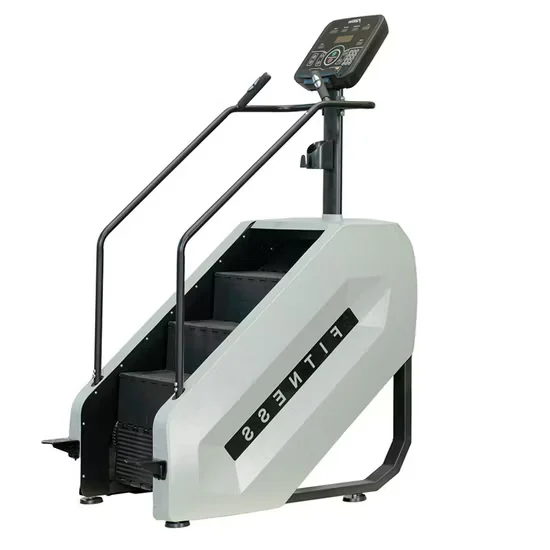
![Commercial Stair Machine for Cardio Fitness SQ1017 [WARN] draft identifier mismatch](https://bicksport.com/wp-content/uploads/2026/08/commercial-stair-machine-for-cardio-fitness-sq1017-warn-draft-identifier-mismatch-8c06e9.webp)
Motor-Drive Durability — Continuous electric stair climbing from 15 to 164 steps per minute, verified through sustained load testing before factory release.
Technical Specifications
| Parameter | Value |
|---|---|
| Designation | SQ1017 |
| Product Type | Stair Climber |
| Drive Type | Motor Drive |
| Step Velocity Range | 15–164 steps/min |
| Step Area | 560 × 235 × 220 mm |
| Console Display (OSD) | Time, Climb, Calories, Steps, Heart Rate |
| Mains Input | AC220V±10% / AC110V±10% |
| Frame Material | Steel Pipe + PP Plastic |
| Product Dimensions | 1450 × 820 × 2080 mm |
| Net Weight | 148 kg |
| Foldable | No (Unfolded) |
| Condition | New |
| Certification | CE |
Application Suitability
| Deployment Scenario | Typical Use |
|---|---|
| Five-star hotel fitness center on guest room floors | Continuous low-noise stair climbing for guests with 24-hour access |
| International chain gym cardio zone | High-traffic stepmill station during peak membership hours |
| Corporate wellness room | Employee cardiovascular conditioning with real-time metric tracking |
| High-end residential home gym | Personal motor-driven stepping with adjustable velocity range |
| Sports performance training center | Athlete interval protocols requiring precise step-rate control |
Why Motors Fail Before the Warranty Expires on Commercial Stair Climbers
Motor-drive stair climbers must sustain output across thousands of daily steps, not just short bursts.
Light-commercial motors often carry peak ratings that look impressive on a spec sheet but cannot sustain continuous operation under public-facility run-times. I have seen entire batches pulled back from hotel deployments because the drive system could not handle the thermal load of back-to-back users climbing at high step rates [NEED_CITE: motor duty cycle classification for continuous commercial operation]. The SQ1017 is built around a motor-drive architecture rated for extended duty cycles, which means the system is evaluated under sustained load rather than momentary peak output. When a commercial stair climber motor drive electric system is specified only by peak numbers, the facility operator absorbs the risk of premature thermal cutoff and winding degradation.
Where the SQ1017 Fits in a Commercial Cardio Floor Plan
This motor-driven stair climber covers the full intensity spectrum from rehabilitation-level stepping at 15 steps per minute up to athlete-grade intervals at 164 steps per minute. In a mixed cardio zone, it pairs with treadmills for steady-state users and ellipticals for low-impact alternatives, filling the vertical climbing niche that demands high caloric output per square meter. The unit suits medium-to-high traffic deployment and accommodates adult users across a wide body-mass range. The console OSD captures time, climb count, calories, steps, and heart rate, giving facility operators visibility into session intensity without requiring external wearable integration.
Continuous Run-Time, Floor Loading, and Electrical Considerations
A stair climber in a 24-hour hotel gym or a busy chain cardio zone may run for ten or more hours daily, which demands a motor and bearing system validated for extended thermal cycles. Upper-floor deployments above guest rooms or offices require attention to structure-borne vibration, making a level subfloor and appropriate isolation pads critical [NEED_CITE: EN 957 requirements for commercial cardio equipment]. The dual-voltage input (AC220V±10% / AC110V±10%) removes the risk of discovering plug-standard mismatches after the container arrives, a problem I have encountered on shipments destined for markets with non-standard supply voltages. Adequate lateral clearance around the 1450 × 820 mm footprint ensures safe mounting and dismounting, while overhead clearance must accommodate the 2080 mm frame height plus user reach.
Interpreting the Motor-Drive and Step-Velocity Specifications
The motor-drive system on the SQ1017 delivers electric stepping motion rather than user-powered hydraulic resistance, which means the motor itself must absorb the entire load of decelerating and repositioning the step mechanism under user weight. Continuous-duty motor ratings matter far more than peak figures because a stair climber in commercial service rarely shuts down between users. The step velocity range of 15–164 steps per minute is unusually broad, allowing programming from slow controlled stepping for deconditioned users up to aggressive intervals for athletic populations. The 560 × 235 mm step area provides a full-foot contact surface, reducing the edge-of-step instability that narrower platforms create during fatigue. Heart rate data displayed on the OSD enables staff to verify that users are training within target zones, though grip-based sensors are inherently less stable than chest-strap telemetry.
The Hidden Cost of Underspecified Drive Components
When a stair climber specified for light duty enters a commercial rotation, the motor windings overheat and the bearings degrade, generating noise that travels through floor slabs into occupied spaces below. I recall a Middle East hotel deployment where inconsistent magnetic gap calibration on an earlier stair climber batch caused resistance levels to jump unpredictably, triggering guest complaints and a full recall for reinspection. Voltage mismatches compound the problem: a unit designed for 220V running on a 110V supply will draw excessive current and shorten motor life. Data that cannot sync with facility management software leaves usage patterns invisible, preventing evidence-based decisions about equipment rotation and preventive maintenance [NEED_CITE: facility management data integration for commercial cardio].
Why This Product Line Earns Its Place in Your Facility
Every SQ1017 leaving the Shandong facility has completed a durability run under sustained load before it reaches the logistics hub, reflecting a testing culture built on the assembly floor. Sub-35dB noise performance is verified in hotel corridor deployments where sound transmission between floors is the primary complaint vector. The six-series cardio family means your procurement team sources treadmills, bikes, ellipticals, rowers, stair climbers, and spin bikes from one engineering platform, simplifying spare-parts inventory. OEM customization extends to console UI and branding so the equipment matches your facility identity. A free 3D cardio-zone layout covers square footage, sightlines, and member flow, ensuring the SQ1017 is positioned with correct spacing for safe entry and exit. Post-delivery, 24/7 technical support and spare parts availability keep units in rotation rather than waiting for overseas diagnostics.
Documentation & Test Records
- CE declaration of conformity for the SQ1017 stair climber
- EN 957 safety and performance test report
- ISO 9001 quality management system certificate
- Noise level test record for motor-drive operation
- Motor continuous-duty specification sheet
- Console technical documentation and OSD parameter reference
- Installation guide and spare parts list
Installation, Commissioning & Maintenance
- Maintain safe clearance around the 1450 × 820 mm footprint for user mounting and dismounting
- Level the subfloor and fit isolation pads to limit structure-borne vibration on upper floors
- Connect to a dedicated circuit matching the specified AC220V or AC110V input
- Run a full velocity sweep from 15 to 164 steps/min during commissioning to verify step mechanism smoothness
- Inspect step-area surfaces and frame fasteners at scheduled intervals per the maintenance guide
- Calibrate the OSD heart rate sensor and verify all metric displays against known references
Request a Deployment-Matched Quotation
Share your cardio zone area and planned equipment count to receive a 3D layout with airflow planning specific to the SQ1017 footprint. Specify daily run-time expectations so the motor duty cycle can be confirmed against your traffic profile. Identify the deployment floor and adjacent room types to validate noise suitability, and confirm your target market voltage and plug standard before production. If your facility management system requires console data output, outline the protocol requirements during the scoping stage.
Frequently Asked Questions
Q: What is the difference between motor continuous duty and peak rating for stair climbers?
A: Peak rating measures the maximum output a motor can deliver for a brief interval, often just seconds. Continuous duty reflects sustained output under realistic thermal conditions over hours of operation. In a commercial stair climber that runs between users all day, only the continuous-duty figure predicts real-world reliability and motor lifespan.
Q: How does the step velocity range affect programming for different user levels?
A: The 15–164 steps/min range accommodates slow controlled stepping for rehabilitation or beginners and rapid intervals for athletic conditioning. Trainers can design progressive programs that increment step rate weekly. A broad range ensures the same unit serves general-membership cardio and performance-oriented sessions without requiring separate machines.
Q: Can the console data sync with gym management software or member apps?
A: The OSD tracks time, climb, calories, steps, and heart rate in real time. Integration with external systems depends on the console data output protocol specified at the OEM stage. Confirm your facility management software interface requirements during the customization scoping process so the correct output module is included before production.
Q: What noise level should I expect for upper-floor hotel or residential deployments?
A: Motor-drive stair climbers in this product line target sub-35dB operation, validated in hotel floor deployments where sound travels through structural slabs. Actual perceived noise depends on subfloor composition, isolation pads, and user stepping force. Request the noise level test report and plan floor isolation measures for rooms directly above occupied spaces.
Q: How do I confirm voltage and plug compatibility before shipment?
A: The SQ1017 accepts AC220V±10% or AC110V±10%, but the physical plug type must match your market standard. State your target country and required plug format during the quotation stage. The production team configures the correct input wiring and plug before the unit reaches the logistics hub.


![High-Strength Commercial Stair Machine for Hotel Gyms [WARN] draft identifier mismatch](https://bicksport.com/wp-content/uploads/2026/08/high-strength-commercial-stair-machine-for-hotel-gyms-warn-draft-identifier-mismatch-99a47f.webp)