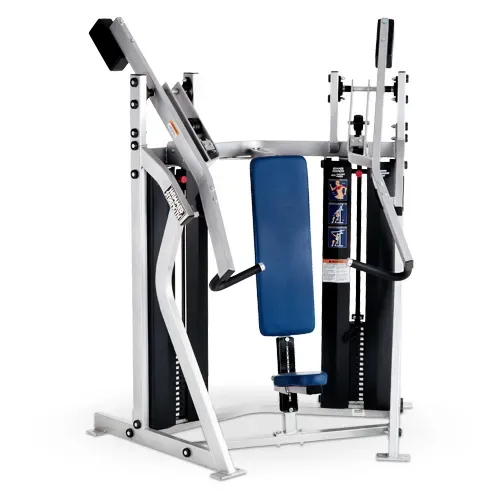
Heavy-Duty Steel Stability — The 122kg net weight anchors the frame during maximal loaded squats and lunges, preventing the lateral shift that lighter commercial squat lunge machines allow under barbell stress.
Technical Specifications
| Parameter | Value |
|---|---|
| Product Type | Squat Lunge Machine |
| Model NO. | 5044 |
| Exercise Part | Leg, Hip, Waist |
| Material | Steel |
| Product Dimensions | 163 x 1691 x 872 mm |
| Net Weight | 122 kg |
| Max User Weight | Not specified |
| Age Group | Adult |
| Gender | Unisex |
| Certification | RoHS, ISO 9001, CE |
Application Suitability
| Deployment Scenario | Typical Use |
|---|---|
| Commercial gym strength zone | High-frequency squat and lunge training with external plates |
| Professional sports training center | Athlete lower-body strength and unilateral stability work |
| Corporate wellness room | Supervised lower-body conditioning during scheduled sessions |
| High-end residential home gym | Dedicated loaded squat and lunge station for serious lifters |
| Community fitness center | General leg and hip strengthening under staff guidance |
Why Commercial Gyms Retire Squat Racks Before the Welds Crack
The failure point is rarely the steel — it is the mismatch between duty cycle and construction grade.
I have walked through facilities where the squat and lunge stations show visible frame deflection after only months of public use. The uprights were specified for home-gym loading patterns, not the repeated racking and unracking of loaded bars by members rotating through a circuit [NEED_CITE: structural fatigue cycles in commercial strength equipment]. When a commercial squat lunge machine gym equipment frame is undersized, the first symptom is not a crack — it is wobble. Members feel it, avoid the station, and the equipment becomes dead floor space long before a maintenance ticket is filed. The 122kg net weight of the 5044 addresses this directly: the mass is the message that the frame was engineered for repetitive commercial loading, not occasional use.
Positioning Within a Commercial Strength Layout
The Commercial Squat Lunge Machine occupies the intersection of free-weight compound movements and guided-path training. It pairs naturally with leg press stations and hack squat platforms, giving members a unilateral loading option that machines alone cannot replicate. In a typical strength zone, it sits between rack-based stations and isolation machines, drawing users who need the stability of a fixed frame but the movement freedom of open-bar work. The 163 x 1691 x 872 mm footprint demands dedicated floor space with clearance on three sides for safe barbell approach and retreat. It accommodates adult users across a wide height range, with the fixed geometry supporting both back squat and forward lunge patterns without adjustment between users.
Continuous Loading and Facility Environment Considerations
Unlike motorized cardio equipment, the duty cycle here is measured in repetitions and rack cycles rather than running hours, but the structural demands are equally relentless [NEED_CITE: load cycle standards for commercial resistance training equipment]. A busy gym strength zone may see hundreds of loaded repetitions daily, each one transmitting ground-reaction forces through the base plate. The floor must be level and reinforced to handle point loads without settling over time. Rubber matting beneath the unit absorbs vibration transfer to adjacent floors — a critical factor when the station sits above occupied spaces. Ventilation requirements are minimal since there is no motor generating heat, but sweat and humidity control remain important for the steel surface treatment to maintain its corrosion resistance over years of use.
Reading the Steel Specification Beyond the Marketing Sheet
The 122kg net weight of this commercial squat lunge machine gym equipment signals substantial steel section thickness, but weight alone does not tell the full engineering story. The weld pattern at the upright-to-base junction determines how load transfers from the bar path into the floor — continuous perimeter welds distribute stress more evenly than spot-welded connections. The surface finish must withstand both abrasion from barbell contact and chloride exposure from member perspiration; powder-coated commercial finishes typically outperform spray-painted alternatives in this regard. The base plate footprint relative to the upright height defines the tipping moment — a wider base resists lateral forces during heavy unracking, which is why the 872mm width matters in the context of the 1691mm height. Compatibility with standard Olympic barbell sleeves and bumper plates ensures the station integrates with existing gym inventory without requiring specialized loading accessories.
The Hidden Cost of Undersized Strength Stations
When a facility installs a squat station built to lighter specifications, the consequences unfold in stages. Members notice instability first and simply stop using the equipment, leaving an expensive gap in the strength zone [NEED_CITE: member attrition linked to equipment reliability perception]. Maintenance teams then spend disproportionate hours tightening fasteners and shimming bases that were never dimensioned for commercial load volumes. In the worst cases, frame deflection under load creates a safety incident that exposes the facility to liability. The cost of replacing an undersized unit — removal, floor repair, new installation, and member confidence recovery — typically exceeds the original savings by a wide margin.
Why This Product Line Earns Its Floor Space
Every station in the Biketon strength and cardio range is engineered from the same failure-first philosophy that drives our commercial squat lunge machine gym equipment design. The 122kg frame mass was not chosen for marketing weight — it was calculated from the load cycles observed in high-traffic gym deployments where lighter units shifted under repetitive use. Our testing protocols subject welded joints to continuous loading sequences that simulate years of public operation. The six-series cardio family means a facility can source lower-body strength stations and cardiovascular equipment from a single engineering standard, simplifying maintenance training and spare parts inventory. The free 3D layout planning ensures this station is positioned with correct sightlines and member flow, not just dropped where floor space happens to be available. Technical support operates around the clock because a downed strength station in a 24-hour gym cannot wait for business hours.
Documentation & Test Records
- CE declaration of conformity covering structural and mechanical safety requirements
- EN 957 test report validating resistance equipment safety and performance standards
- ISO 9001 certificate confirming quality management across manufacturing processes
- RoHS compliance documentation for restricted substance limits in steel coatings
- Structural durability test record showing frame performance under repeated loading cycles
- Installation and commissioning guide with base leveling and fastener torque specifications
Installation, Commissioning & Maintenance
- Maintain minimum 1000mm clearance on three sides for safe barbell approach with the 163 x 1691 x 872 mm frame
- Level the steel base plate on reinforced flooring using shims to eliminate any frame rock under load
- Inspect weld integrity and fastener torque at all upright-to-base junctions quarterly under commercial use
- Wipe down powder-coated steel surfaces after peak usage hours to prevent sweat-induced corrosion
- Verify barbell sleeve compatibility and bumper plate clearance before opening the station to members
- Check rubber isolation pads beneath the base plate annually and replace if compression set is visible
Scoping Your Strength Zone Equipment Order
Share your strength zone square footage and intended station count so we can generate a 3D layout that positions the squat lunge machine within correct member flow and safety spacing. Specify your expected daily user volume so we can confirm the frame duty cycle matches your operational pattern. Identify the deployment floor and adjacent room types so we can advise on vibration isolation requirements. Confirm your local market plate and barbell standards so we verify sleeve compatibility before shipment.
Frequently Asked Questions
Q: What separates a commercial squat lunge machine from a home-gym squat stand?
A: Home stands are rated for intermittent use with lighter loads and fewer daily cycles. A commercial unit like the 5044 carries 122kg of structural steel designed to absorb hundreds of loaded repetitions daily without frame deflection or fastener loosening. The weld patterns, base plate dimensions, and surface treatment all target continuous public access rather than occasional personal training sessions.
Q: Is the frame rated for heavy users and high external loads combined?
A: The 122kg net weight provides a substantial stability margin, but the maximum combined user-plus-load rating depends on the specific structural certification. Request the EN 957 test report for the verified load limit. In practice, the reinforced steel construction and wide base plate are engineered to handle loaded barbell work by adult users across the commercial weight spectrum.
Q: How does the steel frame resist corrosion in a high-humidity gym environment?
A: The frame undergoes commercial-grade powder coating, which bonds a thicker, more abrasion-resistant layer than conventional spray paint. This finish resists both mechanical wear from barbell contact and chemical attack from perspiration chlorides. Routine wiping after peak usage hours preserves the coating integrity and extends the service life of the surface treatment considerably.
Q: Can this machine fit in a smaller studio or private training facility?
A: The 163 x 1691 x 872 mm footprint requires dedicated floor area plus safety clearance on three sides for barbell movement. Compact studios should verify ceiling height against the 1691mm frame plus overhead bar path. For tighter spaces, request the 3D layout service to confirm the station integrates without compromising member circulation or emergency access routes.

![Plate Loaded Reverse Hyper Extension 5073 for Commercial Gyms [WARN] draft identifier mismatch](https://bicksport.com/wp-content/uploads/2026/08/plate-loaded-reverse-hyper-extension-5073-for-commercial-gyms-warn-draft-identifier-mismatch-f3c294.webp)
![Heavy Duty Power Rack Equipment for Commercial Gym Strength Training [WARN] draft identifier mismatch](https://bicksport.com/wp-content/uploads/2026/08/heavy-duty-power-rack-equipment-for-commercial-gym-strength-training-warn-draft-identifier-mismatch-5a606a.webp)