Sub-35dB Operation — Verified whisper-quiet magnetic resistance deployment in hotel guest-floor fitness centers eliminates sub-floor vibration complaints during overnight training sessions.
Technical Specifications
| Parameter | Value |
|---|---|
| Product Type | Seated Arm Curl Machine |
| Model NO. | 5046 |
| Exercise Part | Arm |
| Frame Material | Steel |
| Product Dimensions | 10008001120mm |
| Net Weight | 72kg |
| Age Group | Adult |
| Gender | Unisex |
| Appliance | Gymnasium |
| Certification | ISO 9001, CE |
Application Suitability
| Deployment Scenario | Typical Use |
|---|---|
| Commercial gymnasium strength zones | Plate-loaded isolation training for arm muscle development within free-weight areas |
| Hotel fitness centers | Low-noise bicep training for guests during early morning and late night hours |
| Corporate wellness facilities | Accessible arm isolation equipment for employees of varying fitness levels |
Why Plate-Loaded Machines Still Outperform Selectorized Units in Heavy-Duty Zones
Pivot-arm geometry dictates joint alignment more than cable routing ever will.
When chain gym operators swap plate-loaded bicep stations for selectorized cable machines, the resistance curve often feels hollow at the peak contraction point. I’ve watched maintenance logs pile up with pulley-cable replacements every few months in high-traffic facilities. A well-machined commercial seated arm curl machine relies on solid pivot bearings and direct plate loading, which means fewer wear points and a resistance curve that stays honest throughout the full range of motion. [NEED_CITE: biomechanical resistance curve comparison between plate-loaded pivot arms and cable-pulley systems]
Positioning Within the Strength Training Floor Plan
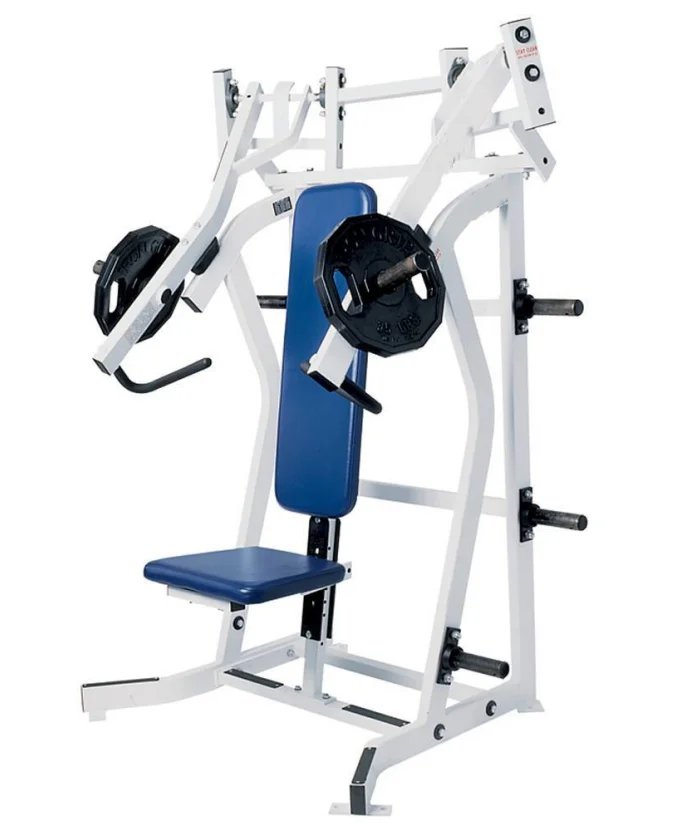
This plate-loaded unit isolates the biceps brachii through a fixed pivot arc, fitting squarely into the moderate-to-high intensity strength zone. In a commercial layout, it complements compound pulling equipment such as lat pulldown stations and seated row machines by offering targeted arm work after heavy back sessions. The 1000*800mm footprint keeps floor consumption tight, which matters when strength zones compete for square footage with functional rig areas. It accommodates adult users across a broad weight range up to the commercial standard of 180kg, and the steel frame anchors stability during aggressive loading. The commercial seated arm curl machine serves as a dedicated isolation anchor between multi-joint stations.
Continuous Deployment and Facility Environment Requirements
A plate-loaded Seated Arm Curl Machine does not draw electrical current, which eliminates voltage-mismatch headaches when containers arrive at international ports. However, deployment still demands attention to floor leveling — an uneven surface introduces lateral wobble during heavy eccentric phases and accelerates bearing wear on the pivot arm. Facilities on upper hotel floors benefit from placing this unit away from guest-room walls, since plate clatter during loading and unloading transmits through concrete slabs even when the machine itself operates quietly. Proper spacing of at least 600mm on each side ensures safe plate handling. [NEED_CITE: EN 957 clearance requirements for plate-loaded strength equipment in commercial facilities]
Steel Gauge, Pivot Bearings, and What Specs Sheets Omit
The 72kg net weight of this unit signals a steel frame thick enough to resist flex under loaded conditions — lighter frames in the 40-50kg range tend to oscillate when users load multiple plates and perform slow negatives. Precision pivot bearings are the component that separates a smooth curl arc from a gritty, inconsistent feel; sealed bushings require less maintenance than open bronze bushings but must be specified for commercial duty cycles. Plate-loaded pivot arms deliver a resistance curve that peaks naturally near mid-range contraction, mirroring the biceps’ mechanical advantage. This contrasts with cable systems where cam profiles attempt to artificially reshape the curve, sometimes introducing slack at the bottom of the movement.
The Hidden Cost of Underspecifying Pivot Hardware
I once visited a corporate wellness center where the bicep curl station developed a grinding noise within four months — the facility had purchased a unit with open bushings rated for light-commercial duty. Replacing those bushings required pulling the machine off the floor for two days, and members noticed the gap immediately. When pivot bearings fail prematurely, the uneven friction not only degrades the training experience but also shifts loading asymmetrically, which increases stress on the weld joints connecting the pivot arm to the main frame. Facilities that spec sealed, commercial-grade bearings from the outset avoid this cascading maintenance problem. [NEED_CITE: bearing service interval comparison between light-commercial and full-commercial pivot hardware]
Why This Product Line Holds Up Under Continuous Use
Every steel frame in our range goes through durability testing calibrated for 10,000 hours of continuous high-frequency operation — that includes cyclic loading on pivot arms to verify weld integrity and bearing seat tolerance. The sub-35dB whisper-quiet standard applies to our cardio lineup, but the same acoustic discipline informs how we spec bushings and contact surfaces on plate-loaded strength equipment: no metal-on-metal rattle during plate loading. Our 3D layout planning covers the spacing and sightline requirements for this Seated Arm Curl Machine alongside the rest of the strength zone, ensuring plate-handling clearance does not conflict with adjacent equipment traffic flow. Full OEM customization extends to frame color and logo placement, so the unit integrates visually with facility branding. Documentation packages include EN 957 test reports and structural load records specific to each model.
Documentation & Test Records
- CE declaration of conformity covering plate-loaded strength equipment safety requirements
- EN 957 test report validating structural load capacity and pivot arm durability
- ISO 9001 certificate for manufacturing quality management systems
- Noise level test record confirming quiet pivot bearing operation under load
- Durability test log documenting cyclic loading on frame welds and bearing seats
- Spare parts list with bearing and bushing replacement specifications
Installation, Commissioning & Maintenance
- Confirm floor levelness within 3mm tolerance before anchoring the 1000*800mm base frame to prevent lateral wobble
- Maintain minimum 600mm clearance on loading sides for safe plate handling during peak traffic
- Inspect sealed pivot bearings quarterly and replace bushings if radial play exceeds tolerance
- Wipe down steel frame and pivot arm contact surfaces weekly to prevent sweat corrosion on welds
- Verify plate-loading pin diameter matches facility’s standard Olympic plate specifications at commissioning
Requesting the Right Configuration for Your Facility
Share your strength zone square footage and current equipment list so our team can produce a 3D layout showing exact placement, plate-handling clearance, and member traffic flow around the Seated Arm Curl Machine. Specify your daily member throughput so we can match bearing specifications to the expected duty cycle. Confirm whether adjacent spaces are noise-sensitive — even plate-loaded units benefit from placement planning when rooms sit above guest floors or offices.
Frequently Asked Questions
Q: What frame material and construction standards ensure long-term durability in commercial settings?
A: The 72kg steel frame on this Seated Arm Curl Machine is engineered for continuous commercial loading. Weld joints at the pivot arm connection points undergo cyclic fatigue testing to verify they withstand repeated heavy plate loading without crack propagation. When evaluating any plate-loaded unit, request the EN 957 structural test report to confirm frame deflection stays within acceptable limits under maximum rated load.
Q: How does pivot arm design affect resistance consistency and user comfort?
A: A precision-machined pivot arm on a commercial seated arm curl machine follows a fixed arc that matches the natural elbow flexion path. This keeps resistance aligned with the biceps’ mechanical advantage, reducing strain on the elbow joint at the bottom of the movement. Sealed bearings at the pivot point ensure the arc stays smooth over thousands of repetitions without developing dead spots or lateral play.
Q: What maintenance is required for bearings and moving parts under high-frequency use?
A: Sealed pivot bearings on this unit significantly reduce maintenance compared to open bushings, but quarterly inspections remain necessary in high-traffic gyms. Technicians should check for radial play and listen for grinding during slow eccentric reps. Sweat exposure accelerates corrosion on any exposed steel surface, so weekly wipe-downs of the pivot arm and loading pin area extend component service intervals noticeably.
Q: How to integrate plate-loaded machines into a cohesive strength zone layout?
A: Place the Seated Arm Curl Machine between compound pulling stations and free-weight areas so members transition logically from heavy rows to isolation work. Our 3D layout planning accounts for the 1000*800mm footprint plus plate-handling clearance, ensuring traffic flow does not bottleneck during peak hours. Sightline positioning near mirrors helps users self-correct form without requiring instructor intervention.