
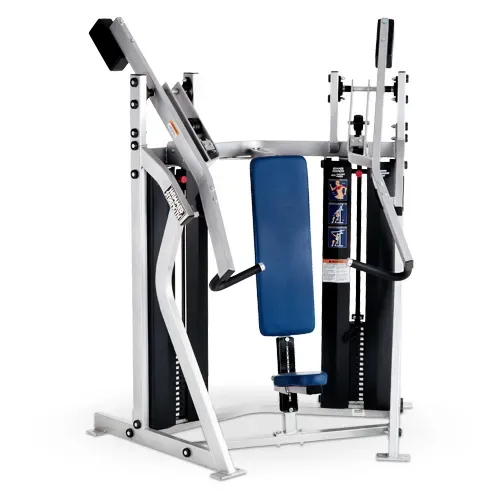
Heavy-Duty Dual-Stack Resistance — 347 kg frame mass and sealed bearing guide rails validated for continuous high-frequency strength training cycles.
Technical Specifications
| Parameter | Value |
|---|---|
| Designation | MTS-8001 |
| Product Type | ISO-Lateral Incline Press (Strength Equipment) |
| Weight Stack | 100 kg x 2 Stacks (200 kg total load) |
| Machine Weight | 347 kg |
| Dimensions (L x W x H) | 102 cm x 173 cm x 196 cm |
| Exercise Part | Chest |
| Target User | Adult, Men and Women |
| Machine Grade | Commercial Use |
| Folded | Unfolded |
| Customization | Available (logo, color, specification) |
| Condition | New |
| Certification | CE, ISO 9001, RoHS, SGS, EN 957 |
Application Suitability
| Deployment Scenario | Typical Use |
|---|---|
| International gym chain networks | High-frequency chest and upper body strength training in dedicated machine zones |
| Five-star hotel fitness facilities | 24-hour self-service access for guests requiring guided movement paths |
| Professional sports training centers | Athlete-specific hypertrophy and power development with isolated limb loading |
| Corporate wellness centers | Safe, controlled resistance training for employees with varying fitness levels |
Why Guide Rod Wear Dictates the Replacement Cycle Before the Frame Fails
Sealed linear bearings and hardened guide rails determine whether a plate-loaded selectorized machine survives its third year in a commercial facility.
When a strength machine sees eight hours of daily use, the friction points between the weight stack and the guide rods accumulate wear that manifests as grinding noises and uneven resistance long before the structural frame shows fatigue. I have pulled apart chest press units from hotel gyms where the original guide rods were scored deep enough to catch fingernails, generating complaints from members who felt the resistance stuttering through the range of motion [NEED_CITE: commercial strength equipment guide rail wear patterns under continuous use]. The MTS-8001 ISO-Lateral Incline Press addresses this failure mode through sealed bearing assemblies that isolate the guide rail from dust and chalk contamination, paired with a 347 kg machine weight that eliminates the frame flex contributing to misalignment under load.
Where the ISO-Lateral Incline Press Fits in a Commercial Strength Zone
The MTS-8001 covers the incline pressing movement pattern, targeting the clavicular head of the pectoralis major and anterior deltoids through a converging arm path that accommodates natural shoulder mechanics. In a commercial strength equipment layout, this unit complements flat and decline chest machines, cable crossovers, and free weight bench stations by providing a guided movement alternative for high-volume training days or rehabilitation phases. The ISO-lateral independent arm design allows unilateral loading, making it suitable for corrective work when bilateral imbalances are present. The 102 cm x 173 cm footprint requires standard clearance spacing for safe ingress and egress, and the 100 kg per side weight stacks serve users from beginners requiring minimal load to advanced lifters working near full stack capacity.
Continuous Operation Demands on Selectorized Strength Equipment
A commercial chest machine in a chain gym or hotel fitness center operates under duty cycles that consumer-grade equipment never encounters—multiple users per hour, sweat exposure, chalk dust infiltration, and minimal daily maintenance windows. The structural mass of the commercial ISO-lateral incline press MTS-8001 chest strength machine provides inherent vibration dampening that prevents the micro-movements accelerating bearing wear [NEED_CITE: structural mass requirements for commercial selectorized strength equipment]. Floor mounting requirements depend on the substrate; concrete slabs handle the static load directly, while elevated floors or suspended structures require load distribution plates. Ventilation around the weight stack enclosure prevents heat buildup in the pulley and cable routing during sustained high-repetition sessions.
Dual Independent Stacks and the Mechanics of ISO-Lateral Resistance
The ISO-lateral design decouples the left and right pressing arms, meaning each limb moves through its own arc without mechanical linkage to the opposite side. This differs fundamentally from a fixed-bar path where the stronger limb compensates for the weaker one throughout the set. The 100 kg x 2 weight stacks use independent cable and pulley routing, so selecting 60 kg on the left side does not affect the resistance available on the right. The converging movement path brings the handles together at the top of the press, matching the natural adduction of the shoulder joint rather than forcing a straight vertical press. Sealed bearings in the pivot points and pulley assemblies reduce friction loss, ensuring the selected weight translates to actual resistance felt by the user rather than being absorbed by mechanical inefficiency.
The Cost of Underspecifying Guide Rails and Pivot Bearings
Machines built with unsealed bushings instead of linear bearings develop play within months of commercial deployment, creating a rattle that members interpret as structural failure even when the frame remains sound. Weight stacks that drag on worn guide rods deliver inconsistent resistance—users feel the stack hang and release rather than move smoothly, leading to abandoned sets and member complaints [NEED_CITE: member retention impact of equipment maintenance perception]. Pivot points without sealed bearings absorb chalk dust and moisture, seizing progressively until the arm movement feels gritty throughout the range of motion. These failures cascade: a machine perceived as unreliable gets avoided, shifting traffic to adjacent units that then wear prematurely from overuse.
Why This Product Line Holds Up Under Commercial Deployment
The 347 kg machine weight reflects steel gauge choices that eliminate frame flex during heavy presses, verified through load testing protocols covering static and dynamic stress cycles. The dual weight stack system undergoes repeated cycling tests that simulate years of selectorized pin insertion and cable tension [NEED_CITE: EN 957 testing requirements for selectorized strength equipment]. Full OEM/ODM customization extends to frame color, upholstery, and weight stack labeling, allowing facility operators to match existing equipment aesthetics. The six-series cardio family from this manufacturing group means a facility sourcing the MTS-8001 can also procure treadmills, ellipticals, and bikes through unified logistics and warranty channels. Free 3D strength zone layout planning accounts for this unit’s footprint, user traffic flow, and ceiling height requirements for full arm extension clearance.
Documentation & Test Records
- CE declaration of conformity covering mechanical safety requirements
- EN 957 test report for stationary strength training equipment
- ISO 9001 certificate for quality management systems
- Durability test record for weight stack and cable cycling
- Structural load test report for frame and pivot assemblies
- Installation guide with anchoring specifications and spare parts list
Installation, Commissioning & Maintenance
- Allow minimum clearance around the 102 cm x 173 cm footprint for safe user ingress and plate loading access
- Verify floor levelness and install vibration isolation pads if deploying on suspended floor structures
- Inspect cable tension and pulley alignment after initial 500-use break-in period
- Clean guide rails monthly and apply manufacturer-specified lubricant to prevent chalk buildup
- Check selectorized pin engagement and weight stack alignment quarterly
- Wipe down upholstery and frame contact points daily to prevent sweat corrosion
How to Scope This Unit for Your Facility
Provide your strength zone square footage and adjacent equipment list to receive a 3D layout showing traffic flow and spacing around the MTS-8001. Specify your expected daily user volume so we can confirm the weight stack and cable system match your duty cycle requirements. Confirm your floor construction type—suspended floors may require load distribution recommendations. Indicate whether you need frame color matching, custom upholstery, or weight stack labeling to align with existing equipment branding.
Frequently Asked Questions
Q: How does ISO-lateral independent arm movement differ from a fixed-path chest press?
A: ISO-lateral arms move independently, allowing each side to press through its own range of motion without mechanical linkage to the opposite arm. This means a stronger limb cannot compensate for a weaker one during the set, and users can perform unilateral work for rehabilitation or imbalance correction. Fixed-path machines force both arms along a single bar trajectory, which can mask asymmetries and limit exercise variation.
Q: What maintenance does the dual weight stack system require under commercial use?
A: Guide rails should be cleaned monthly to remove chalk dust and debris that accelerate bearing wear. Cable tension and pulley alignment need inspection quarterly, with adjustment if the weight stack does not return smoothly to the rest position. Selectorized pins and stack plates should be checked for proper engagement to prevent partial-load selections that cause uneven wear on the lifting mechanism.
Q: How should strength zone layout account for this machine’s dimensions and usage patterns?
A: The 102 cm x 173 cm footprint requires clearance on all sides for safe loading and user movement, particularly behind the seat for adjustment access. Position the machine where ceiling height accommodates full arm extension at the top of the pressing range. High-traffic placement near the zone entrance increases visibility but concentrates wear; interior placement distributes usage across the equipment array more evenly.
Q: What customization options are available for matching existing facility equipment?
A: Frame color, upholstery material and color, and weight stack labeling can all be specified through OEM/ODM customization at flexible minimum order quantities. Logo placement on the shroud or frame is available for branded facility environments. Console and specification customization options depend on the integration requirements of your facility management system.


![Commercial Gym Fitness Equipment Linear Leg Press Machine [WARN] draft identifier mismatch](https://bicksport.com/wp-content/uploads/2026/08/commercial-gym-fitness-equipment-linear-leg-press-machine-warn-draft-identifier-mismatch-ecdc6b.webp)