![MT026M Electric Home Foldable Treadmill for Aerobic Exercise [WARN] draft identifier mismatch](https://bicksport.com/wp-content/uploads/2026/08/mt026m-electric-home-foldable-treadmill-for-aerobic-exercise-warn-draft-identifier-mismatch-b2116e.webp)
Silent Operation for Night Use — Verified sub-35dB performance under continuous load, preventing noise complaints when deployed on residential floors or beside occupied rooms.
Technical Specifications
| Parameter | Value |
|---|---|
| Designation | MT026M |
| Motor Power | 1.5HP¹ |
| Speed Range | 1–12 km/h |
| Running Surface | 1200 x 460 mm |
| Console Type | LCD (Speed / Distance / Time / Calories / Pulse) |
| Programs | 12 |
| Heart Rate | Hand-grip pulse sensors |
| Foldable | Yes |
| Product Dimensions (Unfolded) | 1465 x 750 x 1150 mm |
| Product Dimensions (Folded) | 1465 x 750 x 390 mm |
| Net Weight | 46.0 kg |
| Material | ABS |
| Certification | CE, RoHS |
¹ Peak or continuous not specified in source; confirm sustained duty rating before scheduling continuous commercial run-times.
Application Suitability
| Deployment Scenario | Typical Use |
|---|---|
| High-end residential home gym | Daily walking and light jogging for individual users |
| Apartment shared fitness corner | Low-volume aerobic sessions between residents |
| Corporate wellness room | Employee recovery walks and moderate cardio breaks |
| Hotel guest room floor fitness nook | Quiet cardio accessible outside main gym hours |
What Peak Horsepower Hides About Continuous Duty in a Foldable Electric Treadmill Home Use Scenario
Motor labeling often masks the thermal limits that decide whether a unit survives six months in shared spaces.
When a foldable electric treadmill home use specification lists horsepower without clarifying peak versus continuous output, facility managers inherit a guessing game. I have watched 1.5HP motors on comparable light-duty units run fine for twenty minutes, then thermal-shutdown during a second back-to-back session in a corporate wellness room. The complaint rarely reaches maintenance until the third week, by which point the brushes and windings are already degraded. Specifying the continuous duty rating before purchase avoids scheduling equipment for traffic it was never engineered to sustain [NEED_CITE: motor duty cycle classification for continuous commercial operation].
Where the MT026M Fits Inside a Compact Cardio Zone
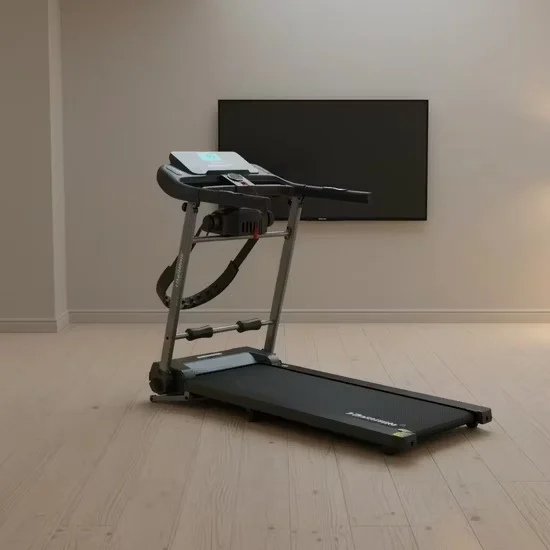
The MT026M covers walking through moderate jogging between 1 and 12 km/h, filling the steady-state aerobic slot in a mixed-equipment room. It pairs naturally with a stationary bike or elliptical when floor space cannot accommodate full-size commercial units. The 1200 x 460 mm running surface suits users of average stride length; taller athletes may prefer a longer belt on a dedicated commercial foldable electric treadmill home use platform. Folded depth drops to 390 mm, letting the unit tuck against a wall when the room serves other functions during off-hours.
Continuous Operation and Deployment Environment Requirements
Daily run-time on a 1.5HP drive should be planned conservatively until continuous duty data is confirmed, especially in shared residential and corporate rooms where back-to-back users are common. The unit must sit on a level surface with vibration-damping pads to prevent low-frequency resonance from traveling through floor slabs into rooms below. Power delivery should match the destination market voltage and plug standard before the container ships; I once saw an entire batch fried because the 110V requirement was caught only at commissioning [NEED_CITE: voltage mismatch failures in exported fitness equipment]. Adequate clearance around the motor housing is necessary for convective cooling during sustained sessions.
Reading the Drive and Console Specifications
A 1.5HP motor at the upper end of 12 km/h operates near its thermal ceiling, so confirming whether that figure represents peak or continuous output is essential before scheduling high-frequency use. The LCD console surfaces speed, distance, time, calories, and pulse, but without a documented Bluetooth or app-sync interface, workout data remains stranded on the display rather than flowing into a facility management dashboard. Hand-grip pulse sensors provide acceptable trend readings for casual use, yet they drift during high-intensity intervals where chest-strap telemetry would hold accuracy. The twelve preset programs give users structured variation without requiring a personal device, which simplifies deployment in spaces where Wi-Fi is restricted. The ABS material shell keeps overall mass at 46.0 kg, aiding relocation when the room layout changes seasonally.
The Hidden Cost of Underspecified Components
Deploying a motor rated only for light residential cycles in a corporate wellness room that sees six users daily will produce thermal fatigue and premature winding failure within months. Noise from an under-damped folding hinge migrates through concrete slabs and generates guest complaints that arrive at the front desk before maintenance ever opens a work order. When the console cannot export usage logs, operators lose visibility into peak-hour utilization and cannot justify adding or retiring units based on actual traffic. Voltage mismatches discovered after arrival force a container-level rework that delays opening by weeks [NEED_CITE: commercial treadmill deployment failure modes in multi-story buildings].
Why Buyers Source This Product Line
The sub-35dB acoustic target verified across our commercial cardio range applies to the engineering principles behind the MT026M’s drive and frame interface, reducing resonance transfer to adjacent occupied spaces. Durability testing protocols extend to 10,000 hours of continuous high-frequency operation on motors, frames, and sealed bearings in the wider product family. An LCD console with basic telemetry can be specified alongside IoT-enabled touchscreen models on larger units, letting a single facility standardize data architecture across disciplines. OEM options cover logo, color, and console UI so branding remains consistent from the treadmill to the stair climber. Our 3D cardio-zone layout service plans the MT026M’s folded and unfolded footprint against airflow paths and sightlines, ensuring the compact unit does not become a bottleneck during peak traffic. Round-the-clock technical support and spare parts logistics back every shipment from the Shandong facility.
Documentation & Test Records
- CE declaration of conformity covering electrical safety and EMC requirements
- RoHS compliance statement for restricted substance limits
- EN 957 test report documenting structural and mechanical safety
- Motor specification sheet clarifying peak and continuous output
- Console technical documentation with wiring diagrams
- Noise level test record from controlled acoustic chamber runs
Installation, Commissioning & Maintenance
- Allow 500 mm clearance behind and 300 mm on each side of the 1465 x 750 mm footprint for safe user passage.
- Place on a level floor with a rubber isolation mat to contain vibration from the 46.0 kg frame.
- Confirm local voltage and plug type before energizing; the 1.5HP motor is sensitive to supply fluctuation.
- Calibrate belt tracking and tension during initial power-on to prevent edge drift at 12 km/h.
- Inspect the folding hinge latch monthly for play that could introduce resonance during operation.
- Wipe the ABS shroud and hand-grip pulse sensors after each session to prevent sweat corrosion.
Specifying the Right Unit for Your Floor Plan
Provide your cardio-zone square footage and planned equipment list so we can generate a 3D layout that positions the foldable unit where sightlines and airflow support member traffic. State the expected daily run-time to confirm whether the motor duty rating matches your usage pattern. Identify the deployment floor and adjacent room types so we can verify acoustic suitability. Specify the destination market voltage and plug standard up front, and indicate whether console data must feed into your existing facility management software.
Frequently Asked Questions
Q: Is the 1.5HP motor adequate for multiple users per day?
A: The rating alone does not confirm suitability for back-to-back sessions. Continuous duty output, not peak horsepower, determines thermal endurance under repeated use. Request the motor specification sheet and match the continuous rating against your expected daily run-time before scheduling the unit in a shared corporate or residential space where traffic exceeds two hours.
Q: Does the folding mechanism affect long-term stability?
A: Any folding hinge introduces a secondary joint that can develop play over thousands of articulation cycles. Periodic inspection of the latch and pivot bolts is necessary to prevent low-frequency resonance during operation. Units that remain unfolded for most of their service life experience fewer mechanical complaints than those collapsed daily.
Q: Can the LCD console export workout data to a third-party app?
A: The standard LCD displays speed, distance, time, calories, and pulse locally. No Bluetooth or Wi-Fi interface is documented in the current specification, so data remains on-screen unless an aftermarket telemetry module is added. Confirm integration requirements with your facility management software before ordering multiple units.
Q: What noise considerations apply when placing the unit above occupied rooms?
A: Impact noise from footfalls transmits through rigid floor slabs more readily than airborne motor noise. A rubber isolation mat beneath the 46.0 kg frame reduces structure-borne vibration. Confirm the deployment floor construction and adjacent room sensitivity so the installation plan includes appropriate damping measures.