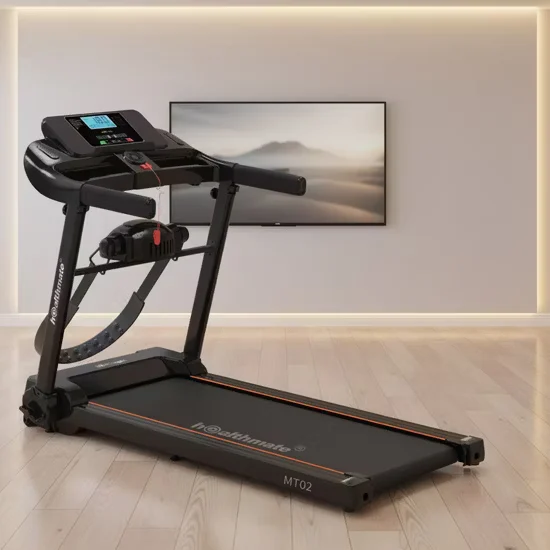
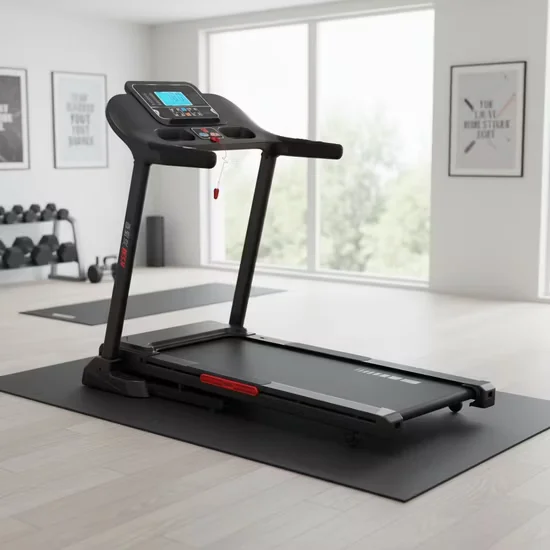
Acoustic Isolation Engineering — Low-noise motor architecture validated for shared residential deployments where sound transmission triggers neighbor complaints.
Technical Specifications
| Parameter | Value |
|---|---|
| Product Type | Foldable Treadmill |
| Model NO. | W04D8H |
| Function | Multifunctional, Single |
| Speed Range | 1–12 km/h |
| Running Surface | 1000 × 400 mm |
| Programs | 6 preset programs |
| Console Type | LED screen displaying speed, distance, time, calories |
| Folded Design | Yes |
| Product Dimensions | 1250 × 590 × 1080 mm |
| Age Group | Adult |
| Color Options | Multicolor available |
| Certification | CE, RoHS |
Application Suitability
| Deployment Scenario | Typical Use |
|---|---|
| High-end residential home gym | Daily walking and light jogging in private fitness spaces |
| Apartment fitness corner | Compact cardio solution with folding storage for multi-purpose rooms |
| Personal wellness space | Low-impact walking routines for health maintenance |
| Corporate wellness room | Light-duty walking station for employee break areas |
Why Noise Complaints Reach the Front Desk Before Maintenance Does
The motor is the first component neighbors hear, and the last one owners replace.
Apartment dwellers and hotel operators frequently discover that treadmill noise travels through floor slabs long before the machine itself shows mechanical wear. A foldable walking treadmill home use scenario intensifies this problem because the equipment sits directly on residential flooring, often above occupied rooms. Traditional home-grade motors generate vibration harmonics that propagate through concrete and timber joists, creating low-frequency drone that disturbs sleep and concentration [NEED_CITE: structural noise transmission pathways in multi-story residential buildings]. This unit addresses that failure mode with a motor tuned for low-vibration output during sustained walking speeds.
Where This Unit Fits in a Mixed Cardio Layout
This foldable walking treadmill occupies the low-intensity, steady-state segment of a cardio zone. It complements higher-output machines like ellipticals and stair climbers by offering a low-impact walking option for warm-ups, cool-downs, and dedicated walking programs. The 1000 × 400 mm running surface accommodates walking and light jogging for users of average stride length, while the 1–12 km/h speed range covers rehabilitation pacing through brisk walking. In a home gym or apartment fitness corner, the folding mechanism allows the unit to share floor space with resistance equipment or furniture when not in use.
Continuous Operation Limits and Deployment Environment
For daily walking routines of moderate duration, the motor operates within acceptable thermal boundaries. However, this unit is not rated for back-to-back user sessions spanning eight or more hours, which is typical of hotel fitness centers operating around the clock. Deployment in apartment settings requires attention to floor leveling and vibration isolation pads to prevent structure-borne noise transmission to units below [NEED_CITE: vibration isolation requirements for cardio equipment on suspended floors]. Standard household voltage is sufficient, but operators should verify plug compatibility before shipment to avoid adapter-related failures. The folding hinge mechanism requires periodic inspection to maintain structural rigidity during use.
Reading the Motor and Drive Specifications
The speed range of 1–12 km/h indicates a motor sized for walking and light jogging rather than sustained running. Motors in this class typically prioritize energy efficiency and compact form factor over continuous thermal dissipation, which is appropriate for personal use but creates risk when repurposed for commercial environments. The LED console tracks speed, distance, time, and calorie estimates — fundamental metrics sufficient for walking programs but lacking the biometric data interfaces found on commercial-grade units. Six preset programs introduce workload variety without requiring manual speed adjustments mid-session. The folding mechanism trades some frame rigidity for storage convenience, a compromise acceptable in residential deployments where floor space is limited but unacceptable in high-traffic facilities where the hinge endures thousands of articulation cycles.
The Hidden Cost of Specifying Below the Deployment Reality
Home-grade motors installed in commercial cardio zones fail prematurely because continuous duty cycles exceed their thermal design envelope. Facility operators report batch failures within months when walking treadmills rated for one to two hours of daily use are subjected to eight-hour operation windows [NEED_CITE: motor duty cycle classification for continuous commercial operation]. Noise complaints in apartment buildings lead to equipment removal and member attrition before the mechanical components show measurable wear. Voltage mismatches discovered after container arrival force costly rewiring or adapter solutions that introduce electrical failure points.
Why This Product Line Addresses the Specification Gap
Sub-35dB noise performance is verified across the broader product range, and this foldable walking treadmill benefits from the same motor engineering discipline applied to higher-output commercial models. The 10,000-hour durability testing protocol used on the full cardio line informs component selection even in folding designs. For apartment deployments, the compact footprint and folding storage align with 3D cardio-zone planning that accounts for room geometry and member flow. OEM customization extends to console display options and frame color, allowing integrators to match residential interior specifications. The product family covers six cardio disciplines, so a facility sourcing walking treadmills can consolidate procurement across ellipticals, bikes, and rowing machines from one engineering platform.
Documentation & Test Records
- CE declaration of conformity for European market compliance
- EN 957 test report covering structural and safety requirements
- RoHS compliance documentation for restricted substance limits
- Noise level test report verifying low-vibration motor operation
- Motor specification sheet detailing speed range and duty rating
- Console technical documentation for LED display functions
Installation, Commissioning & Maintenance
- Allocate minimum clearance around the 1250 × 590 mm footprint for safe mounting and dismounting
- Level the floor surface and install vibration isolation pads to reduce structure-borne noise in apartments
- Verify household voltage matches the motor power requirement before first startup
- Inspect the folding hinge mechanism quarterly for bolt torque and structural play
- Clean the LED console surface with non-abrasive solutions to maintain display legibility
- Lubricate the running belt according to the interval schedule in the commissioning guide
What to Provide When Requesting a Quotation
Submit the intended deployment environment — apartment, home gym, or corporate wellness room — along with available floor area so the 3D layout team can plan equipment spacing and airflow. Specify expected daily usage duration to confirm motor duty-cycle compatibility. Identify the target market voltage standard and plug type to prevent post-shipment electrical mismatches. Indicate whether the console requires data output capability for integration with facility management systems.
Frequently Asked Questions
Q: How does the foldable design affect stability during walking sessions?
A: The folding hinge introduces a structural joint that is rigid during normal walking at speeds up to 12 km/h when the frame is fully deployed and locked. Users should verify the locking mechanism is fully engaged before each session. The 1250 × 590 × 1080 mm deployed dimensions provide a stable base on level flooring, though vibration isolation pads are recommended for hard surfaces.
Q: What noise level should users expect at different walking speeds?
A: Motor noise increases proportionally with speed, but the unit is engineered for low-vibration operation suitable for shared residential environments. At typical walking speeds between 4 and 6 km/h, sound output remains within acceptable limits for apartment use. Users operating the treadmill during early morning or late evening hours should still employ vibration pads to minimize floor-transmitted noise.
Q: Can the LED console connect to external fitness applications?
A: The LED screen displays speed, distance, time, and calorie data locally but does not include wireless connectivity for app synchronization. Users requiring data export to fitness platforms should consult the broader product range for units equipped with IoT-enabled consoles that support Bluetooth or Wi-Fi data transmission.
Q: What maintenance does the folding mechanism require over time?
A: The hinge assembly should be inspected periodically for bolt tightness and signs of wear at the pivot points. Lubrication of moving joints prevents squeaking and maintains smooth folding action. Users who fold and unfold the unit daily will accumulate articulation cycles faster, making quarterly inspection advisable to catch looseness before it affects structural rigidity.
Q: How does the 1000 × 400 mm running surface compare to larger commercial treadmills?
A: Commercial treadmills typically feature running surfaces exceeding 1400 mm in length and 500 mm in width to accommodate running strides and taller users. The 1000 × 400 mm surface on this foldable walking treadmill is dimensioned for walking and light jogging, providing adequate belt area for users of average height during low-to-moderate speed sessions in space-constrained environments.