

Whisper-Quiet Glide — Aluminum-alloy sliding track and 80 kg reinforced frame eliminate carriage rattle during high-repetition reformer sessions in shared residential spaces.
Technical Specifications
| Parameter | Value |
|---|---|
| Product Type | Pilates Reformer |
| Model NO. | SRY-12 |
| Color | White |
| Specification | 2570730270mm |
| Net Weight | 80kgs |
| Accessory | Long Box / Jump Board / Platform |
| Logo | Customized Is Allowed |
| Warranty Time | 3 Years |
| Age | Adult |
| Gender | Unisex |
| Transport Package | Standard Wood Case |
| Production Capacity | 80 Pieces/Month |
Application Suitability
| Deployment Scenario | Typical Use |
|---|---|
| Boutique Pilates studio | Multi-class daily scheduling on compact floor plans requiring quiet carriage travel |
| High-end residential home gym | Upper-floor or shared-wall installations where vibration and noise transmission must be minimized |
| Hotel-adjacent fitness room | Guest-accessible movement spaces operating during early-morning and late-evening hours |
| Rehabilitation center | Patient-facing physiotherapy sessions demanding stable, low-noise equipment |
| Personal training facility | One-on-one and semi-private reformer programming with modular accessory swaps |
Why Squeaking Carriages Lose Clients Before Management Notices
Aluminum sliding tracks replace roller-and-rail assemblies to remove periodic bearing noise and mid-session carriage sticking.
In boutique studios built inside residential buildings, the first warning that equipment is failing rarely comes from the maintenance log. It arrives as a noise complaint from the unit below, or a client who quietly cancels their early-morning booking because the reformer next to theirs sounded like it was grinding metal on metal [NEED_CITE: acoustic transmission standards for fitness equipment in multi-story residential buildings]. Traditional roller-and-rail systems develop bearing play after several months of high-frequency carriage travel, and that play announces itself as squeaks, rattles, and lateral wobble during jump-board work. For a portable Pilates reformer home studio deployment, these are not minor annoyances — they are the reason clients choose the competitor down the street.
Where This Reformer Fits in a Compact Cardio-and-Movement Zone
This unit covers full-spectrum Pilates programming — from supine footwork through standing platform work and plyometric jump-board sequences — within a single footprint. In a mixed-use studio layout, it complements mat zones and small-apparatus stations without competing for floor area. The 2570 mm length accommodates tall users in full-extension positions, while the modular accessory system lets a single reformer serve multiple class formats throughout the day. Operators targeting high-frequency boutique scheduling will find the carriage stability holds up under consecutive class turnover without recalibration.
Continuous Scheduling and the Noise Envelope of Upper-Floor Deployments
Boutique studios running four to six classes daily need a reformer carriage that glides without generating low-frequency vibration into the floor slab. The aluminum sliding track produces noticeably less structural vibration than steel roller systems, which matters when the room below is an occupied apartment or a hotel guest corridor [NEED_CITE: vibration isolation requirements for fitness equipment on suspended concrete slabs]. The 80 kg net weight anchors the frame inertially during jump-board landings, reducing the need for permanent floor bolting. Adequate clearance around the unit — typically 600 mm on each side and 900 mm at the head — allows instructor circulation without crowding adjacent stations.
Reading the Frame and Track Specifications
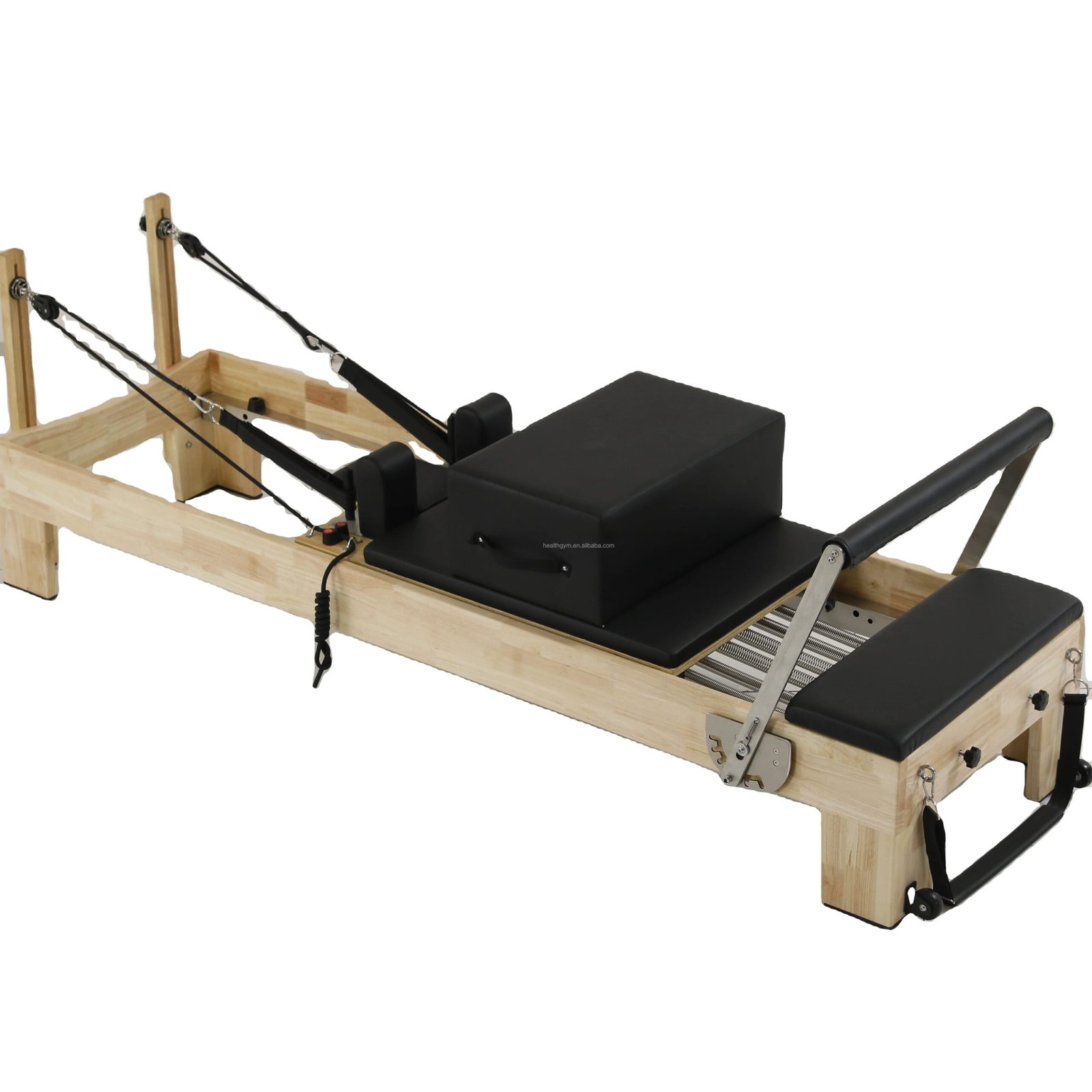
The aluminum-alloy sliding track is the primary engineering decision here. Compared to traditional steel roller-and-rail assemblies, an aluminum track offers lower rolling friction and eliminates the periodic bearing replacements that roller systems demand. Friction consistency across the full travel length means the carriage does not develop sticky spots mid-stroke, which directly affects exercise quality during slow controlled movements like long stretch series. The 80 kg reinforced frame mass provides inertial damping during dynamic exercises — particularly jump-board plyometrics — where a lighter frame would shift or rock on hard flooring. The modular accessory attachment points for the long box, jump board, and platform are designed for tool-free swaps, which keeps class transition times manageable during back-to-back scheduling. Customization options including logo application allow studio chains to maintain brand consistency across multiple locations without commissioning entirely bespoke builds.
What Spec-Down Decisions Cost After Month Three
Studios that purchased reformers with steel roller rails often discover bearing noise by the fourth month of heavy scheduling, and the fix usually involves pulling the carriage out of service for maintenance during revenue hours [NEED_CITE: maintenance downtime impact on boutique studio revenue retention]. Lighter frames under 60 kg tend to shift during jump-board work, forcing instructors to reduce exercise intensity or bolt units to the floor — neither of which serves the business model. Reformers shipped without modular accessory systems force operators to buy separate dedicated units for box work and plyometrics, inflating both capital outlay and floor-space requirements. For a portable Pilates reformer home studio installation, a spec-down decision made at purchase compounds into noise complaints, client attrition, and unplanned equipment replacement within the first year.
Why This Product Line Covers the Deployment Gaps
Sub-35 dB whisper-quiet operation is not a marketing claim applied after testing — it is the design target verified across hotel floor deployments where cardio and movement equipment sits directly above occupied rooms. The 10,000-hour durability testing protocol covers frame welds, track surface wear, and accessory attachment mechanisms under continuous high-frequency use. Full OEM and ODM capability extends to logo, color, and accessory configuration, allowing studio chains to standardize across locations. The free 3D layout and airflow planning service addresses the specific spacing and ventilation needs of this reformer within a multi-unit studio floor plan. Round-the-clock technical support means a stuck carriage or track alignment issue gets a response outside business hours, not after the weekend.
Documentation & Test Records
- CE declaration of conformity for European market entry
- EN 957 test report covering structural integrity and safety
- ISO 9001 certificate for manufacturing quality management
- Track surface friction and glide-resistance test data
- Frame weld integrity and load-cycle durability record
- Accessory attachment torque and wear specification sheet
Installation, Commissioning & Maintenance
- Allow 2570 mm length plus 600 mm lateral clearance on each side for instructor access
- Level the floor surface and place vibration-damping pads beneath all four feet
- Verify sliding track surface is clean and free of debris before first carriage run
- Test long box, jump board, and platform attachment mechanisms for secure lock
- Inspect track glide resistance and carriage alignment at monthly intervals
- Wipe down aluminum surfaces with pH-neutral cleaner to prevent sweat corrosion
Planning Your Reformer Deployment
Provide your studio square footage and intended unit count to receive a 3D layout covering equipment spacing, instructor circulation paths, and ventilation planning. Specify whether the installation is on an upper floor adjacent to occupied residential units so we can confirm the noise and vibration profile matches your building requirements. Indicate your target market and any brand customization needs including logo placement and color matching. Confirm whether you require console data integration or standalone operation for your scheduling model.
Frequently Asked Questions
Q: How does an aluminum sliding track compare to a steel roller rail in noise and longevity?
A: Aluminum tracks generate lower rolling friction and eliminate the ball bearings that wear out in steel roller systems. Over extended commercial scheduling, this means the carriage maintains consistent glide resistance without developing squeaks or lateral play. The track surface requires only periodic cleaning rather than bearing replacement, reducing both maintenance downtime and parts inventory for studio operators.
Q: Does the 80 kg frame weight prevent movement during jump-board exercises?
A: The mass provides inertial stability during dynamic plyometric landings without requiring the unit to be bolted to the floor. Lighter frames tend to shift or rock on hard surfaces during repetitive jump sequences, which compromises exercise quality and creates noise transmission into the floor slab. The reinforced frame design keeps the unit planted through high-repetition dynamic work.
Q: Can this reformer be deployed on upper floors without causing vibration complaints?
A: The aluminum sliding track produces less low-frequency structural vibration compared to traditional roller systems, which is critical when the room below is an occupied apartment or hotel guest space. Combined with vibration-damping pads beneath the frame feet, the unit meets the acoustic requirements of shared residential and hospitality-adjacent deployments where noise complaints are the primary operational risk.
Q: How does the modular accessory system reduce total equipment cost for a new studio?
A: Instead of purchasing separate dedicated units for box work, plyometrics, and platform exercises, a single reformer with swappable long box, jump board, and platform accessories covers full programming range. This consolidation reduces both capital expenditure and the floor area required, allowing studios to fit more workable stations into compact commercial leases.
Q: What maintenance does the sliding track require over its service life?
A: The primary maintenance task is keeping the track surface clean from dust, chalk residue, and sweat deposits that increase friction over time. Unlike roller-and-rail systems that require periodic bearing inspection and replacement, the aluminum sliding track has no consumable bearing components. A monthly inspection of glide resistance and carriage alignment is sufficient to maintain consistent performance.
![Commercial Aluminum Alloy Half Trapeze Pilates Reformer Machine [WARN] draft identifier mismatch](https://bicksport.com/wp-content/uploads/2026/08/commercial-aluminum-alloy-half-trapeze-pilates-reformer-machine-warn-draft-identifier-mismatch-e689ff.webp)

![Folding Maple Wood Pilates Reformer for Home Gym & Studio Fitness [WARN] draft identifier mismatch](https://bicksport.com/wp-content/uploads/2026/08/folding-maple-wood-pilates-reformer-for-home-gym-studio-fitness-warn-draft-identifier-mismatch-2adce9.webp)