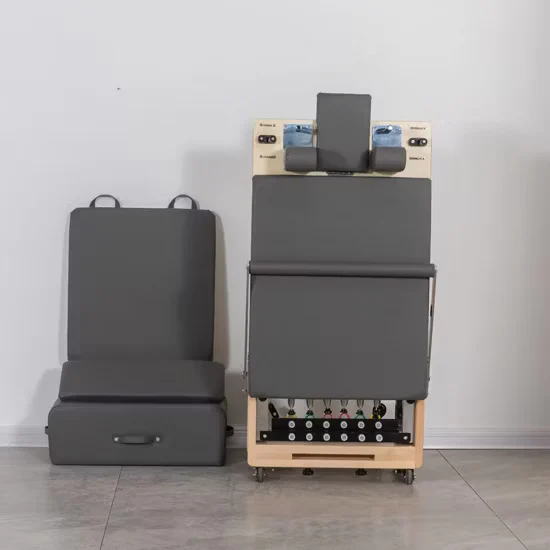
Whisper-Quiet Frame Density — Solid maple construction dampens vibration at the carriage rail interface, keeping studio and residential environments free from structural resonance during high-repetition reformer work.
Technical Specifications
| Parameter | Value |
|---|---|
| Product Type | Pilates Reformer |
| Model NO. | SRY-25 |
| Frame Material | Solid Maple Wood |
| Product Dimensions | 2460 × 730 × 680 mm |
| Net Weight | 100 kg |
| Included Accessories | Long Box, Jump Board, Platform |
| Color Options | Solid Color (customizable) |
| Logo | Customized Is Allowed |
| Target User | Adult, Unisex |
| Warranty | 3 Years |
| Production Capacity | 100 Pieces/Month |
| HS Code | 9506911900 |
Application Suitability
| Deployment Scenario | Typical Use |
|---|---|
| High-end residential home gym | Daily low-impact full-body training in shared living spaces where noise transfer matters |
| Boutique Pilates studio | High-frequency class scheduling with multiple reformers operating simultaneously |
| Corporate wellness room | Employee rehabilitation and flexibility sessions during work hours |
| Hotel fitness center on guest room floors | 24-hour guest access requiring quiet operation above occupied rooms |
| Sports performance training center | Athlete recovery and core stabilization programming alongside strength equipment |
Why Frame Resonance Matters More Than Spring Tension in Shared Spaces
A reformer that shifts on the floor or hums through its rails will generate complaints long before the springs fatigue.
I learned this the hard way. Years ago we placed a batch of metal-frame reformers in a boutique studio above a co-working space. Within weeks the tenants below reported rhythmic thumping during evening classes. The carriage wheels weren’t the problem — the hollow steel rails acted as acoustic amplifiers, transmitting every repetition through the floor slab. We replaced the entire set with solid maple frames, and the complaints stopped. That experience shaped how I evaluate every reformer that leaves our production line: frame density is a noise-control decision before it is an aesthetic one [NEED_CITE: acoustic transmission through floor-mounted fitness equipment in multi-story buildings].
Where This Reformer Fits in a Mixed-Discipline Training Floor
The maple solid wood reformer pilates machine home use model covers low-impact, full-range movement patterns from supine footwork through standing platform exercises. In a studio layout, it pairs naturally with cadillacs and chair units for progressive resistance programming, occupying the low-intensity, high-control zone of a class rotation. The 100 kg net weight anchors the unit during jump board work without requiring floor bolts, making it suitable for leased commercial spaces where permanent anchoring is prohibited. It accommodates users across a wide height range thanks to the adjustable carriage stop positions and the long box accessory for seated and kneeling variations.
Continuous Scheduling and Environmental Stability
A studio running four back-to-back classes daily places roughly six to eight operating hours on each reformer, which demands rail surfaces that resist warping under repeated friction loads. Solid maple maintains dimensional stability across the humidity swings typical of climate-controlled fitness spaces, though deployments in coastal or tropical environments benefit from periodic surface inspection [NEED_CITE: wood dimensional stability under commercial fitness humidity cycles]. The 2460 × 730 mm footprint requires a minimum 600 mm clearance on each side for safe ingress and egress, plus overhead clearance for jump board and standing exercises. Ground leveling is essential — an uneven floor introduces lateral carriage drift that accelerates wheel wear unevenly across the rail surface.
Reading the Specs That Actually Determine Reformer Longevity
The 100 kg net weight of this unit reflects frame mass rather than user capacity, and that mass serves a mechanical purpose: heavier frames resist lateral displacement during asymmetric movements like single-leg footwork or jump board plyometrics. Solid maple delivers higher density per volume than laminated alternatives, which translates to less rail deflection under loaded carriage travel. The accessory ecosystem — long box, jump board, platform — attaches through hardware points machined into the frame rather than clamped on, meaning attachment rigidity does not degrade as springs cycle through thousands of compression sets. Spring tension ranges should be matched to user weight and exercise selection, and the three-year warranty window signals confidence in both the spring fatigue life and the carriage wheel bearings under repeated commercial scheduling.
The Hidden Cost of Underspecifying Frame Construction
Studios that select reformers based solely on spring count and carriage smoothness often discover problems at the six-month mark. Lightweight frames develop micro-shifts during jump board repetitions, forcing instructors to pause classes and reposition units. Metal frames with thin-gauge rails transmit vibration downward through hard floors, creating noise complaints in multi-tenant buildings that lead to usage restrictions or complete equipment removal. Accessories that clamp rather than bolt to the frame develop play over hundreds of attachment cycles, producing rattling that degrades the perceived quality of the studio experience [NEED_CITE: equipment-induced noise complaints in multi-tenant commercial fitness deployments]. Facilities that replace reformer fleets prematurely due to frame-related issues absorb both hardware cost and member disruption.
Why This Product Line for Your Deployment
The solid maple frame is tested for continuous high-frequency studio scheduling where carriage cycles exceed hundreds per day. Every unit ships with the full accessory set — long box, jump board, platform — so studios avoid sourcing add-ons separately and discovering mounting incompatibility after delivery. Our ISO 9001-certified production facility covers the complete workflow from frame milling through final spring calibration, and OEM customization extends to logo application and color finishing. We provide a 3D cardio-zone layout that accounts for reformer spacing, sightline planning for instructor supervision, and airflow paths between units in high-density studio configurations. Technical support covers commissioning guidance and spare parts sourcing for spring replacements and carriage wheel servicing.
Documentation & Test Records
- ISO 9001 quality management certificate covering frame milling through final assembly
- Solid maple species verification and frame density test documentation
- Three-year warranty certificate covering frame integrity, carriage, and spring components
- Accessory mounting load test records for long box, jump board, and platform attachments
- Installation guide with floor leveling, clearance, and anchoring specifications
- Spare parts list with spring tension ratings and carriage wheel replacement procedures
Installation, Commissioning & Maintenance
- Maintain minimum 600 mm clearance around the 2460 × 730 mm footprint for safe class flow
- Level the floor surface before placement to prevent lateral carriage drift on the maple rails
- Inspect carriage wheel contact surfaces quarterly for uneven wear patterns indicating misalignment
- Verify spring attachment hardware torque after the first 200 compression cycles post-installation
- Clean maple frame surfaces with wood-compatible products to prevent sweat-induced finish degradation
- Re-tighten accessory mounting bolts on the long box and jump board monthly under studio-frequency use
Equipment Selection and Deployment Inquiry
Share your studio floor plan and target unit count to receive a 3D layout covering reformer spacing, instructor sightlines, and ventilation requirements. Specify whether deployment is above occupied floors so we can confirm noise transmission suitability for your building type. Indicate your target market for voltage-compatible accessory lighting if applicable, and note whether console-based usage tracking is required for your membership management system.
Frequently Asked Questions
Q: How does solid maple compare to metal frames for noise control in multi-story buildings?
A: Solid maple absorbs vibration at the rail-carriage interface rather than transmitting it through the frame into the floor structure. Metal frames, particularly hollow-gauge steel, act as acoustic conductors that amplify rhythmic loading patterns downward. For studios above offices or residential units, maple frames measurably reduce structural noise transfer without requiring additional floor isolation mats beneath each reformer.
Q: What does accessory modularity mean for long-term training programming?
A: The included long box, jump board, and platform attach through machined frame points, enabling instructors to progress clients from supine foundation work through plyometric power training on a single unit. This eliminates the need to purchase separate specialized apparatus as class offerings expand, and bolt-on attachment maintains rigidity through thousands of cycles unlike clamp-on alternatives that develop play.
Q: What floor and spacing requirements apply to multi-unit studio deployment?
A: Each 2460 × 730 mm unit requires roughly 600 mm lateral clearance for safe participant movement and instructor circulation. The 100 kg frame weight provides ground stability without permanent anchoring, which matters for leased spaces. Floors must be level within tolerance to prevent carriage drift, and high-density layouts benefit from planned airflow corridors between units.
Q: How should maple frames be maintained in variable humidity environments?
A: Solid maple maintains dimensional stability across typical climate-controlled ranges, but coastal or tropical deployments should schedule periodic surface inspections for finish integrity. Sweat accumulation accelerates finish wear at contact points, so daily wiping with wood-compatible cleaning products extends frame appearance and prevents moisture penetration into the grain structure at high-wear zones.
Q: What does the three-year warranty cover on structural versus component failures?
A: The warranty addresses frame structural integrity including rail deflection and joint separation under normal commercial use. Springs and carriage wheels are classified as wear components with separate replacement schedules documented in the spare parts list. Accessory mounting hardware is covered for manufacturing defects but not for loosening caused by insufficient maintenance intervals between retightening cycles.
![Hot Sale White Wooden Pilates Reformer for Home Use [WARN] draft identifier mismatch](https://bicksport.com/wp-content/uploads/2026/08/hot-sale-white-wooden-pilates-reformer-for-home-use-warn-draft-identifier-mismatch-54c6d7.webp)