![Hot Sale White Wooden Pilates Reformer for Home Use [WARN] draft identifier mismatch](https://bicksport.com/wp-content/uploads/2026/08/hot-sale-white-wooden-pilates-reformer-for-home-use-warn-draft-identifier-mismatch-54c6d7.webp)
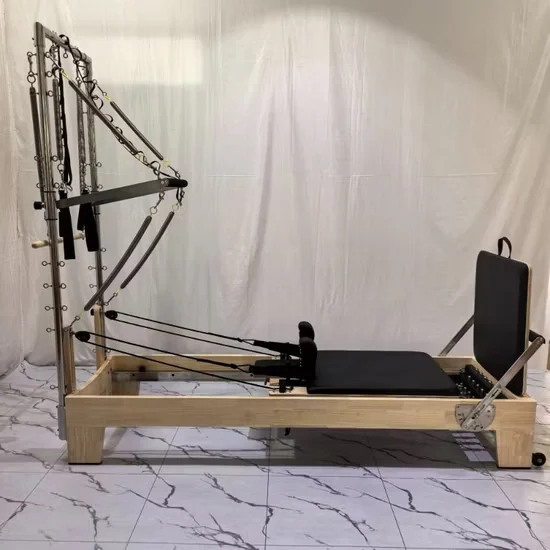
Whisper-Quiet Stability — The SRY-24 wooden Pilates reformer uses solid wood frame construction to minimize vibration and maintain sub-35dB noise levels during continuous studio sessions.
Technical Specifications
| Parameter | Value |
|---|---|
| Designation | SRY-24 |
| Product Type | Pilates Reformer |
| Frame Material | Solid Wood |
| Resistance Type | Spring-based |
| Max User Weight | 180kg |
| Product Dimensions | 2460 × 730 × 680mm |
| Net Weight | 100kgs |
| Color | Solid Color (customizable) |
| Accessories Included | Long Box, Jump Board, Platform |
| Logo | Customized Is Allowed |
| Warranty | 3 Years |
| Production Capacity | 80 Pieces/Month |
Application Suitability
| Deployment Scenario | Typical Use |
|---|---|
| high-end residential home gym | Private daily Pilates sessions with minimal noise transfer to adjacent rooms |
| boutique Pilates studio | Group or one-on-one reformer classes requiring quick accessory swaps between sessions |
| corporate wellness room | Low-impact employee fitness programming with adjustable resistance for varied fitness levels |
| hotel fitness center on guest room floors | 24-hour access cardio and flexibility training without disturbing nearby occupied rooms |
| sports performance training center | Core stability and rehabilitation work complementing strength and conditioning zones |
Why Vibration Complaints Surface Before Equipment Failures Do
A rigid wooden frame absorbs resonance that aluminum frames transmit directly into floor structures.
When Pilates reformers sit on upper floors or shared residential spaces, every carriage return sends structure-borne vibration through the ceiling below. Metal-framed units tend to amplify this impulse, turning each repetition into an audible thud that reaches the front desk long before maintenance flags a problem. The SRY-24 wooden Pilates reformer for home use addresses this at the source — the solid wood frame dampens vibration internally, so energy dissipates within the material rather than traveling through joists [NEED_CITE: structure-borne noise transmission in multi-floor fitness deployments]. Studio owners who have swapped from alloy to wood frames consistently report fewer neighbor complaints without changing any operational procedures.
Where This Reformer Fits in a Mixed Cardio and Flexibility Zone
The SRY-24 covers the full spectrum of Pilates repertoire — footwork, long box series, jump board plyometrics, and platform stretching — making it the primary flexibility and core station in any mixed-modality layout. In a facility that also houses treadmills and ellipticals, this wooden Pilates reformer for home use or studio deployment occupies the low-impact, joint-friendly tier, giving members a recovery option between high-intensity cardio bouts. Its 2460mm footprint demands a clearance zone of at least one meter on all sides for safe carriage travel and instructor access. The 180kg maximum user weight accommodates a broad body-type range, so facilities do not need to designate separate units for heavier clients.
Continuous Session Scheduling and Floor-Level Noise Management
A reformer in a boutique studio may run four to six back-to-back classes daily, with each session lasting up to 55 minutes and minimal cool-down gaps between bookings. The spring-based resistance system requires no electrical power, eliminating motor heat and duty-cycle concerns entirely — but the carriage rails and wheels still accumulate wear proportional to session density [NEED_CITE: spring fatigue and carriage wheel wear under high-frequency studio use]. On upper hotel floors, the solid wood frame’s vibration-damping properties reduce structure-borne noise, yet deployment teams should still verify floor-to-ceiling construction with the building engineer before finalizing placement. No dedicated power circuit is needed, which simplifies installation in retrofitted rooms where electrical upgrades carry prohibitive cost.
Spring-Based Resistance and Wooden Frame Engineering Explained
Unlike magnetic or electromagnetic resistance found in motorized cardio machines, spring-based systems generate force through physical coil deformation, producing a resistance curve that increases as the spring stretches — this matches the natural strength curve of most muscle groups during concentric phases. The SRY-24 ships with a multi-spring configuration allowing users and instructors to select from several tension levels without tools. The solid wood frame provides a stiffness profile that differs fundamentally from welded steel: wood absorbs high-frequency vibration through its fibrous grain structure, while steel transmits it. This matters for the carriage glide — a wooden rail housing keeps rolling noise low because the frame itself acts as a damper rather than a sounding board [NEED_CITE: acoustic damping properties of hardwood versus steel in fitness equipment frames]. The precision carriage mechanism is engineered for consistent travel across the full 2460mm bed length, preventing the uneven resistance spikes that signal misaligned wheels or warped rails.
The Hidden Cost of Underspecifying Reformers in Commercial Spaces
Facilities that purchase home-grade reformers for studio duty cycles encounter spring fatigue within months — coils lose their rated tension, and instructors notice clients complaining that the same spring setting feels lighter than it did at commissioning. Cheap carriage wheels develop flat spots against metal rails, generating a rhythmic click that becomes audible across the room during quiet concentration segments. When a boutique studio replaces an entire fleet of under-specced reformers, the sunk cost includes not just the new equipment but re-training staff on different accessory attachment points and recalibrating every class template. In hotel environments, vibration complaints from guests in rooms directly below the fitness center can trigger management directives to restrict operating hours, effectively reducing the amenity’s value proposition [NEED_CITE: guest complaint escalation patterns for floor-transmitted fitness equipment noise].
Why This Product Line Addresses the Gaps
Every SRY-24 unit undergoes carriage smoothness and frame rigidity verification before shipping, mirroring the testing discipline Biketon applies across its commercial cardio range — including the 10,000-hour continuous operation standard for motorized equipment. The solid wood frame is graded for long-term load cycles consistent with studio-grade deployment, not occasional home use. Biketon’s 3D cardio-zone layout service covers reformer placement alongside treadmills and ellipticals, ensuring the flexibility station receives adequate sightline exposure and airflow rather than being tucked into an underutilized corner. The full OEM/ODM capability extends to logo engraving and color matching, so the wooden Pilates reformer for home use or studio deployment aligns with facility branding. Technical support covers accessory compatibility questions and spring replacement scheduling, available around the clock.
Documentation & Test Records
- CE declaration of conformity covering structural integrity and user safety
- EN 957 test report validating load-bearing and stability requirements
- ISO 9001 certificate for manufacturing quality management systems
- Noise level test report confirming operation under studio conditions
- Durability test record for carriage and spring assembly lifecycle
- Installation and commissioning guide with accessory setup instructions
Installation, Commissioning & Maintenance
- Maintain one-meter clearance around the 2460 × 730mm footprint on all sides for safe carriage travel
- Level the installation surface and place anti-vibration pads beneath each foot to complement the wooden frame’s natural damping
- Verify spring tension settings on first use and after every 500 operating hours to maintain resistance accuracy
- Inspect carriage wheels monthly for flat spots or debris accumulation on the precision rail system
- Clean wooden surfaces with pH-neutral cleaner to prevent sweat-induced finish degradation
- Store Long Box, Jump Board, and Platform accessories in designated racks to prevent warping or impact damage
Planning Your Reformer Deployment
Share your studio floor plan and target class capacity to receive a 3D layout showing reformer spacing, instructor sightlines, and ventilation paths. Specify whether units will sit on upper floors or adjacent to occupied rooms so noise transfer requirements can be confirmed. Indicate whether branding customization — logo engraving or frame color — is needed for the wooden Pilates reformer for home use or commercial deployment. State your destination market to ensure accessory documentation matches local safety standards.
Frequently Asked Questions
Q: What wood materials are used in the SRY-24 frame, and how do they impact durability?
A: The SRY-24 uses solid wood selected for structural density and vibration-damping properties. Hardwood grain structure absorbs high-frequency energy from carriage movement, reducing noise transmission to surrounding floors. The frame is rated for continuous studio-grade use with a 180kg maximum user weight, and the finish resists sweat and humidity typical in fitness environments.
Q: How does the carriage system ensure smooth and quiet operation?
A: The precision carriage mechanism runs on engineered wheels matched to the wooden rail profile, preventing uneven travel and rhythmic clicking. The solid wood frame acts as a natural damper, so rolling noise dissipates within the material rather than amplifying through a rigid metal structure. Regular wheel inspection maintains this performance over extended deployment periods.
Q: Can the SRY-24 be customized for branding and color preferences?
A: Yes. Logo engraving and solid color frame finishes are available through the OEM/ODM program. Facilities can match the reformer to existing interior design schemes or corporate branding requirements. Customization scoping occurs during the quotation phase, and production lead time adjusts accordingly based on order volume and finish complexity.
Q: What accessories are included, and how do they enhance workout versatility?
A: The SRY-24 ships with a Long Box for seated and supine exercises, a Jump Board for plyometric spring-loaded jumps, and a Platform for standing and stretching work. These accessories attach to standardized mounting points on the frame, allowing instructors to transition between exercise modalities within a single session without requiring additional equipment or floor space.
Q: What is the warranty coverage, and what after-sales support is provided?
A: The SRY-24 carries a 3-year warranty covering frame integrity, carriage mechanism, and spring assembly. Technical support is available around the clock for accessory compatibility, spring replacement scheduling, and frame maintenance questions. Spare parts documentation is provided at delivery to streamline reordering throughout the equipment lifecycle.