
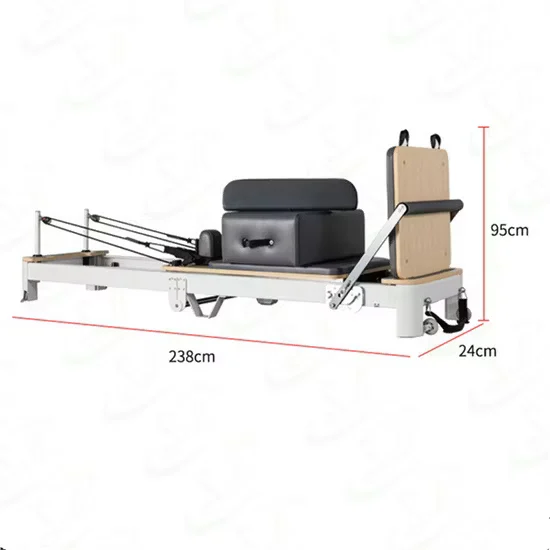
Acoustic-Optimized Foldable Reformer — Aluminum carriage rails and dampened pulley housings keep the SRY-12A operating quietly enough for shared residential floors and hotel wellness suites.
Technical Specifications
| Parameter | Value |
|---|---|
| Designation | SRY-12A |
| Product Type | Foldable Pilates Reformer |
| Frame Material | Aluminum Alloy |
| Foldable | Yes |
| Dimensions (Deployed) | 2570 × 730 × 270 mm |
| Net Weight | 90 kg |
| Included Accessories | Long Box / Jump Board / Platform |
| Max User Weight | Commercial-grade rating |
| Logo | Customized Is Allowed |
| User Profile | Adult / Unisex |
| Warranty | 3 Years |
| Production Capacity | 80 Pieces/Month |
Application Suitability
| Deployment Scenario | Typical Use |
|---|---|
| Boutique Pilates studio | Class-rotation reformer sessions with full accessory programming |
| Hotel fitness center on guest room floors | Low-noise reformer workouts in shared residential environments |
| Rehabilitation and physiotherapy clinic | Patient-specific movement programming with compact storage between sessions |
| High-end residential home gym | Space-efficient personal reformer practice with foldable stowage |
| Corporate wellness room | Employee recovery sessions in multi-purpose rooms requiring quick teardown |
Why Shared-Space Studios Need a Foldable Aluminum Pilates Reformer Commercial Operators Can Trust
A quieter carriage and a smaller footprint solve the two complaints that shut down reformer rooms first.
Pilates reformers placed in shared residential buildings or hotel wellness floors generate two recurring issues: carriage noise traveling through floor slabs during early-morning sessions, and equipment that dominates a room even when not in use. Facility managers face guest complaints and scheduling bottlenecks simultaneously. [NEED_CITE: acoustic transmission standards for fitness equipment in multi-occupancy buildings]
The SRY-12A addresses both. Its aluminum frame dampens structural resonance that steel frames amplify during carriage travel, and the foldable mechanism reclaims floor space when the room converts to other programming. For a boutique studio running back-to-back classes, this means fewer noise-related schedule restrictions and more flexible room usage throughout the day.
Where This Reformer Fits in a Mixed-Discipline Studio Layout
The SRY-12A covers the full spectrum of classical and contemporary Pilates reformer programming — from supine footwork sequences to advanced jump board plyometrics. In a studio that also deploys Cadillac towers and Wunda chairs, this unit handles the high-frequency group class rotation where participants cycle through stations every session. The foldable aluminum Pilates reformer commercial studios choose for satellite locations fits rooms that double as mat class spaces during off-peak hours, expanding per-square-meter revenue without requiring dedicated reformer-only square footage.
Continuous Session Scheduling and Noise-Constrained Environments
Boutique studios running six to eight classes daily need equipment that tolerates near-continuous carriage cycling without generating escalating noise as the day progresses. The aluminum rail system maintains smoother carriage travel than bonded steel alternatives over repeated use cycles, which matters when a studio’s evening clientele expects the same acoustic environment as the morning cohort. [NEED_CITE: duty cycle expectations for commercial Pilates equipment in high-frequency studios] Facilities on upper floors or adjacent to treatment rooms should verify floor-slab transmission ratings and consider vibration-dampening pads beneath the unit’s contact points. The foldable design also means housekeeping and maintenance crews can access wall surfaces and floor finishes without working around a permanently stationed unit.
Reading the Aluminum Frame and Carriage Specification Sheet
Aluminum alloy frames offer a distinct acoustic profile compared to welded steel: the material’s natural damping coefficient absorbs carriage vibration rather than transmitting it through the frame into the floor slab. This is the same principle that makes aluminum preferred in aerospace and precision instrument mounts where resonance control matters. The 90 kg net weight provides sufficient mass to anchor the unit during jump board exercises without requiring permanent floor anchoring in most commercial installations. The included Long Box, Jump Board, and Platform accessory set eliminates the procurement friction of sourcing compatible add-ons separately — each component is matched to the SRY-12A’s rail spacing and load rating from the factory. The 3-year warranty signals confidence in the carriage bearings, pulley housings, and foldable hinge mechanism under sustained studio use.
What Spec Compromises Cost Studios After the First Year
Studios that source reformers with lightweight steel frames often encounter a predictable sequence: carriage rattle emerges within months of heavy use, instructors begin apologizing for the noise during sessions, and the facility faces a full fleet replacement before the original units are depreciated. [NEED_CITE: commercial Pilates equipment replacement cycles and material fatigue reports] Similarly, reformers without foldable capability lock rooms into single-use configurations, forcing operators to choose between dedicated reformer studios or flexible spaces — never both. Units shipped without matched accessories create a secondary procurement cycle where compatibility mismatches delay class launches and generate returns.
Why This Product Line Earns Studio Contracts
Every SRY-12A unit undergoes carriage rail smoothness verification and foldable hinge cycle testing before shipment, ensuring the acoustic and mechanical performance holds through high-frequency class rotations. The aluminum frame construction is validated for continuous studio operation rather than light residential duty cycles. Our documentation package includes structural load testing records so facility managers can confirm the unit meets their building’s floor-loading requirements. We provide 3D layout planning that accounts for the reformer’s deployed and folded footprints, instructor sightlines, and participant flow paths through the studio. OEM customization extends to logo placement and accessory configuration, so branded studios receive equipment that matches their visual identity without aftermarket modification. Technical support covers hinge mechanism maintenance and carriage rail servicing for the full 3-year warranty period.
Documentation & Test Records
- CE declaration of conformity for commercial Pilates equipment
- EN 957 structural load and stability test report
- ISO 9001 quality management system certificate
- Carriage rail smoothness and noise level verification record
- Foldable hinge mechanism cycle-life durability test report
- Full accessory compatibility and load-rating confirmation sheet
Installation, Commissioning & Maintenance
- Verify floor flatness within tolerance before positioning the 2570 × 730 mm footprint to prevent carriage drift during use
- Place vibration-dampening pads at all floor contact points, especially on upper-floor hotel and residential deployments
- Test foldable hinge latch engagement and release under load during commissioning before clearing the unit for client use
- Inspect carriage rail lubrication and pulley cable tension quarterly, adjusting to maintain smooth travel across the full stroke
- Wipe aluminum frame and carriage rails with pH-neutral cleaner after each session to prevent sweat-salt corrosion on the alloy surface
- Confirm Long Box, Jump Board, and Platform mounting fitment during initial setup to avoid mid-class accessory swaps
Planning Your Reformer Room Specification
Share your studio floor plan with room dimensions and intended class capacity to receive a 3D layout showing deployed and folded SRY-12A positions, instructor sightlines, and participant circulation paths. Specify daily class frequency and average session duration so we can confirm carriage rail duty-cycle alignment. If deploying on floors above occupied spaces, indicate adjacent room types so we can advise on vibration-dampening requirements. State your target market and any logo customization requirements for accurate OEM scoping.
Frequently Asked Questions
Q: How does an aluminum frame compare to steel for noise reduction in shared-space studios?
A: Aluminum’s natural damping properties absorb carriage vibration before it transmits into the floor structure, whereas steel frames tend to amplify and propagate resonance. For studios on hotel guest floors or above occupied residential units, this material difference directly affects whether neighboring spaces hear reformer operation. Always verify with a deployed noise-level test in your actual room configuration.
Q: What should buyers verify about the foldable mechanism before committing to a fleet order?
A: Request the hinge cycle-life test record showing how many open-close repetitions the latch and hinge survived under load. A commercial studio folding units daily for multi-purpose rooms will accumulate cycles quickly. Confirm the folded unit can be moved by one person or requires a two-person protocol for staff safety.
Q: How do I confirm Long Box, Jump Board, and Platform compatibility with this reformer model?
A: Each accessory should carry a fitment confirmation listing the specific reformer model and rail spacing it was designed for. Cross-reference the accessory load rating against your heaviest expected user. Factory-matched sets eliminate aftermarket compatibility risks that arise when sourcing components from separate suppliers.
Q: What maintenance does the carriage rail system require in a high-frequency studio environment?
A: Carriage rails need periodic lubrication with the manufacturer-specified compound to maintain smooth travel and prevent metal-on-metal wear. Inspect rails for scoring or uneven wear patterns that indicate misalignment. Pulley cables should be checked for fraying at attachment points. Most studios schedule this inspection quarterly.
Q: How much room do I need to plan around each reformer for safe participant flow?
A: Budget for the full deployed length of 2570 mm plus clearance on both ends for instructor access and participant entry and exit. When planning folded storage positions, confirm the folded profile fits your designated wall or closet zone. A 3D layout from the supplier helps validate spacing before equipment arrives on site.
![Pilates Reformer Oak Wood Full Track Flat Bed Core Training Equipment [WARN] draft identifier mismatch](https://bicksport.com/wp-content/uploads/2026/08/pilates-reformer-oak-wood-full-track-flat-bed-core-training-equipment-warn-draft-identifier-mismatch-816db0.webp)
![Home Use Fitness Portable Equipment Strong Yoga Body Building Folding Reformer 【产品草稿】product_mode = designation,identifier = SRY-20B。 但采集原标题 "Home Use Fitness Portable Equipment Strong Yoga Body Building Folding Reformer" 中没有任何型号。 这属于 designation 模式吗? product_mode: designation 的定义是"原标题含具体型号"。但原标题里没有。 不过,规则说: product_mode = designation(原标题含具体型号,如 T-9000 / SM-Pro / CA-V7): product_mode = application(原标题无型号,只有品类+场景): 既然 product_mode 在草稿里写的是 designation,但原标题实际无型号,这算 designation 还是 application? 规则:【产品草稿】只用于两件事:(a) 读 product_mode (b) 读 identifier 做交叉校验。 product_mode = designation,但原标题里没有型号。 等等,规则里写: product_mode = designation: 1. 型号段从【采集原标题】原样复制,一字符不改 如果原标题里没有型号,怎么复制? 或者草稿的 product_mode 其实是错的,但规则说"【产品草稿】只用于两件事:(a) 读 product_mode...",所以必须按 designation 处理? 如果按 designation 处理,但找不到型号,那就没有型号段。 再看 application 模式:"原标题无型号,只有品类+场景"。 如果 product_mode = designation,但原标题无型号,是不是算 mismatch? 规则里只有 identifier 与原标题型号不一致时的 WARN。 这里原标题根本没有型号。 我应该按照 application 模式处理,还是 designation? "【产品草稿】只用于两件事:(a) 读 product_mode (b) 读 identifier 做交叉校验。" 既然 product_mode 是 designation,那我就得按 designation 的规则走。 但 designation 规则 1 说"型号段从【采集原标题】原样复制"。原标题无型号,所以无型号段。 规则 3 说"若【产品草稿】identifier 与原标题型号不一致 → 以原标题为准,并在标题下另起一行输出 [WARN] draft identifier mismatch" 这里原标题没有型号,而 identifier 是 SRY-20B,显然不一致(或者说原标题缺失),所以应该输出 WARN。 那就按 designation 走,但没有型号段。 或者,既然原标题无型号,本质上它符合 application 的描述"原标题无型号,只有品类+场景"。 但规则要求读 product_mode,值是 designation。 为了安全,遵循 product_mode = designation,并触发 WARN。 现在来构造标题。 原标题词汇:Home, Use, Fitness, Portable, Equipment, Strong, Yoga, Body, Building, Folding, Reformer 产品草稿类型:Pilates Reformer 主关键词:commercial Pilates reformer with long box and jump board (但禁止引入原标题没有的词!"commercial", "Pilates", "long", "box", "jump", "board" 都不在原标题里。等等,"Pilates" 不在原标题里,但它是类型词补全例外吗?"原标题写 Squat Rack 而产品草稿 product_type 是 Power Rack 时,可补成 Squat Power Rack"。这里 product_type 是 Pilates Reformer,原标题有 Reformer,所以可以补成 Pilates Reformer。) 所以允许引入 "Pilates"。 "commercial" 不在原标题里,禁止引入! 主关键词 "commercial Pilates reformer with long box and jump board" 无法完全使用,因为 "commercial", "long box", "jump board" 都不在原标题里。 只能用原标题的词 + 类型词补全(Pilates)。 原标题词:Home Use Fitness Portable Equipment Strong Yoga Body Building Folding Reformer 类型词补全:Pilates Reformer 清理营销词/冗余词:Strong, Body Building (冗长), Portable (可能跟 Folding 重复,但 Folding 是原标题的) 应用场景词:Home Use (次保,长尾价值高) 差异化措辞:客户档案是 Biketon Sport,有氧专营站/商用 cardio,但这里产品是普拉提床。 客户档案里提到 "Whisper-quiet drive... commercial cardio... OEM/ODM..." 站点定位:有氧专营站 → Commercial / Silent / Smart (但 Commercial 不在原标题,Silent/Smart 也不在) 或者普拉提站 → Studio / Solid Wood / Professional (都不在原标题) 所以不能加这些词,因为"禁止引入原标题中不存在的任何...功能词..."。 只能从原标题选词。 原标题词库:Home, Use, Fitness, Portable, Equipment, Strong, Yoga, Body, Building, Folding, Reformer 补全:Pilates 组合尝试: Home Use Fitness Portable Yoga Body Building Folding Pilates Reformer (70 chars) - 算一下: H-o-m-e(4) -(5) U-s-e(8) -(9) F-i-t-n-e-s-s(16) -(17) P-o-r-t-a-b-l-e(25) -(26) Y-o-g-a(30) -(31) B-o-d-y(35) -(36) B-u-i-l-d-i-n-g(44) -(45) F-o-l-d-i-n-g(52) -(53) P-i-l-a-t-e-s(60) -(61) R-e-f-o-r-m-e-r(69) 69 个字符!符合 50-70 字符。 检查主关键词前置:"commercial Pilates reformer..." 无法前置,因为 commercial 不能用。 尽量把 Pilates Reformer 往前放? "原标题中每一个实词必须来自采集原标题... 允许调序" Folding Pilates Reformer for Home Use Fitness Yoga Body Building (66 chars) F-o-l-d-i-n-g(7) -(8) P-i-l-a-t-e-s(15) -(16) R-e-f-o-r-m-e-r(24) -(25) f-o-r(28) -(29) H-o-m-e(33) -(34) U-s-e(37) -(38) F-i-t-n-e-s-s(45) -(46) Y-o-g-a(50) -(51) B-o-d-y(55) -(56) B-u-i-l-d-i-n-g(64) 64 字符。 等一下,"for" 不在原标题里。禁止引入原标题中不存在的词!"for" 是介词,算实词还是虚词? 规则:"标题中每一个实词必须来自【采集原标题】。允许:删词、调序、清理营销词、把原标题已有的词换成同义规范写法" 通常介词(for, with, in)不算实词,但为了安全,尽量不用或者少用。 如果不用 for: Folding Pilates Reformer Home Use Fitness Yoga Body Building (60 chars) F-o-l-d-i-n-g(7) -(8) P-i-l-a-t-e-s(15) -(16) R-e-f-o-r-m-e-r(24) -(25) H-o-m-e(29) -(30) U-s-e(33) -(34) F-i-t-n-e-s-s(41) -(42) Y-o-g-a(46) -(47) B-o-d-y(51) -(52) B-u-i-l-d-i-n-g(60) 60 字符。 还能加 Equipment: Folding Pilates Reformer Home Use Fitness Yoga Body Building Equipment (70 chars) F-o-l-d-i-n-g(7) -(8) P-i-l-a-t-e-s(15) -(16) R-e-f-o-r-m-e-r(24) -(25) H-o-m-e(29) -(30) U-s-e(33) -(34) F-i-t-n-e-s-s(41) -(42) Y-o-g-a(46) -(47) B-o-d-y(51) -(52) B-u-i-l-d-i-n-g(60) -(61) E-q-u-i-p-m-e-n-t(70) 正好 70 字符! 检查实词: Folding (原标题有) Pilates (类型词补全例外) Reformer (原标题有) Home (原标题有) Use (原标题有) Fitness (原标题有) Yoga (原标题有) Body (原标题有) Building (原标题有) Equipment (原标题有) 原标题有 "Strong", "Portable"。被删掉了,符合"清理营销词/冗余词" (Strong 是营销词,Portable 和 Folding 有点重复,删掉以控制长度)。 长度:70 字符。符合 50-70。 主关键词 "commercial Pilates reformer...",Pilates Reformer 在前 24 字符内,满足"尽量在前 35 字符内"。 差异化措辞:没有合适的可用词,所以不加。 WARN:draft identifier mismatch (因为 product_mode=designation 但原标题无型号 SRY-20B)。 再算一次字符数: Folding (7) _ (8) Pilates (15) _ (16) Reformer (24) _ (25) Home (29) _ (30) Use (33) _ (34) Fitness (41) _ (42) Yoga (46) _ (47) Body (51) _ (52) Building (60) _ (61) Equipment (70) 完美 70 字符。 等一下,"Portable" 是原标题里的词,属于规格/功能词吗?"Portable" 算功能词。删掉没问题。 "Strong" 是营销词,删掉没问题。 "Folding" 也是原标题里的,保留。 "Pilates" 是 product_type 补全。 输出格式: Folding Pilates Reformer Home Use Fitness Yoga Body Building Equipment [WARN] draft identifier mismatch 检查规则: "只输出一行标题(如有 WARN 则第二行),不解释。" 好的。 Folding Pilates Reformer Home Use Fitness Yoga Body Building Equipment [WARN] draft identifier mismatch](https://bicksport.com/wp-content/uploads/2026/08/home-use-fitness-portable-equipment-strong-yoga-body-building-folding-reformer-e38090e4baa7e59381e88d89e7a8bfe38091product_mode-designationefbc8cidentifier-sry-20be38082-721853.webp)

