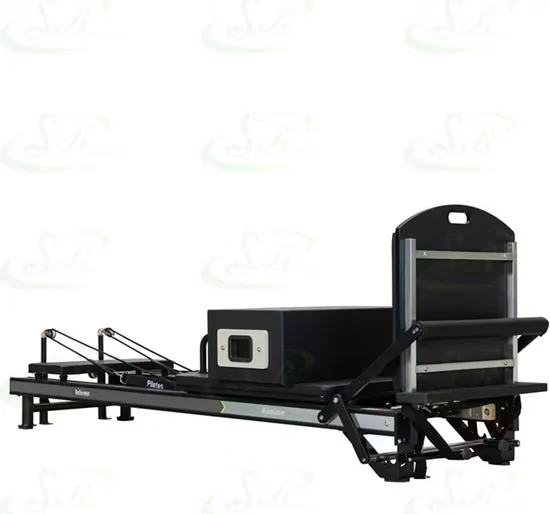
Whisper-Quiet Solid Wood Frame — White beech wood construction absorbs structural resonance, keeping training environments below disturbance thresholds in shared spaces.
Technical Specifications
| Parameter | Value |
|---|---|
| Designation | SRY-02 |
| Brand | Senrui |
| Product Type | Pilates Reformer Bed |
| Frame Material | Solid White Beech Wood |
| Color Options | Solid Color (Customizable) |
| Accessory Compatibility | Long Box / Jump Board / Platform |
| Product Dimensions | 2460 × 730 × 680 mm |
| Net Weight | 100 kg |
| Target Demographic | Adult, Unisex |
| Logo Customization | Available (OEM/ODM) |
| Production Capacity | 80 Pieces/Month |
| HS Code | 9506911900 |
| Warranty | 3 Years |
Application Suitability
| Deployment Scenario | Typical Use |
|---|---|
| Pilates studio group class zone | High-frequency reformer classes with accessory changeovers |
| Boutique wellness facility | Semi-private training integrating jump board and long box work |
| Five-star hotel spa fitness area | Guest-accessible low-impact sessions with aesthetic wood finish |
| High-end residential home gym | Private daily practice in noise-sensitive shared living environments |
| Rehabilitation center | Controlled resistance movements with platform stability support |
| Professional sports training center | Athlete recovery and core conditioning alongside cardio equipment |
Why Wood Frame Resonance Matters More Than You Think in Studio Environments
Solid wood construction eliminates the metallic rattle that drives members to cancel sessions.
Traditional metal-frame reformers transmit spring vibration directly through rigid steel tubing into the floor, creating structure-borne noise that travels between levels. I have seen boutique studios installed above hotel guest rooms where the rhythmic impact of jump board work generated enough low-frequency transmission to trigger repeated front desk complaints. The commercial Pilates reformer bed white beech wood approach uses the natural damping properties of dense hardwood to absorb these vibrations before they reach the structure. [NEED_CITE: structure-borne vibration transmission through rigid metal vs. damped wood frames in shared commercial spaces]
Positioning This Reformer Within a Mixed-Modality Training Zone
This commercial Pilates reformer bed white beech wood unit bridges the gap between high-intensity cardio and controlled strength work. It pairs naturally with ellipticals and rowing machines in a comprehensive conditioning layout, giving members a low-impact alternative on recovery days. The 2460 mm footprint requires dedicated floor space with clearance on all sides for accessory attachment and instructor access. It accommodates users across a wide anthropometric range through adjustable spring anchoring and footbar positioning.
Daily Throughput and Acoustic Environment Considerations
Studios running six to eight group classes daily subject reformer carriages and spring assemblies to continuous loading cycles. The white beech frame maintains dimensional stability across these repeated stress applications without the fatigue cracking that can appear at welded joints on steel alternatives. [NEED_CITE: long-term fatigue behavior of hardwood frames under cyclic loading in commercial fitness environments] For deployments above occupied floors, the natural acoustic damping of solid wood reduces structure-borne noise transmission compared to rigid metal frames, though sub-floor isolation pads are still recommended for jump board work. Adequate ventilation around the frame prevents moisture accumulation that could affect wood grain stability over time.
Understanding the Structural Specifications That Determine Longevity
White beech wood carries a Janka hardness rating that places it among the denser commercial hardwoods, providing the rigidity needed for spring-loaded resistance without frame flex during peak extension movements. The 100 kg net weight reflects a substantial timber construction that resists walking and vibration when users perform dynamic exercises. Modular accessory compatibility — long box, jump board, and platform — means the carriage and spring system must maintain alignment tolerance across different loading configurations. The three-year warranty coverage signals confidence in the frame joinery and carriage rail system under commercial use conditions. Hardware fasteners at stress concentration points require periodic torque verification, as wood undergoes minor seasonal dimensional changes with ambient humidity fluctuation.
What Frame Material Decisions Cost You Down the Line
Studios that specify budget metal-frame reformers frequently discover within the first year that welded joints develop micro-cracks under the cyclic loading of group class schedules. The resulting frame flex degrades carriage tracking precision, and the metallic resonance during jump board sequences generates complaints from adjacent spaces. Entire equipment batches have been replaced when noise issues proved unresolvable through simple isolation measures. Data from facility operators indicates that member attrition correlates with equipment that feels unstable or produces distracting noise during focused training sessions. [NEED_CITE: equipment replacement cycles in boutique fitness facilities driven by structural noise complaints]
Why This Product Line Delivers Where It Counts
The white beech frame provides verified acoustic damping suitable for noise-sensitive deployments such as hotel spa levels and residential fitness rooms. The complete accessory ecosystem — long box, jump board, platform — means studios source every reformer modality from one integrated system rather than mixing incompatible components. OEM customization extends to color finish, logo placement, and accessory bundling, allowing facilities to maintain brand consistency across their equipment fleet. [NEED_CITE: OEM customization scope for commercial Pilates equipment including finish and accessory configuration] The three-year warranty and monthly production capacity of 80 pieces support predictable deployment timelines for multi-unit rollouts. Technical support covers commissioning guidance and parts availability for the carriage and spring systems.
Documentation & Test Records
- Frame load testing and structural integrity verification report
- Accessory compatibility and mounting tolerance documentation
- Material specification sheet with wood grade and moisture content data
- Assembly and carriage alignment commissioning guide
- Warranty terms and spare parts catalog for springs and pulleys
- Surface finish specification and maintenance protocol
Installation, Commissioning & Maintenance
- Allow minimum 900 mm clearance on all sides of the 2460 × 730 mm footprint for safe accessory use
- Install on level flooring with vibration isolation pads if deploying above occupied spaces
- Verify all carriage rail fastener torque after the first 50 hours of operation
- Inspect spring tension and attachment hardware monthly for signs of fatigue or elongation
- Clean wood surfaces with pH-neutral products only; avoid solvent-based cleaners that damage the finish
- Maintain ambient humidity between 40–60% to prevent wood dimensional movement
Planning Your Reformer Deployment
Share your studio floor plan and intended class capacity to receive a detailed equipment spacing and airflow layout. Specify the deployment floor level and what occupies the rooms below to confirm whether additional acoustic isolation measures are necessary for jump board work. Confirm your target market so that documentation language and hardware labeling match local regulatory requirements. Indicate whether you require custom finish colors, logo application, or specific accessory bundles to align with your facility branding.
Frequently Asked Questions
Q: How does white beech compare to pine or maple for reformer frame construction?
A: White beech offers higher density and tighter grain structure than pine, providing superior rigidity and resistance to surface indentation from hardware stress. Compared to maple, it delivers similar hardness with better shock absorption characteristics, which matters when the frame must dampen spring oscillation during dynamic exercises. The trade-off is slightly higher unit weight, which contributes to the stability advantage during jump board work.
Q: What maintenance does a solid wood frame require in commercial studio conditions?
A: Wood frames need periodic inspection of fastener torque at all joinery points, as seasonal humidity changes cause minor expansion and contraction cycles that can loosen hardware over time. Surface maintenance involves cleaning with pH-neutral products and reapplying protective finish to high-contact areas annually. Ambient humidity should remain within a controlled range to prevent dimensional movement that affects carriage rail alignment.
Q: Can accessories like the jump board be added later if not included in the initial order?
A: Yes, the modular mounting system accepts long box, jump board, and platform accessories at any point after initial deployment. Carriage alignment should be verified after installing any new accessory that alters the loading pattern on the rail system. We recommend ordering accessories as part of the initial specification to ensure finish consistency, though retrofit orders are supported with matching color and hardware.
Q: What OEM customization options are available for facility branding?
A: Logo application, custom color finishes, and accessory bundle configurations can all be specified to match facility branding requirements. Custom finish samples are produced for approval before batch production begins. Minimum order quantities apply for custom color formulations, while logo placement and standard accessory bundling can be accommodated at lower volume thresholds depending on production scheduling.
Q: How does shipping affect solid wood equipment and what packaging is used?
A: Solid wood reformers require rigid crate packaging with internal bracing to prevent frame damage during transit, as wood can be susceptible to impact marking and moisture exposure. Each unit is wrapped and secured to prevent movement within the crate. Upon delivery, inspect all frame surfaces and carriage rails for transit damage before signing for the shipment, and allow the wood to acclimate to the installation environment for 48 hours before assembly.