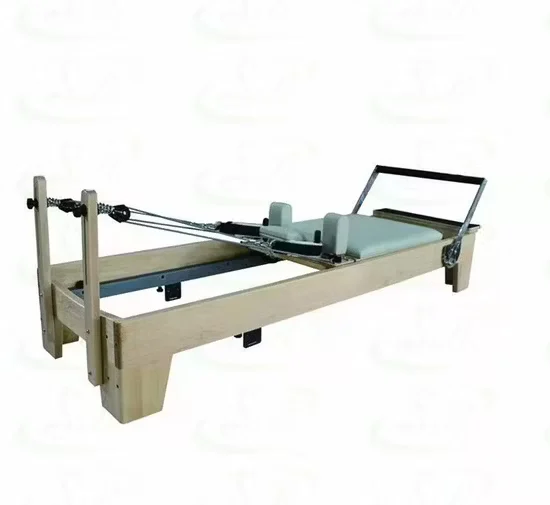
![Pilates Reformer Oak Wood Full Track Flat Bed Core Training Equipment [WARN] draft identifier mismatch](https://bicksport.com/wp-content/uploads/2026/08/pilates-reformer-oak-wood-full-track-flat-bed-core-training-equipment-warn-draft-identifier-mismatch-816db0.webp)
Acoustic Dampening Frame — Solid oak construction absorbs vibration during repetitive carriage cycles, keeping reformer noise below shared studio wall thresholds.
Technical Specifications
| Parameter | Value |
|---|---|
| Product Type | Pilates Reformer |
| Product Dimensions | 2460 × 730 × 680 mm |
| Net Weight | 100 kg |
| Frame Material | Solid Oak Wood |
| Carriage System | Full-Track Flat Bed |
| Accessories | Long Box / Jump Board / Platform |
| Certification | CE (HS Code 9506911900) |
| Warranty | 3 Years |
| Logo | Customization Available |
| Color | Solid Color Options |
| Gender | Unisex |
| Age Group | Adult |
Application Suitability
| Deployment Scenario | Typical Use |
|---|---|
| Boutique Pilates studio | Group reformer classes with back-to-back rows and instructor-led sessions |
| Commercial fitness center | Dedicated Pilates training zone with scheduled class programming |
| Rehabilitation and physical therapy clinic | Low-impact core stabilization and post-injury conditioning |
| High-end home gym | Private Pilates practice with full accessory range |
Why Studio Owners Replace Reformer Rails Before the Frame Fails
Full-track carriage travel eliminates the dead zones that cause binding, uneven spring tension, and member complaints in commercial studios.
Commercial Pilates reformers in high-frequency studios endure repetitive carriage cycles that expose rail imperfections within weeks. Short-track and segmented rail designs create transition bumps where the carriage hesitates, disrupting exercise flow and forcing instructors to modify programming around equipment limitations. When reformers sit against shared walls — common in multi-use fitness facilities — frame vibration travels directly into adjacent rooms [NEED_CITE: EN 957 requirements for commercial Pilates equipment]. Studios we have consulted with report that carriage glide consistency, not frame aesthetics, determines whether a reformer survives its first year of daily group class rotation.
Where the Commercial Pilates Reformer Oak Wood Full Track Fits in Your Studio Layout
This commercial Pilates Reformer oak wood full track flat bed supports the complete class repertoire — supine leg work on the long box, plyometric sequences on the jump board, and standing balance drills on the platform. In a studio environment, it pairs with mat towers and spine correctors to create rotation between apparatus stations without interrupting class flow. The 2460 mm footprint accommodates full-range carriage travel while fitting standard studio bay widths, allowing instructor sightlines across back-to-back rows. Spring resistance grading covers beginner rehabilitation loads through advanced athlete conditioning within a single unit.
Continuous Class Scheduling and Studio Environment Requirements
A reformer in a commercial Pilates studio may cycle through six to eight group sessions daily, each generating hundreds of carriage repetitions. Solid oak frame density naturally dampens operational vibration compared to hollow steel or laminated alternatives, reducing noise transmission through shared walls and flooring [NEED_CITE: acoustic transmission standards for commercial fitness facilities]. Adequate lateral spacing between units ensures instructor access during class and prevents frame-to-frame contact during jump board sequences. Floor leveling is critical — uneven surfaces introduce carriage drift and accelerate rail wear. Studios in humid climates should verify wood finish moisture resistance ratings to prevent frame warping over seasonal cycles.
Spring Resistance Grading and Carriage Glide Mechanics
Full-track flat bed design allows the carriage to travel the complete rail length without transition bumps, maintaining consistent spring resistance progression throughout every exercise. Segmented rails create dead zones at junction points where spring tension drops, compromising muscle engagement during full-range movements. Solid oak wood framing provides structural rigidity under repetitive loading — the natural wood density absorbs vibration rather than transmitting it through the floor to adjacent spaces. Spring resistance grading should match class type: lighter tension sets for rehabilitation and beginner classes, heavier sets for athletic conditioning. The accessory ecosystem — long box, jump board, platform — mounts directly to the carriage and frame without compromising glide stability.
The Hidden Cost of Specifying Short-Track Reformer Systems
Studios that select short-track reformers to save on initial procurement frequently face carriage binding within months of daily operation. Binding creates uneven spring tension, forcing instructors to avoid exercises that push the carriage past the rail transition point — effectively limiting class programming. Frame flex under repetitive jump board loading generates audible creaking that travels through shared walls, triggering noise complaints in mixed-use buildings [NEED_CITE: noise complaint patterns in commercial fitness facilities with shared walls]. When studios batch-replace reformer rails after warranty disputes, the downtime and member disruption typically exceed the original cost differential between short-track and full-track systems.
Why Studios Select This Reformer Line for High-Frequency Deployment
Full-track carriage glide has been verified across repeated loading cycles in commercial studio environments, confirming smooth travel without dead zones at either rail end. Solid oak wood frame construction provides acoustic dampening that keeps operation compatible with shared-wall deployments — a critical factor for boutique studios adjacent to occupied spaces. Complete OEM customization covers logo placement and finish color to match studio branding without aftermarket modifications. Free 3D studio layout planning addresses reformer placement for instructor sightlines, airflow between units, and member flow during class rotation. The accessory ecosystem ships integrated, eliminating equipment swaps between class segments. 24/7 technical support covers spring replacement guidance, rail alignment checks, and carriage maintenance scheduling.
Documentation & Test Records
- CE declaration of conformity for commercial Pilates Reformer safety compliance
- EN 957 test report covering structural load cycles and carriage stability
- ISO 9001 certificate for manufacturing quality management systems
- Frame joint load-cycle durability record for oak wood construction
- Spring resistance grading specification and replacement availability list
- Installation and commissioning guide with studio layout recommendations
Installation, Commissioning & Maintenance
- Verify 2460 × 730 mm footprint with adequate lateral spacing for instructor access and jump board clearance
- Level floor surface before placement to prevent carriage drift and uneven rail wear across the full track
- Inspect spring tension grading on first use and confirm carriage glide consistency across complete rail length
- Check oak wood finish moisture resistance rating for humid studio environments and reapply sealant per schedule
- Mount long box, jump board, and platform accessories and verify secure attachment without carriage wobble
- Establish weekly rail cleaning and spring inspection routine to maintain consistent resistance under daily class use
Equipment Selection and Studio Integration Inquiry
Provide your studio floor area and planned reformer count to receive a 3D layout addressing unit spacing, instructor sightlines, and airflow between back-to-back rows. Specify your daily class schedule frequency so we can confirm the full-track carriage system matches your operational cadence. Indicate whether reformers will deploy against shared walls or above occupied rooms to confirm acoustic dampening requirements. State your target market for accessory and finish configuration alignment.
Frequently Asked Questions
Q: How does full-track rail design affect carriage travel compared to segmented rails?
A: Full-track rails allow the carriage to glide the entire rail length without transition bumps at junction points. Segmented rails create dead zones where carriage hesitation disrupts exercise flow and spring resistance consistency. For commercial studios running diverse class programming, full-track design ensures every exercise uses the complete resistance range without modification.
Q: What are the acoustic and durability differences between oak wood and steel reformer frames?
A: Solid oak wood frames absorb vibration naturally due to wood density, reducing operational noise transmission through shared walls. Steel frames transmit vibration directly to flooring and adjacent structures. Oak provides structural rigidity under repetitive loading while maintaining a quieter studio environment — critical for facilities with occupied rooms nearby.
Q: How should spring resistance levels be matched to different class types?
A: Lighter spring tension suits rehabilitation and beginner classes requiring controlled, low-impact movements. Heavier resistance supports athletic conditioning and advanced practitioner sessions. Studios running mixed-level programming benefit from reformers with easily swappable spring sets, allowing instructors to adjust tension between class segments without equipment replacement.
Q: Does adding jump board or platform accessories affect carriage stability?
A: When accessories mount directly to the carriage and frame connection points designed for their weight distribution, stability remains consistent during plyometric and standing exercises. The full-track system maintains glide smoothness even under jump board loading cycles, provided spring tension matches the user weight and exercise intensity.
Q: What spacing is required between reformers for group class deployment?
A: Adequate lateral spacing must accommodate instructor walkways between units and jump board clearance beyond the frame footprint. Back-to-back rows need sufficient distance for airflow and sightlines across the studio. Exact spacing depends on your reformer dimensions and class format, which a 3D studio layout plan can address based on your floor area.


![White Aluminum Pilates Reformer Machine for Studio Body Building [WARN] draft identifier mismatch](https://bicksport.com/wp-content/uploads/2026/08/white-aluminum-pilates-reformer-machine-for-studio-body-building-warn-draft-identifier-mismatch-af5a29.webp)