![Fitness Equipment Maple Wood Pilates Bed Reformer for Yoga Studio [WARN] draft identifier mismatch](https://bicksport.com/wp-content/uploads/2026/08/fitness-equipment-maple-wood-pilates-bed-reformer-for-yoga-studio-warn-draft-identifier-mismatch-6090a0.webp)
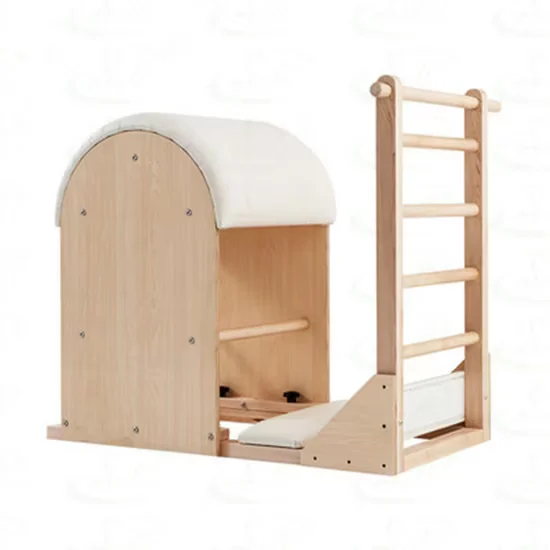
Fitness Equipment Maple Wood Pilates Bed Reformer for Yoga Studio
Acoustic Stability in Studio Environments — Solid maple wood frame construction with precision-machined carriage rails delivers whisper-quiet transitions during high-repetition class sequences.
Technical Specifications
| Parameter | Value |
|---|---|
| Designation | SRY-02 |
| Product Type | Pilates Reformer |
| Frame Material | Solid Maple Wood |
| Specification | 2460730680mm |
| Net Weight | 100kgs |
| Accessories Included | Long Box / Jump Board / Platform |
| Logo Customization | Available upon request |
| Target Demographic | Adult / Unisex |
| Origin | China |
| HS Code | 9506911900 |
| Production Capacity | 80 Pieces/Month |
| Warranty Time | 3 Years |
Application Suitability
| Deployment Scenario | Typical Use |
|---|---|
| Boutique Pilates studio | Group reformer classes with rapid accessory turnover between sessions |
| Yoga and movement studio | Cross-discipline flexibility training and deep stretching programming |
| Physical therapy and rehabilitation clinic | Controlled resistance protocols for post-injury recovery and joint mobilization |
| High-end residential home gym | Daily private practice with full accessory range for varied programming |
Why Studio Owners Discover Frame Flex Too Late
Solid maple construction eliminates the mid-year replacement cycle that plagues studios deploying residential-grade equipment.
When a boutique studio fills its schedule with back-to-back group classes, every spring-loaded repetition transmits force through the carriage rail and into the frame itself. Laminated wood frames and composite alternatives gradually develop micro-flex points under these repeated loading cycles. Within months, carriage movement becomes uneven, springs lose calibration consistency, and clients begin noticing the degradation in movement quality before instructors can articulate why [NEED_CITE: long-term fatigue characteristics of laminated versus solid hardwood in fitness applications]. The commercial Pilates reformer maple wood frame maintains dimensional stability through humidity fluctuations and thousands of spring-tension cycles, preventing the structural drift that forces costly equipment rotation.
Where This Reformer Fits in a Multi-Apparatus Studio Layout
The SRY-02 covers full-spectrum resistance programming from rehabilitation-level spring tension to advanced athletic conditioning loads. In a studio deploying multiple apparatus types, this commercial Pilates reformer maple wood unit complements Cadillac and chair equipment by providing the primary horizontal resistance plane for group class formats. The included jump board and platform attachments enable standing and plyometric sequences without requiring separate dedicated stations. Studios typically position reformers along perimeter walls with instructor sightlines across the carriage travel path, accommodating user heights across the adult range with carriage stop adjustments.
Continuous Class Scheduling and Studio Environment Requirements
A fully booked studio running four to six group sessions daily demands equipment that tolerates rapid user turnover without performance degradation. The solid wood frame absorbs and dissipates vibration differently than metal alternatives, reducing transmitted noise to adjacent treatment rooms or shared wall spaces [NEED_CITE: acoustic transmission characteristics of solid wood versus tubular steel in fitness environments]. Studios deploying on upper floors or above occupied commercial spaces benefit from this natural damping. Adequate spacing between units must account for long box attachment length and instructor circulation paths. Climate control becomes relevant—maple wood responds to humidity swings with dimensional changes that can affect carriage rail alignment if the studio lacks consistent environmental management.
Spring Resistance Calibration and Carriage Mechanics
The spring resistance system operates on progressive tension curves rather than fixed weight increments, requiring users to control both concentric and eccentric phases throughout the carriage travel range. Spring sets calibrated for commercial use maintain consistent pound ratings at full compression across thousands of cycles before requiring replacement [NEED_CITE: spring steel fatigue life under repeated extension cycles]. Carriage wheel composition and rail surface finish determine rolling friction characteristics—harder wheels reduce drag but transmit more vibration, while softer compounds increase smoothness at the cost of faster wear. The wheel-to-rail interface also generates the primary noise signature during transitions; precision-machined rails with sealed bearings minimize both acoustic output and long-term wear patterns that create dead spots in carriage travel.
The Cost of Overlooking Accessory Integration Design
Studios purchasing reformers without verifying attachment mechanisms face hidden workflow penalties during class turnover. Jump boards and platforms that require tools or multi-step locking sequences add transition time between sequences, compressing actual instruction time within a fixed class duration. Attachment points engineered for standing exercises must distribute load across sufficient frame surface area; concentrated stress points develop finish cracks and structural weakness over time. When accessory compatibility documentation is incomplete or absent, studios discover incompatibilities only when attempting to program advanced sequences mid-semester [NEED_CITE: accessory load distribution standards for commercial Pilates apparatus].
Why Studios Standardize on This Product Line
Equipment selection cascades through every operational decision: class programming, instructor training, maintenance scheduling, and client experience consistency. This product line addresses deployment friction points that emerge after installation—noise transmission to adjacent occupied spaces, carriage smoothness degradation under continuous class schedules, and accessory compatibility gaps that limit programming range. Studios receive 3D layout planning covering unit spacing, instructor sightlines, and airflow considerations specific to reformer studio environments. Full OEM customization extends beyond cosmetic branding to accommodate studio-specific accessory packages and finish requirements. The three-year warranty reflects component durability testing rather than arbitrary coverage periods, and technical support availability extends beyond initial commissioning.
Documentation & Test Records
- CE declaration of conformity for commercial fitness equipment market entry
- EN 957 test report covering structural integrity and safety requirements
- ISO 9001 certificate verifying manufacturing quality management systems
- Material grade documentation confirming solid maple wood species and sourcing
- Accessory load testing records for jump board and platform attachment points
- Assembly and commissioning guide with calibration procedures
Installation, Commissioning & Maintenance
- Position units with clearance for long box extension and instructor circulation paths on all sides
- Verify floor levelness before final placement; shim as needed to prevent carriage drift
- Conduct initial carriage rail inspection and wheel bearing test before client use
- Establish spring replacement tracking based on class volume and resistance levels used
- Implement rail cleaning protocol to remove dust accumulation affecting carriage smoothness
- Document accessory attachment and removal procedures for instructor onboarding
Requesting Deployment Guidance
Provide studio dimensions and planned unit count to receive 3D layout planning covering spacing, sightlines, and ventilation requirements. Specify daily class frequency and average session duration to confirm accessory durability matching. Indicate deployment floor level and adjacent space occupancy to address acoustic transmission considerations. Confirm target market for any regional compliance documentation requirements.
Frequently Asked Questions
Q: What distinguishes solid maple wood from engineered alternatives for commercial studio deployment?
A: Solid maple maintains structural rigidity under repeated spring loading cycles without developing flex points that plague laminated frames. The natural density provides vibration damping that reduces noise transmission to adjacent spaces. Engineered composites may meet initial specifications but degrade under continuous class schedules, requiring replacement within the first year of heavy use. Solid wood also tolerates refinishing to address surface wear without compromising structural integrity.
Q: How frequently should spring sets be replaced in a high-volume studio environment?
A: Spring replacement intervals depend on class frequency, resistance levels programmed, and user weight distribution. Springs lose calibration consistency gradually, creating uneven resistance curves that experienced practitioners detect before visual inspection reveals fatigue. Studios running multiple daily sessions typically establish replacement protocols based on cumulative usage hours rather than calendar time. Documenting spring set rotation across units helps predict failure patterns before they affect class quality.
Q: What maintenance protocols preserve carriage smoothness over extended operation?
A: Carriage rail surfaces accumulate dust and particulate matter that increases rolling friction and accelerates wheel bearing wear. Regular cleaning with appropriate solvents prevents buildup without damaging wood finishes or bearing seals. Wheel inspection should verify even wear patterns across all contact points; uneven wear indicates alignment issues requiring adjustment. Studios should establish cleaning frequency based on ambient dust levels and daily usage volume rather than fixed schedules.
Q: How does accessory storage affect class turnover efficiency?
A: Jump boards, platforms, and long boxes require accessible storage that permits rapid attachment and removal without interrupting class flow. Studios benefit from wall-mounted racks or dedicated shelving positioned within instructor reach but outside client circulation paths. Attachment mechanisms requiring tools or multiple steps add transition time that compresses instruction duration. Specifying tool-free quick-change accessories during procurement prevents workflow bottlenecks during peak scheduling periods.
Q: What spacing considerations apply when planning a multi-unit reformer studio layout?
A: Reformer spacing must accommodate full carriage travel, extended accessory length, and instructor circulation for hands-on cueing. Insufficient spacing forces compromises in programming range or creates safety hazards during standing exercises. Ceiling height becomes relevant when jump boards are programmed. Airflow planning addresses heat and humidity generated during continuous class operation, preventing environmental conditions that affect both wood dimensional stability and client comfort.