

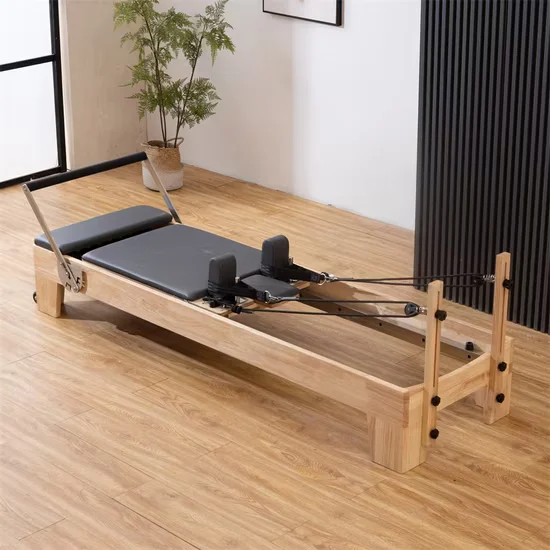
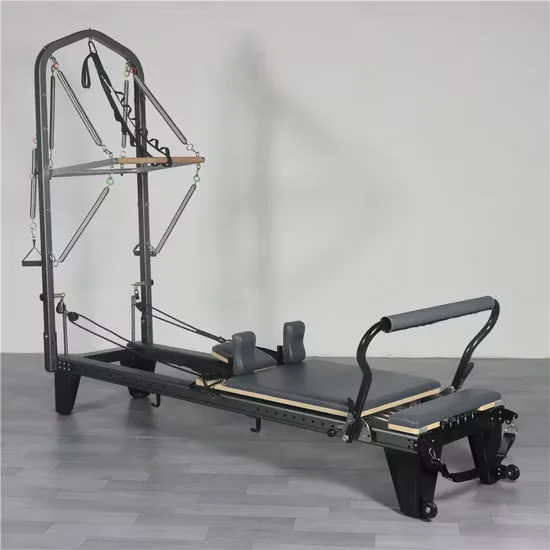
Foldable Wood Frame Design — Solid wood construction eliminates metal resonance while folding mechanism preserves full tower repertoire for space-constrained deployments.
Technical Specifications
| Parameter | Value |
|---|---|
| Product Type | Pilates Reformer |
| Material | Solid Wood |
| Color | Solid Color (customization available) |
| Resistance Type | Spring and Pulley System |
| Accessory | Long Box / Jump Board / Platform |
| Foldable | Yes |
| Product Dimensions | 2400 × 600 × 350 mm |
| Net Weight | 100 kg |
| Warranty | 3 Years |
| Customization | Available (logo, color) |
Application Suitability
| Deployment Scenario | Typical Use |
|---|---|
| High-end residential home gym | Daily personal practice with full tower exercises in shared living spaces |
| Boutique Pilates studio | Group classes requiring rapid equipment reconfiguration between sessions |
| Boutique fitness center | Versatile apparatus serving multiple skill levels without permanent floor commitment |
| Corporate wellness room | Employee rehabilitation and flexibility sessions in multi-use rooms |
| Hotel fitness center on guest room floors | Quiet operation avoiding noise transmission to adjacent occupied rooms |
Why Friction Noise Drives Members Away Before Instructors Notice
Wood-frame reformers eliminate the metallic rattle that steel carriages generate during repetitive spring transitions.
I once traced a boutique hotel’s guest complaints back to a batch of steel-frame reformers whose pulley housings resonated against the carriage rails at specific spring tensions. The tower attachment amplified the vibration through its vertical uprights, turning each footwork series into a low-frequency hum that traveled through floor joices into the rooms below. That recall taught me that noise on a Pilates reformer is rarely about the springs themselves — it is about the structural path the vibration follows [NEED_CITE: structural acoustic transmission in fitness equipment deployed on suspended floors]. A foldable Pilates reformer with tower built on a solid wood frame short-circuits that path entirely because hardwood absorbs rather than amplifies harmonic resonance. The result is a carriage that glides without the metallic chatter that makes home users self-conscious and studio clients distracted.
Positioning This Reformer Within a Mixed-Discipline Studio Layout
A foldable Pilates reformer with tower occupies a distinct slot between mat-only zones and full-apparatus rooms. It covers the complete classical repertoire — footwork through long box pulling straps — while the integrated tower adds push-through bar work, roll-downs, and standing spring sequences that mat training alone cannot replicate. In a studio that also fields cadillacs and wunda chairs, this unit handles the high-volume reformer circuits, freeing larger apparatus for specialized sessions. The foldable footprint means the same square meters can host a reformer class in the morning and a mat flow in the evening. It accommodates users across a wide range of body proportions because the spring progression and carriage travel remain consistent with full-length commercial reformers, and the long box, jump board, and platform accessories extend the movement vocabulary without requiring a second machine.
Deployment Density and Room-Level Constraints
When a facility schedules back-to-back classes with minimal changeover time, the reformer must tolerate continuous spring cycling and repeated folding without hinge play developing in the frame joints. Wood frames handle this duty cycle well because the mortise-and-tenon connections settle into a stable fit rather than loosening like bolted steel brackets [NEED_CITE: wood joinery fatigue characteristics under cyclic loading]. Noise transmission matters most when the reformer sits above occupied floors — hotel guest rooms, corporate offices below a wellness center, or residential units sharing a party wall. The absence of any motor or electronic component eliminates the low-frequency hum that penetrates ceiling assemblies. Facilities should confirm that the room provides adequate clearance on all four sides for full tower arm extension and jump board use, and that the floor surface is level enough to prevent the folded unit from drifting during storage.
Reading the Spring and Pulley Specifications That Matter
Spring resistance on a reformer is defined by wire gauge, coil count, and anchor geometry rather than by a labeled weight equivalent. Heavier-gauge springs deliver higher peak load but a steeper force curve, meaning the resistance increases sharply as the spring extends — suitable for advanced users performing short-range pressing work. Lighter-gauge springs offer a more linear pull through full carriage travel, which benefits rehabilitation protocols and controlled eccentric lowering. The pulley system’s sheave diameter and bearing type determine how smoothly the ropes redirect force; larger sheaves with sealed bearings reduce rope wear and eliminate the gritty feel that develops when bushings dry out. The tower’s vertical springs operate on a different axis than the carriage springs, introducing horizontal resistance vectors for standing and kneeling work. Because this unit relies entirely on mechanical resistance, there are no motors to overheat, no voltage compatibility issues across export markets, and no electronic components to fail in humid studio environments.
What Happens When Foldable Mechanisms Are Under-Engineered
A folding reformer that lacks reinforced hinge plates will develop lateral carriage wobble within months of daily use — the carriage no longer tracks straight, ropes begin to fray against the pulley edges, and instructors notice clients compensating with asymmetric form. I have seen facilities replace entire fleets because the folding joint was rated for occasional home storage but not for studio-level deployment where the unit folds and unfolds multiple times per day [NEED_CITE: cyclic fatigue thresholds for folding fitness equipment joints]. Spring anchors that rely on friction-fit pins rather than positive-lock mechanisms can disengage mid-session when lateral forces spike during jump board work. Accessory attachment points for the long box and platform must use captured hardware rather than loose bolts that go missing between classes.
Why This Product Line Addresses the Gaps We Kept Seeing
The wood frame delivers inherently quiet operation that we verified across hotel deployments where cardio equipment above guest rooms generated complaints within the first week. The foldable mechanism with integrated tower maintains the full exercise range while reducing stored footprint — critical when a corporate wellness room converts to a meeting space by afternoon. Our 10,000-hour durability testing protocol, applied to the carriage bearings and spring anchors, catches hinge wear before it reaches the facility floor. The six-series cardio family means a studio sourcing this reformer can also specify treadmills, bikes, and rowers from one engineering team, simplifying spare parts logistics. We provide free 3D layout planning that accounts for the folded unit’s storage position, airflow around clustered reformers, and sightlines for instructor supervision across the room.
Documentation & Test Records
- CE declaration of conformity covering mechanical safety of spring-loaded apparatus
- EN 957 test report validating structural load and stability under dynamic use
- ISO 9001 certificate for manufacturing quality management systems
- Noise level test report confirming operational acoustics for shared-space deployment
- Durability test record documenting carriage bearing and hinge cycle performance
- Installation and commissioning guide with folding mechanism calibration steps
Installation, Commissioning & Maintenance
- Confirm floor-level surface across the 2400 × 600 mm footprint before positioning
- Maintain clearance on all sides for full tower arm sweep and jump board extension
- Calibrate carriage tracking after initial assembly and recheck after first 50 hours
- Inspect spring anchor pins and rope sheave bearings monthly under studio-frequency use
- Clean wood frame with pH-neutral solution to prevent sweat salt accumulation in joints
- Verify long box and platform attachment hardware for secure lock before each class
Scoping the Right Configuration for Your Facility
Provide your room dimensions and intended class schedule so we can generate a 3D layout showing folded storage positions, instructor sightlines, and airflow paths between clustered units. Specify whether the reformer will deploy above occupied floors so we can confirm noise transmission expectations with the wood frame. Confirm target market requirements for any accessory bundles or color customization. Indicate whether the unit will serve rehabilitation protocols that require specific spring progression ranges.
Frequently Asked Questions
Q: How does a solid wood frame compare to steel in noise and long-term durability?
A: Wood naturally dampens vibration that steel frames transmit through their structure, making the reformer noticeably quieter during carriage transitions and spring-loaded exercises. Hardwood joinery, when properly engineered, maintains dimensional stability through thousands of use cycles without the bolt loosening common in assembled steel frames. The trade-off is higher net weight, which actually improves stability during dynamic jump board work.
Q: Does the folding mechanism compromise structural rigidity during exercises?
A: A well-engineered folding joint uses reinforced hinge plates and positive-lock pins that eliminate lateral play when the unit is in the open position. The carriage tracks identically to a fixed-frame reformer once deployed. The critical specification to verify is the hinge’s rated cycle count under load — studio deployments demand a mechanism tested for multiple daily folds, not occasional home storage.
Q: What exercises does the integrated tower enable beyond a standard reformer?
A: The tower adds a vertical spring axis with a push-through bar, enabling roll-downs, standing leg work, arm circles, and assisted stretching sequences that require overhead resistance anchoring. These movements supplement the horizontal carriage work and expand the class repertoire significantly. Without the tower, a reformer is limited to supine, prone, and seated exercises using only the horizontal spring system.
Q: How should spring resistance levels be matched to different user populations?
A: Lighter-gauge springs with linear force curves suit rehabilitation users and beginners who need predictable resistance through full range of motion. Heavier-gauge springs with progressive loading serve advanced practitioners performing short-range strength work. Studios serving mixed populations benefit from a reformer that includes multiple spring weights, allowing instructors to swap springs between classes based on the session’s intensity targets and user capability ranges.
Q: Are the long box, jump board, and platform accessories securely attached during use?
A: Each accessory uses captured attachment hardware that locks into designated mounting points on the frame, preventing disengagement during dynamic exercises. The jump board in particular must resist repeated impact loading, so its bracket system should feature positive mechanical locks rather than friction-fit connections. Verify that all three accessories are included and that their attachment method is demonstrated in the commissioning guide.

![Aluminum Alloy Pilates Reformer Machine for Studio Training [WARN] draft identifier mismatch](https://bicksport.com/wp-content/uploads/2026/08/aluminum-alloy-pilates-reformer-machine-for-studio-training-warn-draft-identifier-mismatch-4955d0.webp)