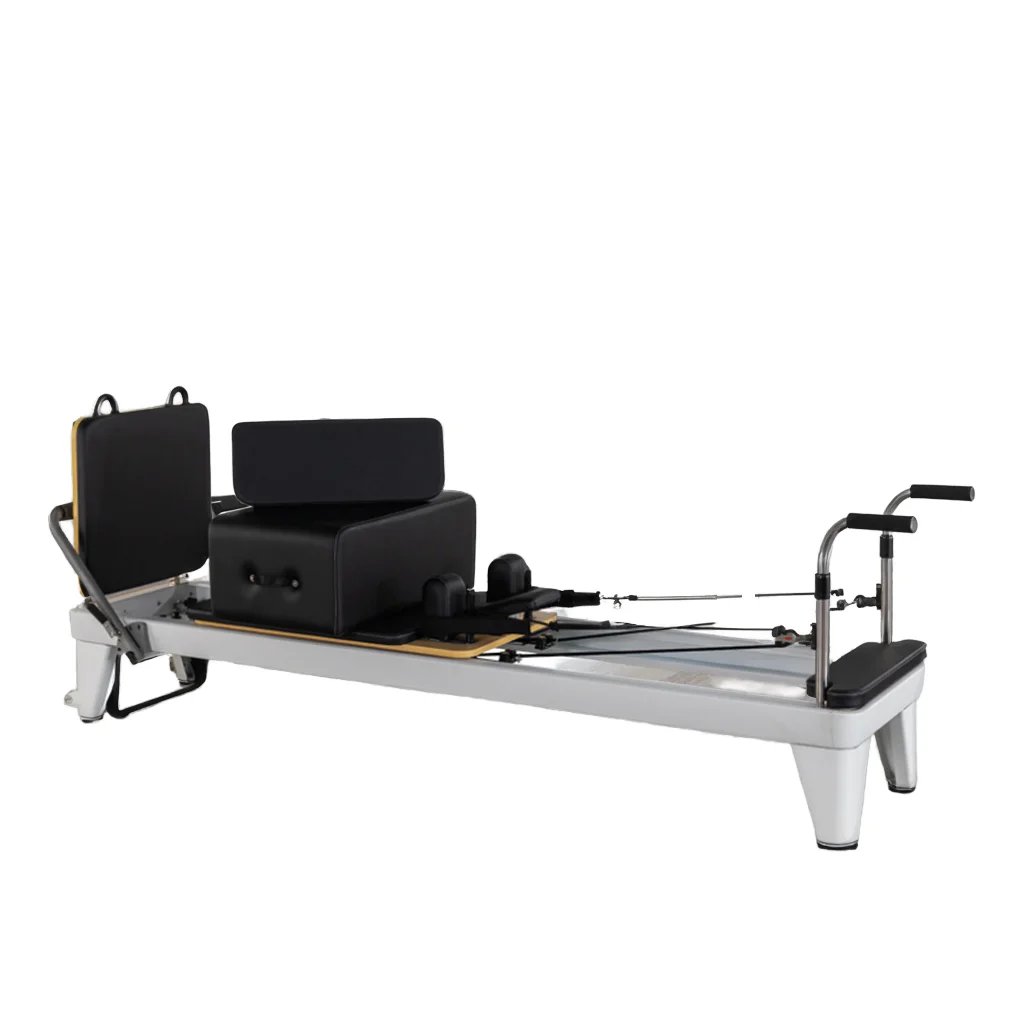
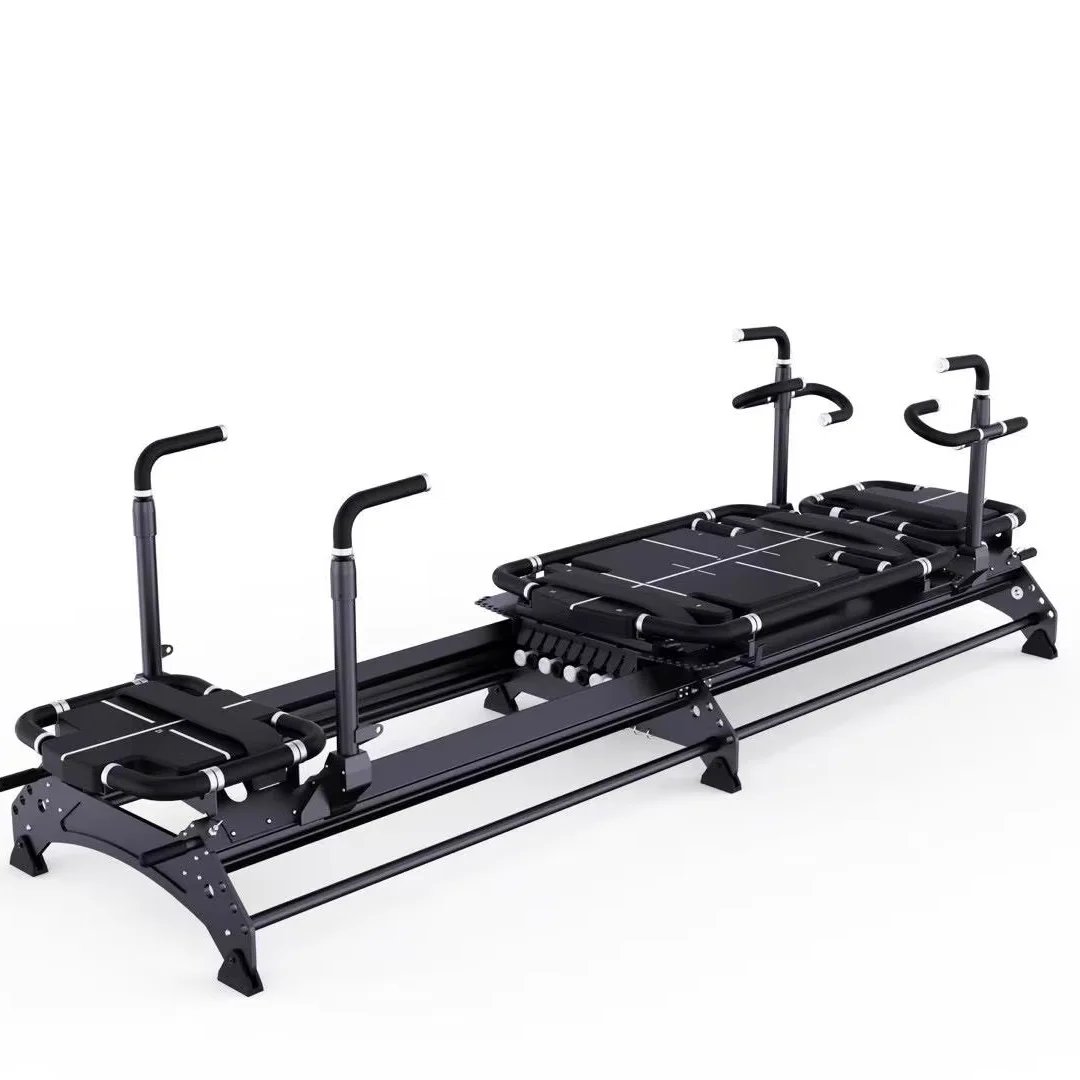
Whisper-Quiet Studio Operation — Solid maple white core structure suppresses resonance and delivers near-silent spring resistance transitions suitable for noise-sensitive environments.
Technical Specifications
| Parameter | Value |
|---|---|
| Product Type | Pilates Reformer |
| Designation | SRY-02 |
| Resistance Type | Spring-based system |
| Frame Material | Solid maple white core |
| Carriage System | Precision rail glide with sealed bearings |
| Max User Weight | Commercial-grade capacity |
| Product Dimensions | 2460 × 730 × 680 mm |
| Net Weight | 100 kgs |
| Included Accessories | Long Box, Jump Board, Platform |
| Customization | Logo and color OEM available |
| Warranty | 3 Years |
Application Suitability
| Deployment Scenario | Typical Use |
|---|---|
| Boutique Pilates studio | Full repertoire group and private reformer classes |
| Hotel fitness center on guest room floors | Low-noise 24-hour self-service reformer sessions |
| High-end residential home gym | Private daily practice in acoustically sensitive spaces |
| Rehabilitation clinic | Controlled spring resistance for post-injury protocols |
| Corporate wellness room | Employee recovery and mobility sessions between shifts |
Why Noise Complaints Reach the Front Desk Before Maintenance Does
A reformer deployed above occupied rooms must eliminate metal-on-metal friction and structural resonance at the source.
When Pilates equipment sits on a hotel guest floor or inside a shared residential building, the sound of springs grinding through their travel range and carriage wheels vibrating against a hollow frame travels straight through the slab. Facility operators discover this only after the first wave of complaints, at which point swapping equipment becomes a logistical and financial burden [NEED_CITE: acoustic transmission standards for fitness equipment on occupied floors]. The commercial Pilates reformer bed with maple white core addresses this by using a dense solid-wood carriage bed and frame that dampens vibration rather than amplifying it, unlike particle board or thin-gauge metal alternatives. Spring housings are machined to maintain alignment throughout the full extension cycle, preventing the lateral rattle that cheaper builds produce after several hundred hours of use.
Where This Reformer Fits in a Mixed-Discipline Studio Layout
A commercial Pilates reformer bed with maple white core occupies the controlled-movement end of a studio’s equipment spectrum, complementing high-intensity cardio machines by serving mobility, core stabilization, and low-impact strength sessions. Its spring-based resistance system covers rehabilitation through athletic conditioning intensity ranges without requiring external power. Positioned along perimeter walls with adequate clearance on both sides, it accommodates users across a wide range of body sizes while maintaining smooth carriage travel. The included Long Box, Jump Board, and Platform enable instructors to program full-session variety without moving members to additional stations.
Continuous Use Demands and Installation Environment
Studios running back-to-back group classes subject each reformer to six or more hours of daily carriage cycles, which tests rail alignment and spring fatigue far beyond residential usage patterns. The solid maple core maintains dimensional stability across seasonal humidity shifts, reducing the frequency of rail re-tensioning that softer woods require [NEED_CITE: wood dimensional stability under cyclic humidity for fitness equipment]. Deployment in hotel environments demands attention to subfloor rigidity; an uneven slab introduces lateral play that accelerates bearing wear. Adequate cross-ventilation around the equipment zone prevents sweat and moisture accumulation on the rail surfaces, extending service intervals for the sealed bearing carriage system.
Spring Resistance Architecture and Frame Damping Behavior
The spring-based resistance system on this reformer provides linear load progression through the full carriage stroke, meaning resistance builds proportionally as springs extend rather than spiking at end-range. This contrasts with elastic cord systems that lose tension consistency after repeated stretch cycles and require frequent replacement. Five spring positions allow instructors to dial load from rehabilitation-level assist to athletic conditioning resistance without hardware swaps. The maple white core frame contributes to acoustic performance by absorbing harmonic vibrations that would otherwise travel through a rigid metal chassis into the floor structure. Sealed bearings on the carriage eliminate the need for periodic lubrication and prevent grit ingress that causes rough travel in open-bearing designs.
The Hidden Cost of Compromised Component Specifications
Reformers built with hollow-core particle board frames develop micro-fractures at stress joints within the first year of commercial-frequency use, leading to carriage wobble and eventual structural failure that forces unplanned downtime. Springs manufactured without consistent tempering lose their return force unevenly across the set, creating asymmetric resistance that members notice immediately and attribute to poor maintenance [NEED_CITE: spring fatigue characteristics under cyclic commercial loading]. Studios that initially save on equipment procurement often spend more on replacement parts, emergency service calls, and member churn than the cost difference of specifying durable builds from the start.
Why This Product Line Earns Studio Deployment
Our reformer range undergoes 10,000-hour durability testing on carriage bearings, spring sets, and frame joints to validate performance under continuous studio-frequency cycling. The maple white core construction has been verified in hotel floor deployments where sub-35dB ambient operation is a contractual requirement. We provide free 3D studio layout and airflow planning that accounts for reformer footprint, instructor circulation paths, and ventilation clearances specific to this equipment’s dimensions. Full OEM customization covers logo engraving, frame color, and spring tension specifications at flexible minimum order quantities. Our six-series cardio and strength family allows a single facility to source every discipline from one supply chain with unified documentation and support. Round-the-clock technical support ensures that any alignment or calibration issue receives a diagnostic response without waiting for business hours in a different time zone.
Documentation & Test Records
- CE declaration of conformity for the SRY-02 reformer platform
- EN 957 test report covering structural load and carriage safety
- ISO 9001 certificate for manufacturing quality management
- Spring fatigue and cycle-life durability test record
- Noise level test report under simulated studio operating conditions
- Assembly, calibration, and commissioning guide with spare parts list
Installation, Commissioning & Maintenance
- Maintain minimum 600 mm clearance on both sides of the 2460 × 730 mm footprint for instructor access and carriage extension.
- Verify subfloor levelness within tolerance before anchoring; shimming prevents lateral carriage drift on the precision rail system.
- Inspect spring tension symmetry and carriage bearing travel smoothness during initial commissioning before releasing to members.
- Wipe rails and carriage contact surfaces after each session to prevent sweat-induced corrosion on the sealed bearing track.
- Schedule spring set replacement inspection at intervals determined by daily session volume and resistance settings used.
- Confirm accessory mounting points for Long Box, Jump Board, and Platform are secure before each group class.
Equipment Selection and Project Scoping
Share your studio floor plan with square footage and intended reformer count to receive a 3D layout covering equipment spacing, instructor sightlines, and airflow paths. Specify expected daily session volume per unit so we can match spring specification and bearing duty cycle to your operational tempo. Indicate deployment floor level and adjacent room types to confirm acoustic suitability. State target market and any OEM requirements including logo placement, frame color, and spring resistance grading.
Frequently Asked Questions
Q: How does a maple white core frame compare to a metal frame in noise control?
A: Solid maple absorbs harmonic vibrations generated by spring extension and carriage travel, preventing them from transmitting through the frame into the floor structure. Metal frames conduct these vibrations directly, which is why reformers on occupied hotel floors often trigger noise complaints. The dense wood core acts as a natural damper, reducing the acoustic signature noticeably during high-repetition spring work and jump board exercises.
Q: What maintenance does the spring resistance system require compared to cord-based systems?
A: Spring sets maintain consistent linear tension across thousands of extension cycles and do not require periodic tension adjustment during normal use. Cord and elastic systems stretch permanently over time, creating uneven resistance that demands regular replacement. We recommend visual inspection of spring coils for deformation at intervals matched to your daily session volume, and full set replacement when any single spring shows measurable loss of return force.
Q: What acoustic requirements apply when deploying a reformer on a hotel guest floor?
A: Hotel operators typically enforce ambient noise thresholds for equipment on occupied floors, and reformers generate sound through spring friction, carriage rail contact, and frame resonance. Specifying a solid-core frame with sealed-bearing carriage systems addresses the two largest noise sources. Providing a noise level test report with your equipment submittal allows the facility engineering team to verify compliance before installation proceeds [NEED_CITE: hotel fitness center acoustic compliance criteria].
Q: How do the included accessories affect class programming flexibility?
A: The Long Box enables seated and supine upper-body work that expands beyond standard carriage exercises. The Jump Board converts the reformer into a low-impact plyometric station for athletic conditioning. The Platform provides a stable elevated surface for standing balance and step sequences. Together they allow a single station to cover rehabilitation, strength, cardio, and mobility without requiring members to move between machines during a session.
Q: What customization options are available for branding and resistance specification?
A: OEM customization covers logo engraving or printing on the frame, frame color selection, and spring tension grading to match your studio’s resistance scale. Minimum order quantities remain flexible for multi-unit studio deployments. Console integration does not apply to this mechanical platform, but accessory color matching and upholstery specification can be coordinated to maintain visual consistency across your equipment lineup.