
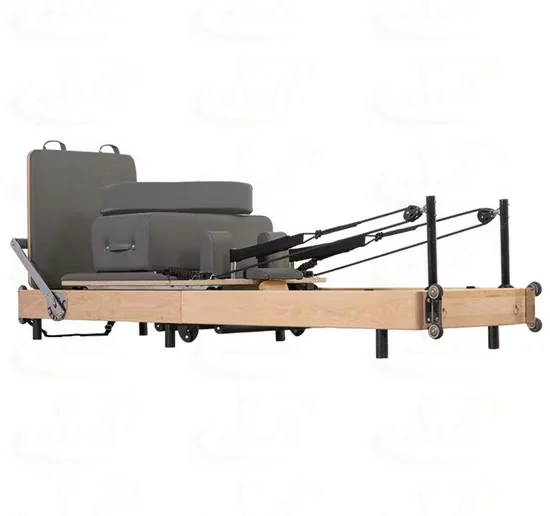
Quiet Carriage Operation — Precision pulley and solid wood frame minimize operational sound for shared spaces and boutique studios.
Technical Specifications
| Parameter | Value |
|---|---|
| Product Type | Pilates Reformer |
| Model NO. | SRY-20B |
| Frame Material | Solid Wood |
| Foldable | Yes |
| Specification | 2400600350mm |
| Net Weight | 100kgs |
| Accessory | Long Box / Jump Board / Platform |
| Color | Solid Color |
| Age | Adult |
| Gender | Unisex |
| Logo | Customized Is Allowed |
| Warranty Time | 3 Years |
| Origin | China |
| Production Capacity | 80 Pieces/Month |
Application Suitability
| Deployment Scenario | Typical Use |
|---|---|
| Boutique Pilates studio on upper floors | Group reformer classes requiring quiet, space-efficient equipment between sessions |
| High-end residential home gym | Daily personal practice where aesthetics and noise control are priorities |
| Rehabilitation center therapy room | Low-impact therapeutic exercises with versatile accessory configurations |
| Hotel wellness suite | Guest-accessible Pilates sessions in sound-sensitive hospitality environments |
| Corporate wellness room | Employee midday mobility and core sessions in limited-floor-space layouts |
Why Vibration Complaints Surface Before Equipment Failure Does
Solid wood construction absorbs micro-vibrations that metal frames transmit to adjacent structures.
When a boutique studio installs reformers on a floor shared with offices or residences, the carriage movement and spring tension releases generate low-frequency pulses through the frame into the subfloor. Metal-frame models tend to transmit these pulses directly, while a wood foldable Pilates reformer bed commercial facility operators choose can dampen much of that energy before it reaches the structure. I have seen studios replace an entire row of reformers after neighboring tenants escalated complaints [NEED_CITE: structural vibration transmission in multi-tenant fitness deployments]. The issue is not the equipment breaking — it is the building responding to frequencies the equipment was never designed to contain.
Reformer Positioning Within a Mixed-Discipline Studio Layout
This unit covers full-range Pilates repertoire from footwork through advanced spinal articulation, occupying the intermediate intensity band between mat work and apparatus-heavy circuits. In a studio layout, it pairs naturally with Cadillac or Wunda Chair stations, giving instructors a progression path without requiring members to cross the floor. The wood foldable Pilates reformer bed commercial studios deploy fits a moderate-density class configuration where each unit serves multiple sessions per day. The frame accommodates adult users across a broad weight range, and the long box, jump board, and platform accessories support exercise variety without requiring additional apparatus.
Continuous Session Scheduling and Floor-Level Deployment Considerations
A reformer running back-to-back classes six days a week demands pulley and carriage components that maintain smooth travel under repetitive loading. In upper-floor deployments, the solid wood frame’s vibration-dampening properties become critical — studios on ground floors tolerate more transmission, but second-floor installations above occupied spaces need every decibel of isolation the frame can provide [NEED_CITE: acoustic isolation requirements for upper-floor fitness studios]. Adequate ventilation around the unit prevents moisture buildup that can affect wood stability over time. Ground-level installations benefit from rubber isolation pads between the reformer feet and hard flooring to further reduce structure-borne transmission.
Pulley Mechanics and Frame Rigidity Under Dynamic Loading
The carriage system relies on precision pulleys and a guided rail to deliver smooth resistance transitions throughout each repetition. Solid wood framing provides inherent rigidity that limits lateral flex during asymmetric movements like single-leg footwork or unilateral arm pulls. Unlike hollow metal tubing that can resonate at specific frequencies, dense wood disperses vibrational energy across its grain structure, which contributes to the quieter operational profile. The foldable mechanism must maintain frame alignment after repeated folding and unfolding cycles — a tolerance issue that directly affects carriage tracking and pulley linearity. Accessory mounting points for the long box, jump board, and platform require reinforced junctions where concentrated loads transfer into the wood structure.
The Hidden Cost of Specifying Below Commercial Thresholds
Reformers built to home-use tolerances show up in studios regularly, and the failure pattern is consistent: pulley bearings develop play within months, carriage rails lose parallelism, and the frame joints begin to creak under loads they were never rated for. Studios end up pulling units from rotation for warranty work while members book elsewhere [NEED_CITE: equipment downtime impact on studio member retention]. The initial savings disappear quickly when replacement frequency doubles and instructor complaints about inconsistent carriage feel accumulate. Floor-level vibration from under-specified frames also triggers lease disputes in multi-tenant buildings, forcing relocation or wholesale equipment swaps.
What This Product Line Brings to the Studio Floor
Sub-35dB operational targets verified in hotel deployments set the noise benchmark this reformer is designed to meet, with solid wood construction serving as the primary vibration management strategy. The 10,000-hour durability testing protocol applied across our commercial range extends to pulley and carriage components on this unit. OEM customization covers logo application and finish selection to match studio branding. The foldable design factors into 3D studio layout planning, allowing operators to reconfigure floor space between class formats or clear the area for non-apparatus sessions. Full six-series cardio family availability means facilities source complementary equipment from a single production line, and 24/7 technical support covers commissioning through ongoing maintenance.
Documentation & Test Records
- CE declaration of conformity for Pilates reformer classification
- EN 957 test report covering structural load and stability requirements
- ISO 9001 certificate for manufacturing quality management
- Noise level test report verifying operational sound under dynamic loading
- Durability test record for pulley and carriage cycle performance
- Wood material grade and treatment certification for moisture resistance
Installation, Commissioning & Maintenance
- Confirm 2400600350mm footprint with clearance for full carriage travel and accessory attachment
- Level the solid wood frame on isolation pads to prevent uneven rail loading and carriage drift
- Inspect pulley alignment and carriage tracking after initial 50-hour break-in period
- Apply wood-safe lubricant to carriage rails at intervals defined by session volume and ambient humidity
- Verify foldable hinge mechanism torque settings quarterly to maintain frame parallelism
- Clean wood surfaces with pH-neutral agents to prevent sweat residue from degrading finish
Scheduling an Equipment Assessment
Provide your studio floor area and planned reformer count so we can generate a 3D layout showing unit spacing, accessory storage zones, and member flow paths. Specify whether units will be positioned above occupied spaces so we can confirm isolation requirements and recommend appropriate floor treatments. Indicate your session volume per unit per day to verify pulley and carriage duty-cycle alignment. Note any accessory configuration preferences beyond the included long box, jump board, and platform to ensure mounting compatibility.
Frequently Asked Questions
Q: What wood materials are used, and how do they impact durability and noise?
A: The frame uses solid wood selected for density and grain consistency, which provides inherent vibration dampening compared to metal alternatives. Proper moisture treatment during manufacturing ensures dimensional stability across varying humidity levels in studio environments. The wood’s natural resonance characteristics help absorb carriage-generated pulses before they reach the floor structure, contributing to quieter operation in shared buildings.
Q: How does the foldable design affect stability and load capacity?
A: The folding mechanism is engineered with reinforced hinge junctions that maintain frame parallelism through repeated cycles. When deployed in the open position, the structural rigidity matches that of fixed-frame configurations within normal operating loads. The foldable feature allows studios to reconfigure floor space between class types or clear areas for mat-based sessions without requiring permanent equipment removal.
Q: Can the pulley system be customized for different resistance levels?
A: The pulley and carriage system delivers smooth resistance transitions suitable for the full Pilates repertoire. Resistance adjustment occurs through spring configuration changes rather than pulley modification, giving instructors granular control over loading without altering the mechanical system. The standard setup accommodates both rehabilitation-level gentle resistance and advanced practitioner loading requirements.
Q: What accessories are included, and how do they expand exercise options?
A: The unit ships with a long box for seated and supine exercises, a jump board for plyometric cardiovascular work, and a platform for elevated positioning variations. These three accessories cover a substantial portion of the classical and contemporary Pilates repertoire, allowing a single reformer station to serve diverse class formats without requiring instructors to move members between apparatus types.
Q: How does this reformer compare to metal-frame models in terms of noise and aesthetics?
A: Wood frames naturally dampen vibration across a broader frequency range than hollow metal tubing, which tends to resonate at specific harmonics. This translates to less structure-borne sound reaching adjacent rooms in multi-tenant deployments. Aesthetically, the solid wood finish integrates into boutique studio interiors and residential settings where industrial metal frames may conflict with the design language of the surrounding space.
![Commercial Foldable Aluminum Pilates Reformer Bed for Home Studio [WARN] draft identifier mismatch](https://bicksport.com/wp-content/uploads/2026/08/commercial-foldable-aluminum-pilates-reformer-bed-for-home-studio-warn-draft-identifier-mismatch-a7cd88.webp)


