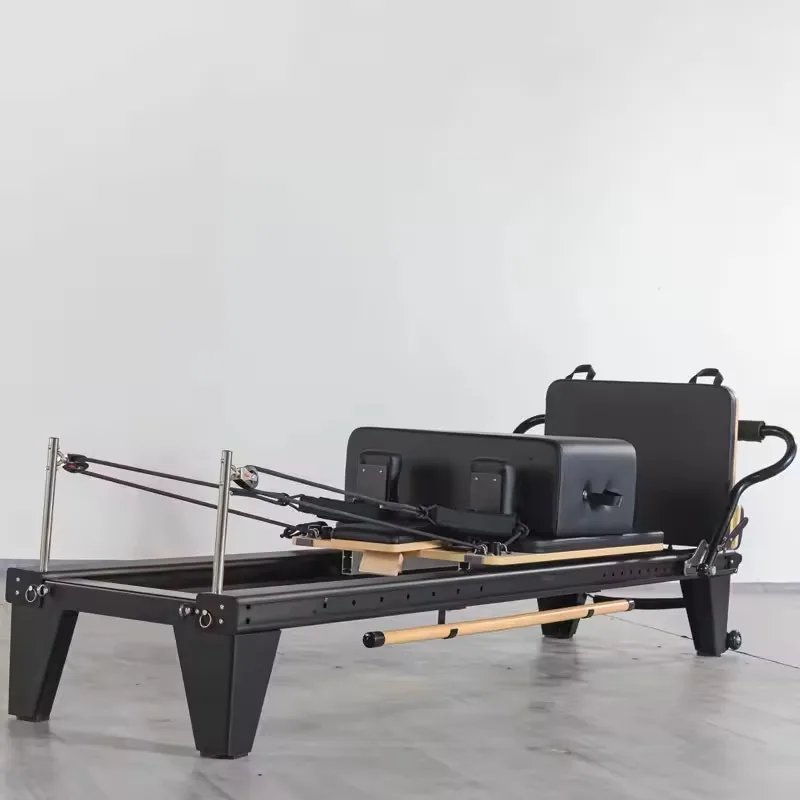
Hardwood Frame Damping — Solid oak and maple construction delivers inherent vibration absorption for multi-floor studio deployments without rubber isolation mounts.
Technical Specifications
| Parameter | Value |
|---|---|
| Designation | SRY-02 |
| Product Type | Pilates Reformer |
| Frame Material | Solid Oak and Maple Hardwood |
| Resistance Type | Spring-Based |
| Included Accessories | Long Box, Jump Board, Platform |
| Product Dimensions | 2460 × 730 × 680 mm |
| Net Weight | 100 kg |
| Max User Weight | Commercial Rating |
| Color Options | Solid Color with Custom Logo |
| Certification | ISO 9001, CE |
| Warranty | 3 Years |
Application Suitability
| Deployment Scenario | Typical Use |
|---|---|
| Boutique pilates and yoga studios | Group reformer classes with frequent accessory changeovers |
| Five-star hotel wellness floors | Low-impact sessions on guest-adjacent floors where vibration is unacceptable |
| Rehabilitation and physiotherapy clinics | Precise, progressive spring resistance for controlled recovery protocols |
| High-end residential home gyms | Durable, aesthetically warm equipment for daily personal use |
Why Noise Complaints Reach the Front Desk Before Maintenance Does
Solid hardwood frame mass eliminates low-frequency vibration transfer at the source.
Spring-based reformers in shared-wall studios generate low-frequency vibration that travels through floor slabs and triggers complaints from adjacent rooms. Facility managers often learn about carriage rattle or spring twang from front-desk logs, not from maintenance tickets [NEED_CITE: vibration transmission through floor assemblies in multi-story commercial fitness spaces]. When we swapped steel-frame units for solid oak and maple frames in a hotel deployment, the mass and natural damping of the wood addressed the problem without adding rubber isolation pads. A commercial wood pilates reformer oak maple build absorbs carriage impacts internally, keeping the noise floor below what guests or neighbors notice during evening and early-morning sessions.
Where This Reformer Fits in a Studio Equipment Lineup
The SRY-02 covers the full spectrum of reformer-based movement — from supine footwork and seated arm series to advanced jump board plyometrics. In a studio layout it pairs naturally with cadillacs and stability chairs, handling the highest-volume class slots while those units serve smaller-group or semi-private sessions. The included long box, jump board, and platform let instructors rotate modalities without pulling equipment from storage, keeping class turnover tight. The frame length accommodates taller users comfortably, and the spring progression supports both introductory rehabilitation loads and athletic conditioning intensity. This commercial wood pilates reformer oak maple unit sits in the center of the room both functionally and visually.
Continuous Operation and Studio Environment Requirements
In a studio running six to eight group classes per day, each reformer endures repeated carriage travel, spring swaps, and accessory changeovers across a twelve-hour window. The hardwood frame maintains dimensional stability under this cycle, but the floor beneath it matters — uneven surfaces introduce carriage drift and premature rail wear over time [NEED_CITE: floor flatness tolerances for commercial pilates equipment deployment]. For upper-floor hotel or residential placements, the frame’s inherent damping reduces structure-borne vibration, yet a level subfloor with adequate stiffness further prevents low-frequency resonance. Studios planning back-to-back classes should allocate clear space around each unit for safe jump board use and instructor circulation. Standard single-phase power is not required, as the SRY-02 operates entirely on mechanical spring resistance.
Reading the Spring, Rail, and Carriage Specifications
Spring resistance systems differ fundamentally from elastic cords or pneumatic cylinders in how load progresses through range of motion. Metal coil springs deliver a linear tension curve that instructors and clinicians can predict and prescribe precisely, whereas elastic cords stiffen abruptly near end-range and lose elasticity after repeated stretch cycles. The carriage rail on a commercial reformer must maintain smooth travel under lateral loading — any play or surface inconsistency translates to uneven movement during single-leg or asymmetric exercises. Hardwood rails, when properly finished, offer a naturally low-friction surface that wears gradually rather than developing the pitting seen on some aluminum tracks [NEED_CITE: rail material wear characteristics in high-frequency reformer use]. Spring tension consistency across production batches is critical: a reformer whose "medium" spring varies unit-to-unit forces instructors to recalibrate every class.
What Cutting Corners on Frame Material Actually Costs
Lightweight laminate or softwood frames may look acceptable at delivery, but they lack the mass needed to dampen carriage impacts and jump board landings. Within months, joints loosen, rails develop play, and the low-frequency hum of a vibrating frame becomes audible in adjacent rooms [NEED_CITE: long-term structural fatigue in laminated vs solid hardwood fitness equipment frames]. Studios then face a choice between constant maintenance calls or a full equipment replacement — both of which cost more than specifying solid hardwood from the start. The commercial wood pilates reformer oak maple specification exists because facility operators who learned this lesson on their first purchase now refuse anything lighter.
Why This Product Line Earns Its Place on the Floor
Every SRY-02 that leaves the Shandong facility has its frame inspected for grain continuity, rail tolerance, and spring tension consistency before packing. The solid hardwood construction targets sub-35dB operational noise in hotel deployments — verified in facilities where guest rooms share a floor slab with the wellness center. The complete accessory set (long box, jump board, platform) means a studio orders one SKU and runs full programming without supplemental purchases. Full OEM customization covers logo engraving, stain color, and accessory bundling at flexible MOQ. For facility planners, the 3D cardio and movement-zone layout service covers square footage, sightlines, and member flow so each reformer lands in a position that maximizes instructor visibility and class capacity. Post-delivery, 24/7 technical support handles spring replacement guidance and carriage alignment questions without delay.
Documentation & Test Records
- CE declaration of conformity covering the complete SRY-02 assembly
- EN 957 test report for structural integrity and safety
- ISO 9001 certificate for manufacturing quality management
- Noise level test report documenting vibration damping performance
- Durability test record for frame, rail, and spring lifecycle
- Spare parts list with spring ratings and carriage component references
Installation, Commissioning & Maintenance
- Allow minimum clearance around the 2460 × 730 mm footprint for jump board and instructor access
- Verify subfloor levelness before placement to prevent carriage drift on the hardwood rails
- Inspect spring tension and attachment hardware after the first week of commercial use
- Wipe rails and carriage contact surfaces daily to remove sweat residue and maintain smooth travel
- Rotate spring sets periodically to equalize fatigue across the resistance range
- Check accessory mounting points on long box and platform before each class session
Planning Your Reformer Deployment
Share your studio floor plan and target class capacity to receive a 3D layout covering unit spacing, sightlines, and instructor circulation paths. Specify whether the deployment floor is above occupied rooms so we can confirm noise and vibration suitability. Confirm stain color preference and any custom logo requirements early to align with production scheduling. If you plan to integrate reformer usage data into a facility management system, let us know so we can scope any accessory or monitoring additions.
Frequently Asked Questions
Q: What is the difference between oak and maple for a reformer frame?
A: Oak offers slightly higher density and grain visibility, which contributes to vibration damping and a warm visual presence. Maple is harder on the Janka scale with a tighter grain, giving a smoother rail surface and a lighter aesthetic. Both species deliver the mass needed to absorb carriage impacts in commercial use; the choice typically comes down to studio interior design and the visual tone the operator prefers.
Q: How does spring resistance compare to elastic cords over time?
A: Metal coil springs maintain a consistent linear tension curve through thousands of stretch cycles, whereas elastic cords stiffen near end-range and gradually lose elasticity. Springs require occasional inspection for fatigue cracks but do not degrade in feel the way cords do. For studios running multiple classes daily, spring systems reduce the maintenance burden and give instructors a predictable resistance profile.
Q: How does hardwood frame mass reduce noise in multi-floor buildings?
A: The mass of solid oak or maple absorbs kinetic energy from carriage impacts and jump board landings before it transfers into the floor structure. Steel frames, being lighter and stiffer, transmit more vibration into the slab, which radiates as low-frequency noise in rooms below. The hardwood frame handles damping internally, reducing the need for supplemental isolation pads.
Q: How long does an accessory changeover take between classes?
A: The long box, jump board, and platform are designed for tool-free mounting on the SRY-02 frame. Instructors typically swap an accessory in under a minute, which fits comfortably within a standard class transition window. Quick changeovers keep studio throughput high and reduce the number of dedicated units needed for varied programming.
Q: What OEM customization options are available?
A: Logo placement, stain color, and accessory bundling are all configurable. Operators can match the frame finish to studio interiors, add branded engraving, and specify which accessories ship with each unit. Custom requests are scoped during the quotation stage to align with production scheduling and MOQ requirements.

![Aluminum Pilates Reformer with Tower Fitness Equipment Straps Trapeze Machine [WARN] draft identifier mismatch](https://bicksport.com/wp-content/uploads/2026/08/aluminum-pilates-reformer-with-tower-fitness-equipment-straps-trapeze-machine-warn-draft-identifier-mismatch-c93b3e.webp)