

Solid-Frame Vibration Control — Wood construction inherently dampens carriage resonance, reducing structure-borne noise transmission to adjacent and lower-floor occupied spaces.
Technical Specifications
| Parameter | Value |
|---|---|
| Product Type | Pilates Reformer |
| Designation | SRY-20B |
| Material | Wood |
| Color | Solid Color |
| Accessory | Long Box / Jump Board / Platform |
| Specification | 2400600350mm |
| Net Weight | 100kgs |
| Foldable | Yes |
| Warranty | 3 Years |
| Age Group | Adult |
| Gender | Unisex |
| Customization | Logo, Color, UI available |
Application Suitability
| Deployment Scenario | Typical Use |
|---|---|
| Boutique Pilates studio in shared-wall or multi-floor buildings | Low-noise group reformer classes and private sessions |
| Commercial fitness center expanding mind-body programming | Recovery, flexibility, and core conditioning zones |
| High-end residential wellness suite | Private reformer training within a compact home gym footprint |
| Corporate wellness room | Employee flexibility and posture recovery between shifts |
| Sports performance training center | Athlete rehabilitation and controlled resistance conditioning |
Why Structure-Borne Vibration Travels Further Than You Think
Wood-frame construction absorbs carriage vibration before it reaches the floor slab.
Metal-frame reformers transmit every carriage pulse through rigid joints directly into concrete. In a boutique studio located above a retail space or residential floor, that vibration becomes a persistent complaint [NEED_CITE: structure-borne noise transmission through concrete floor slabs]. Facility operators often discover the problem only after tenants file formal noise reports. A commercial foldable Pilates reformer wood studio equipment built from solid timber inherently dampens those frequencies at the frame level, preventing the resonance that rigid steel tubing amplifies.
The Role This Reformer Fills in a Studio Layout
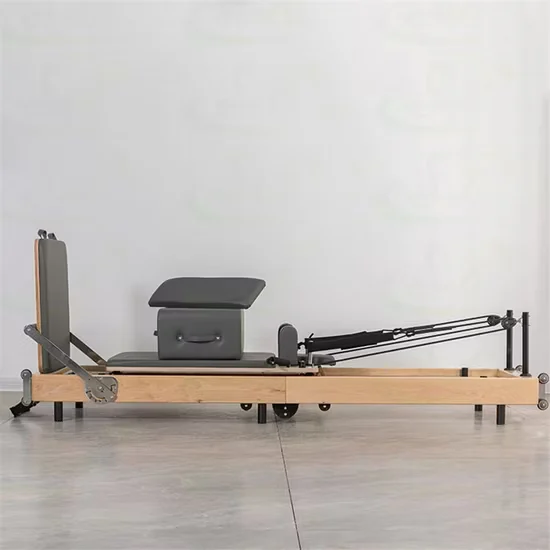
This unit covers rehabilitation through athletic conditioning on a single platform. The long box supports supine and seated pulling sequences, the jump board introduces plyometric loading, and the platform extends the working surface for standing balance work. In a multi-class studio schedule, the foldable mechanism lets operators clear floor space between group sessions and private appointments. It pairs with mat zones and barrel stations to create a full mind-body circuit. The solid wood frame suits deployment in rooms where metal vibration would disturb neighboring spaces, and it accommodates the full adult body-weight range for commercial-grade commercial foldable Pilates reformer wood studio equipment use.
Operating Environment and Deployment Constraints
A reformer running six classes daily demands consistent spring tension and pulley alignment across every session. Deploy the unit on a level surface with shock-absorbing pads beneath the feet to further isolate residual vibration from the floor [NEED_CITE: vibration isolation pad specifications for studio fitness equipment]. Leave clearance at both ends for the full carriage travel plus the jump board attachment. In upper-floor studios, position reformers away from shared walls where low-frequency resonance concentrates. Confirm that the room ventilation manages humidity to protect the wood finish over extended use cycles.
What Wood Construction Means for Transmission Behavior
Wood absorbs and dissipates vibrational energy differently than welded steel tubing. A metal frame conducts carriage impact along continuous rigid paths, transmitting structure-borne noise into floor slabs and adjacent walls. Solid timber introduces natural damping at every joint and along the grain, reducing the amplitude of frequencies that reach the building structure. The foldable hinge mechanism on the SRY-20B must maintain frame rigidity when locked in the open position — any play in the hinge introduces lateral carriage wobble under high-resistance spring settings. Pulley wheels and spring anchors distribute load across the wooden rails, and their alignment directly affects smooth carriage travel and consistent resistance delivery.
What Happens When Specifications Are Compromised
A reformer with undersized hinge hardware develops carriage wobble within months of high-frequency use, forcing the studio to pull the unit from rotation for repairs [NEED_CITE: commercial fitness equipment failure rates under continuous daily operation]. Cheap pulley wheels generate grinding noise that compounds the very vibration problem the wood frame was meant to solve. Springs that lose tension calibration across different resistance levels force instructors to compensate mid-class, degrading programming consistency. Facilities that skip load-rating verification on the foldable mechanism discover structural fatigue only when a client reports instability during a heavy-resistance set.
Why This Product Line Fits Commercial Rollout
Every SRY-20B undergoes continuous load testing to verify hinge durability and rail alignment under high-frequency studio scheduling. The wood species and joint construction methods are specified for long-term structural integrity. OEM customization covers logo, color, and console UI so multi-location studio networks maintain brand consistency across every room. Our 3D layout planning accounts for the 2400×600mm footprint, required clearance for jump board attachment, and member flow between units. Full accessory compatibility — long box, jump board, and platform — means a facility sources every reformer discipline from one line. Technical support is available around the clock for alignment calibration and spring replacement guidance.
Documentation & Test Records
- CE declaration of conformity for the SRY-20B reformer unit
- EN 957 test report covering structural load and safety requirements
- ISO 9001 certificate for the manufacturing quality system
- Durability test record documenting foldable hinge cycle performance
- Noise level test report measuring vibration transmission under load
- Spare parts list covering springs, pulleys, and carriage wheels
Installation, Commissioning & Maintenance
- Position the 2400×600mm frame on a level floor with vibration isolation pads beneath each foot
- Leave full carriage travel clearance plus jump board extension space at both ends
- Verify hinge lock engagement before every session to prevent lateral carriage movement
- Inspect spring tension calibration quarterly and replace springs showing permanent elongation
- Clean pulley tracks weekly and apply dry lubricant to prevent grinding noise buildup
- Wipe wood surfaces with pH-neutral cleaner to protect the finish from sweat and humidity
Equipment Selection and Layout Planning
Provide your studio floor area and intended unit count to receive a 3D layout covering equipment spacing, member flow, and ventilation requirements. Specify whether the deployment floor sits above occupied rooms so we can confirm vibration isolation needs. State your target market for any documentation or labeling requirements. Indicate whether you need OEM logo and color customization applied across a multi-location rollout.
Frequently Asked Questions
Q: How does a wood frame compare to metal in controlling studio vibration?
A: Solid wood dampens carriage vibration at the joint and grain level, reducing the amplitude of frequencies transmitted into floor slabs and shared walls. Metal frames conduct vibration along rigid continuous paths, amplifying structure-borne noise in multi-floor buildings. For studios above retail or residential spaces, wood construction noticeably reduces low-frequency resonance complaints.
Q: Does the foldable mechanism affect carriage stability under heavy resistance?
A: The hinge mechanism on the SRY-20B is engineered and cycle-tested to maintain full frame rigidity when locked open. Any lateral play in a foldable reformer indicates hardware wear or misalignment, not a design limitation. Request the foldable mechanism load rating and cycle-test documentation during procurement to verify durability for your expected class volume.
Q: Which accessories are compatible with this reformer model?
A: The SRY-20B supports the long box for supine and seated pulling sequences, the jump board for plyometric loading, and the platform for standing balance work. All three attach to standardized anchor points on the frame. Confirm attachment compatibility and load capacity for each accessory component when placing your order to ensure full programming coverage.
Q: What maintenance intervals apply to pulleys and springs in daily commercial use?
A: Pulley wheels and tracks should be inspected and cleaned weekly to prevent grinding noise and uneven wear. Spring tension calibration should be verified quarterly, with immediate replacement of any spring showing permanent elongation or inconsistent resistance delivery. Request the recommended spare parts list and maintenance schedule specific to your expected daily class count.
Q: What elements can be customized for multi-location studio branding?
A: OEM customization covers logo placement, frame color finish, and console UI where applicable. This allows studio networks to maintain visual brand consistency across every location. Clarify lead time and minimum order quantity for customized units during the quotation stage, especially when planning a phased multi-site rollout.


![Aluminum Pilates Reformer with Trapeze Tower for Commercial Studio Use [WARN] draft identifier mismatch](https://bicksport.com/wp-content/uploads/2026/08/aluminum-pilates-reformer-with-trapeze-tower-for-commercial-studio-use-warn-draft-identifier-mismatch-413f93.webp)