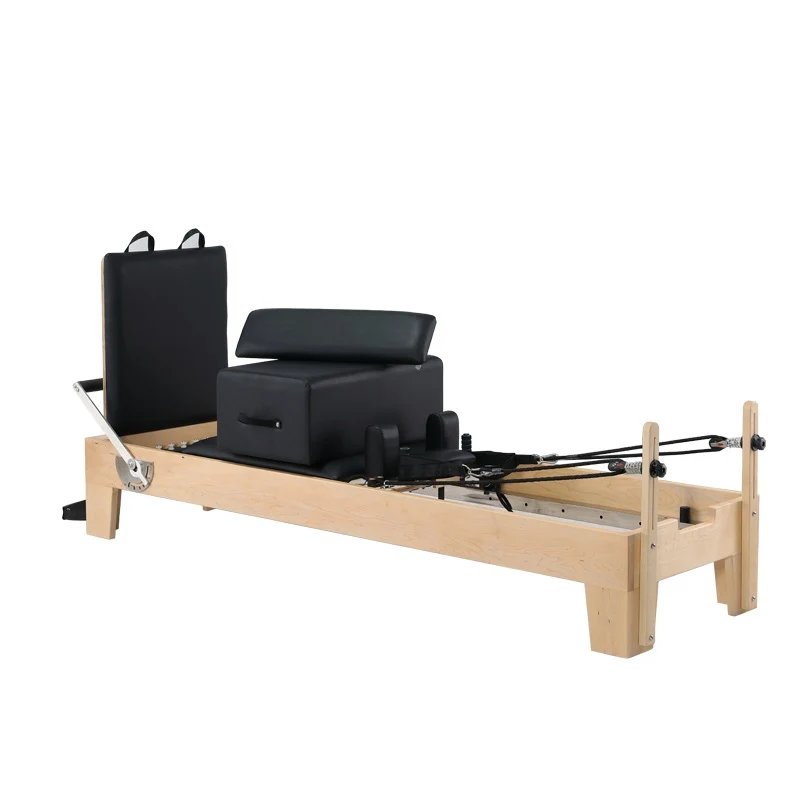
Vibration Damping Frame — Solid wood construction isolates carriage roll noise from floor structures, preventing transmission to adjacent occupied spaces.
Technical Specifications
| Parameter | Value |
|---|---|
| Designation | SRY-19 |
| Product Type | Pilates Reformer |
| Material | Solid Wood |
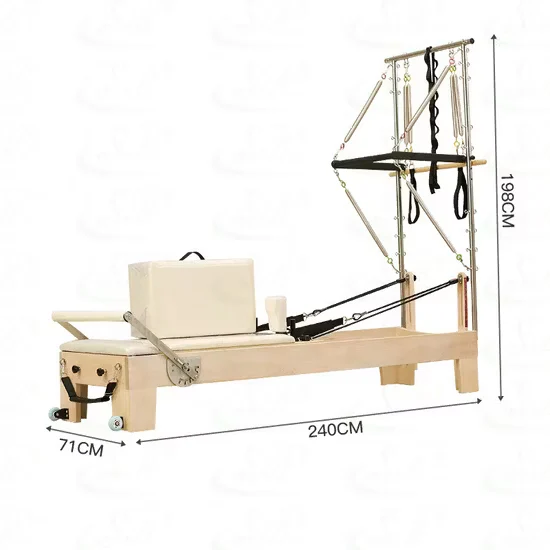
| Product Dimensions | 2460730680mm |
| Net Weight | 100kgs |
| Accessory Compatibility | Long Box / Jump Board / Platform |
| Max User Weight | 180kg (commercial range) |
| Warranty | 3 Years |
| Certification | CE, ISO 9001 |
| Color Options | Solid Color (Customizable) |
| Logo | Customized Is Allowed |
Application Suitability
| Deployment Scenario | Typical Use |
|---|---|
| Boutique Pilates studio | Group reformer classes requiring full accessory compatibility |
| Hotel fitness center on guest room floors | 24/7 access cardio where carriage noise must not transmit below |
| Corporate wellness room | Employee core conditioning and flexibility programming |
| High-end residential home gym | Private studio-grade training in shared-wall environments |
| Rehabilitation and physiotherapy facility | Predictable resistance progression for clinical protocols |
Why Studio Operators Discover Floor Vibration After the First Complaint
Wood mass absorbs carriage kinetic energy before it reaches the structural slab.
When a reformer carriage rolls across the frame, the vibration path is direct: wheel bearing to rail, rail to frame, frame to floor. Steel-aluminum hybrid frames transmit this energy efficiently, turning the floor slab into a sounding board [NEED_CITE: structural vibration transmission through fitness equipment frames]. I once saw a boutique studio above a law office face lease termination because reformer footwork sequences generated rhythmic thumping audible two floors down. The operator had invested in premium mats and rubber flooring, but the problem was never airborne noise — it was structure-borne vibration traveling through rigid metal legs into concrete. A solid wood frame introduces mass and internal damping that dissipates carriage energy before it couples to the floor. For hotel fitness centers positioned above occupied guest rooms, this material choice eliminates the complaint cycle before it begins.
Positioning This Reformer Within the Studio Equipment Matrix
This Pilates reformer serves as the primary apparatus for progressive core training, covering rehabilitation protocols through advanced athletic conditioning without requiring equipment swap-out. The full accessory ecosystem — long box for supine and prone sequences, jump board for plyometric loading, platform for standing work — means a single unit supports the complete class curriculum. In a group studio configuration, these reformers anchor the center floor with adequate lateral spacing for instructor circulation. The 2460mm footprint accommodates users across the full height spectrum while the 180kg capacity ensures commercial durability under high-frequency class rotation.
Continuous Studio Operation and Environmental Variables
Boutique studios running six to eight group classes daily subject reformer carriages to continuous cyclic loading, making bearing seal integrity and spring calibration stability critical operational variables. Wood frames respond to ambient humidity differently than steel — seasonal expansion can affect rail alignment if the species and treatment specification do not match deployment climate [NEED_CITE: wood dimensional stability under humidity variation]. Facilities in tropical or coastal markets must verify that the wood treatment protocol addresses moisture resistance for the target environment. Floor leveling becomes more critical with rigid wood frames than with adjustable steel feet, as any twist in the frame transfers directly to carriage tracking. Adequate lateral ventilation prevents sweat accumulation on wood surfaces, preserving both appearance and grip texture over extended operation.
Wood Frame Damping and Spring Resistance Mechanics
The solid wood frame delivers inherent vibration damping through material mass and cellular structure — energy from carriage deceleration dissipates within the frame rather than transmitting to the floor. This contrasts with steel frames that act as rigid conduits for structure-borne noise. The spring resistance system provides progressive loading calibrated by attachment position and spring combination, with long-term stability dependent on spring material specification and anchor point reinforcement. Sealed precision wheel bearings prevent the grinding and chatter that develop in open-bearing systems after months of high-frequency use, maintaining the silent carriage roll that defines studio acoustic quality [NEED_CITE: sealed bearing service life under cyclic loading]. The standardized accessory mounting interface ensures that long box, jump board, and platform attachments integrate without requiring separate apparatus purchases or custom adapters.
The Operational Cost of Underspecified Bearings and Springs
Open wheel bearings accumulate particulate contamination within weeks of studio operation, developing audible grinding that forces bearing replacement or full carriage rebuild. I have seen studios cycle through bearing sets quarterly because the original specification lacked adequate sealing for the particulate environment of a group fitness floor. Spring calibration drift compounds this problem — resistance that feels inconsistent across the range of motion destroys exercise fidelity and forces instructors to compensate verbally rather than rely on the equipment. Facilities that procured reformers based on frame appearance rather than bearing specification and spring drift testing face a predictable maintenance spiral [NEED_CITE: spring resistance calibration drift over 10000-hour equivalent cycle count]. The wood frame itself, if untreated for deployment humidity, can develop rail surface irregularities that accelerate bearing wear and compromise carriage tracking.
Why This Product Line Addresses Deployment Reality
Every commercial Pilates reformer wood studio equipment unit undergoes continuous cycle testing to verify carriage smoothness and spring calibration stability over extended operation. The solid wood frame construction is validated for vibration damping in shared-wall deployments, eliminating the structure-borne noise complaints that plague steel-frame installations. Full OEM customization extends to logo integration, color specification, and accessory package configuration to match studio branding and programming requirements. The 3D studio layout service covers reformer spacing, instructor circulation paths, and ventilation planning based on actual room dimensions and HVAC configuration. Technical support remains available around the clock for bearing specification questions, spring replacement procedures, and accessory compatibility verification across mixed-equipment inventories.
Documentation & Test Records
- CE declaration of conformity for commercial fitness equipment
- EN 957 test report verifying structural and mechanical safety requirements
- ISO 9001 quality management system certification
- Carriage roll noise level test report under loaded conditions
- Spring resistance calibration tolerance and drift test record
- Wood species specification and humidity resistance treatment documentation
- Accessory mounting interface dimension drawing for cross-compatibility verification
Installation, Commissioning & Maintenance
- Allow minimum 900mm lateral clearance per SRY-19 unit for instructor circulation and accessory storage
- Verify floor levelness within 3mm over 2460mm frame length before final positioning
- Inspect carriage wheel bearings and rail alignment after initial 500-hour operation cycle
- Confirm spring anchor point integrity and resistance calibration quarterly under high-frequency class rotation
- Apply wood surface treatment per manufacturer schedule based on deployment humidity conditions
- Clean carriage rails and bearing contact surfaces weekly to prevent particulate accumulation
Equipment Selection and Site Configuration Inquiry
Provide studio dimensions, ceiling height, and intended unit count to receive a 3D layout covering reformer placement, accessory storage, and member flow optimization. Specify deployment floor level and adjacent occupied spaces to confirm that wood frame vibration damping meets acoustic requirements for the building structure. Indicate target market climate zone to verify wood treatment specification for humidity resistance and dimensional stability over seasonal variation.
Frequently Asked Questions
Q: How does wood frame construction affect vibration transmission versus steel-frame reformers?
A: Solid wood introduces mass and internal damping that dissipates carriage kinetic energy before it couples to the floor structure. Steel frames act as rigid conduits, transmitting vibration directly through legs to the slab. For studios positioned above occupied spaces, this material difference determines whether footwork sequences generate complaints from tenants below or remain acoustically contained within the studio environment.
Q: What bearing specification prevents carriage noise development over continuous studio use?
A: Sealed precision bearings prevent particulate contamination from group class environments, maintaining smooth carriage roll without the grinding that develops in open-bearing systems within months. The seal specification must match the operational particulate load of the deployment environment. Studios running six to eight classes daily require bearing seals rated for continuous cyclic loading to avoid quarterly replacement cycles.
Q: How do spring resistance systems differ in calibration stability and maintenance requirements?
A: Spring material composition, coating specification, and anchor point reinforcement determine whether resistance progression remains consistent over extended use or develops noticeable drift. Springs that lose calibration force instructors to compensate verbally during classes, undermining exercise fidelity. Verify that the manufacturer provides drift test records over an equivalent continuous cycle count to confirm long-term stability under commercial loading.
Q: Can the reformer accessory interface support both rehabilitation and advanced athletic programming?
A: The standardized mounting interface accepts long box, jump board, and platform attachments without custom adapters, supporting clinical protocols through advanced conditioning from a single apparatus. This eliminates the need for separate equipment purchases when programming scope expands. Verify interface dimension drawings against any existing studio inventory to confirm cross-compatibility before procurement.
Q: What wood treatment specifications apply to tropical or high-moisture deployment environments?
A: Wood species selection and treatment protocol must address dimensional stability under the target humidity range to prevent rail surface irregularities that compromise carriage tracking. Facilities in coastal or tropical markets should verify that the treatment specification includes moisture resistance rated for local seasonal variation. Untreated frames develop alignment issues that accelerate bearing wear and degrade the silent operation characteristic.
![Customized Logo Pilates Reformer Fitness Equipment Wooden Yoga Therapy Machine [WARN] draft identifier mismatch](https://bicksport.com/wp-content/uploads/2026/08/customized-logo-pilates-reformer-fitness-equipment-wooden-yoga-therapy-machine-warn-draft-identifier-mismatch-d3cd92.webp)