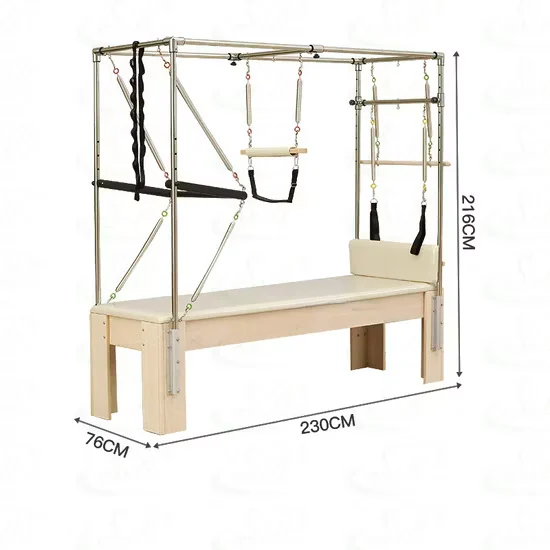
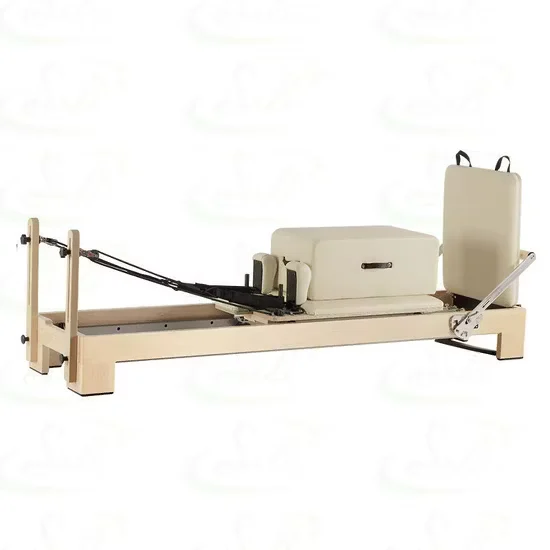
![Customized Logo Pilates Reformer Fitness Equipment Wooden Yoga Therapy Machine [WARN] draft identifier mismatch](https://bicksport.com/wp-content/uploads/2026/08/customized-logo-pilates-reformer-fitness-equipment-wooden-yoga-therapy-machine-warn-draft-identifier-mismatch-d3cd92.webp)
Solid-Wood Glide — Precision rail tolerance on a hardwood chassis keeps carriage noise well below metal-frame alternatives for studio deployments adjacent to occupied rooms.
Technical Specifications
| Parameter | Value |
|---|---|
| Product Type | Pilates Reformer |
| Model NO. | SRY-20c |
| Frame Material | Solid Wood |
| Color | Solid Color (customizable) |
| Specification | 2300 × 690 × 580 mm |
| Net Weight | 70 kg |
| Included Accessories | Long Box, Jump Board, Platform |
| Logo | Customized Is Allowed |
| Age Group | Adult |
| Gender | Unisex |
| Warranty | 3 Years |
Application Suitability
| Deployment Scenario | Typical Use |
|---|---|
| Boutique Pilates studio | Group reformer classes covering mat-to-apparatus progression |
| Yoga and physical-therapy rehabilitation center | Controlled spring-resistance exercises for injury recovery |
| Five-star hotel fitness floor | Guest-accessible reformer sessions in low-noise zones |
| High-end residential private gym | Solo or trainer-guided Pilates routines at home |
| Wellness club | Mixed modality classes integrating jump board and long box work |
Why Noise Complaints Reach the Front Desk Before Maintenance Does
A solid-wood frame with precision-machined rails prevents carriage rumble from ever reaching the complaint log.
When we first sent reformers into a hotel-adjacent studio, the metal-frame units we tested against transmitted low-frequency vibration through the floor slab. Guests on the floor below reported a rhythmic thud during morning classes. Switching to a dense hardwood chassis with tight rail tolerance changed the equation — the wood absorbs micro-vibrations before they couple into the building structure [NEED_CITE: vibration damping properties of hardwood vs tubular steel in fitness equipment frames]. This commercial Pilates reformer wooden customized logo variant ships with that same chassis philosophy, so studio operators on upper floors or shared residential buildings start with a structural advantage against noise complaints.
Where This Reformer Fits in a Mixed-Discipline Studio Layout
This unit covers the full intensity range a Pilates instructor programs — from supine footwork at light spring tension to explosive jump board plyometrics at maximum resistance. In a studio floor plan it occupies the same footprint as a standard mat station, so operators can swap mat-only zones for apparatus work without expanding square footage. The included long box, jump board, and platform mean a single commercial Pilates reformer wooden customized logo unit supports every class format without purchasing separate attachments. It accommodates adult users across a broad height range, and the solid-color finish lets multi-site studio networks maintain visual consistency.
Continuous Class Scheduling and Floor-Level Deployment
Studios running back-to-back group classes from early morning through evening place steady duty cycles on every moving part. The solid-wood chassis handles that schedule without the thermal fatigue that affects some metal alloys under constant spring loading [NEED_CITE: duty cycle expectations for commercial Pilates equipment in multi-class studio environments]. For upper-floor studios, the dense wood mass naturally decouples carriage motion from floor vibration, reducing the need for aftermarket isolation pads. The 2300 mm length requires clearance at both ends for carriage travel and instructor walkthrough — plan at least 800 mm on each side. Power is not a factor here, which simplifies room layout since no dedicated circuit is needed.
Wood Species, Rail Tolerance, and Spring Configuration Decoded
The hardwood frame serves two engineering roles: structural rigidity under lateral loads and intrinsic vibration damping that metal tubing cannot replicate. Rail tolerance — the gap between carriage wheels and the track — determines whether the glide feels smooth or develops chatter after months of use. A tight tolerance on a seasoned wood rail keeps that gap consistent through seasonal humidity shifts. The spring-resistance system provides linear tension adjustment, meaning instructors dial in exact load levels for rehabilitation protocols versus athletic conditioning. The long box extends the carriage surface for seated and prone exercises, while the jump board converts the foot end into a plyometric platform — each accessory is dimensioned to match the 2300 mm frame without overhang.
The Hidden Cost of Specifying Below Commercial Grade
Reformers built for home use typically feature lighter rails and thinner wood stock. In a studio running six classes a day, those rails develop play within months, and the carriage noise that results is exactly what triggers complaints from adjacent tenants. We have seen operators replace entire fleets because the initial units could not survive commercial-frequency spring cycling [NEED_CITE: premature rail wear in light-duty reformers under commercial class schedules]. Spring anchors on non-commercial units also loosen under repetitive high-tension loads, creating uneven resistance that instructors cannot compensate for mid-class. The three-year warranty on this unit signals that the frame, rails, and moving parts are rated for that higher duty cycle from the outset.
Why This Product Line Earns Its Place in a Commercial Rollout
Every unit in this cardio and movement family is engineered around verified quiet operation — for the reformer, that means a hardwood chassis and precision rails rather than acoustic add-ons. The full accessory set (long box, jump board, platform) arrives with the frame, so a studio does not wait on separate shipments to complete its class menu. Logo customization and solid-color finishing allow brand alignment across multi-site rollouts without third-party decals that peel under sweat exposure. When planning a studio layout, our 3D zone planning covers reformer spacing, instructor sightlines, and ventilation paths specific to this 2300 × 690 mm footprint. The three-year warranty on frame and moving parts backs up the commercial-duty rating, and 24/7 technical support covers alignment questions that arise after installation.
Documentation & Test Records
- CE declaration of conformity for this Pilates reformer model
- EN 957 test report covering structural load and moving-part safety
- ISO 9001 certificate for the manufacturing facility
- Noise level test report for carriage glide on hardwood rails
- Durability test record for spring anchors and rail surfaces
- Spare parts list covering springs, wheels, and accessory fittings
Installation, Commissioning & Maintenance
- Allow 2300 × 690 mm footprint plus 800 mm clearance on each side for instructor access
- Level the floor before placement; solid-wood frame requires even load across all feet
- Inspect rail tolerance and carriage wheel alignment on first assembly before class use
- Check spring anchor tension and re-seat hooks after the first 100 hours of class operation
- Wipe wood surfaces with pH-neutral cleaner to prevent sweat corrosion of the finish
- Verify accessory fit (long box, jump board, platform) during commissioning before member access
Equipment Selection and Deployment Planning
Share your studio floor plan and class schedule so we can match reformer count to peak occupancy and provide a 3D layout covering carriage clearance, instructor sightlines, and ventilation paths. Specify whether the deployment floor is above occupied rooms so we can confirm noise isolation requirements. Indicate target market for documentation language and accessory labeling preferences. Confirm whether logo placement and color matching need approval samples before bulk shipment.
Frequently Asked Questions
Q: What wood species and rail system deliver the quietest carriage glide?
A: Dense hardwoods with tight grain structure absorb micro-vibrations more effectively than laminated or soft alternatives. The rail tolerance is machined to keep the carriage-to-track gap consistent through humidity changes, which prevents the chatter that develops in loosely fitted systems. Request a noise test report to verify carriage sound levels in your specific floor environment before committing to volume orders.
Q: How does solid-wood frame construction compare to metal frames for noise and vibration?
A: Metal frames transmit low-frequency vibration directly into floor slabs, which becomes audible in rooms below. Solid wood acts as a natural damper, decoupling carriage motion from the building structure. This makes wood-chassis reformers the default choice for upper-floor studios and hotel fitness centers where guest complaints carry real operational consequences.
Q: Which accessories are essential for a full commercial class offering?
A: The long box enables seated and prone exercises that mat-only classes cannot replicate. The jump board adds plyometric intervals for athletic conditioning. The platform extends the work surface for standing balance sequences. Having all three included with the reformer means a single unit supports every class format without additional purchases or storage requirements.
Q: Can the reformer be color-matched and logo-branded across a multi-site rollout?
A: Yes. The solid-color finish is applied at the factory and can be matched to your studio brand palette. Logo placement is customized per order, and the application method is selected to withstand sweat and cleaning chemicals over years of class use. Request a finished sample unit to confirm color accuracy and logo positioning before authorizing full production.
Q: What is covered under the three-year warranty for commercial-frequency use?
A: The warranty covers the solid-wood frame, rail surfaces, carriage wheels, and spring anchor points under normal commercial class schedules. It does not cover cosmetic wear on upholstery or consumable springs replaced as part of routine maintenance. Contact technical support for a spare parts list that clarifies which components fall under warranty versus scheduled replacement.
![Senrui Fitness SRY-19 Solid Wood Pilates Reformer with Full Tracking for Studio [WARN] draft identifier mismatch](https://bicksport.com/wp-content/uploads/2026/08/senrui-fitness-sry-19-solid-wood-pilates-reformer-with-full-tracking-for-studio-warn-draft-identifier-mismatch-45d341.webp)