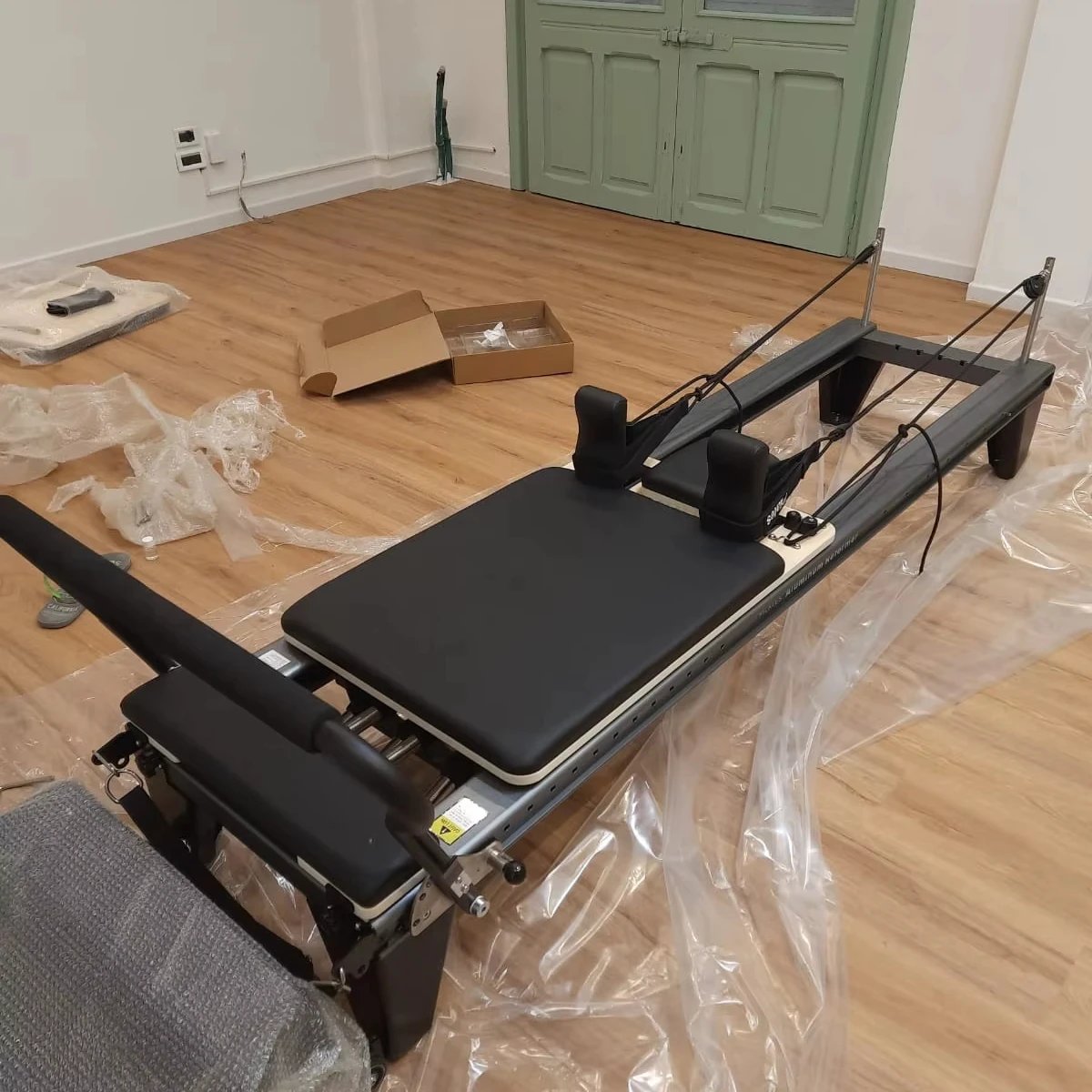
![Solid Wood Multifunctional Foldable Pilates Reformer Bed [WARN] draft identifier mismatch](https://bicksport.com/wp-content/uploads/2026/08/solid-wood-multifunctional-foldable-pilates-reformer-bed-warn-draft-identifier-mismatch-3f88ad.webp)
Precision-Machined Solid Wood Frame — Eliminates metallic resonance and spring squeak at the structural level for multi-occupancy fitness floors.
Technical Specifications
| Parameter | Value |
|---|---|
| Product Type | Pilates Reformer |
| Designation | SRY-20B |
| Material | Solid Wood |
| Product Dimensions | 2400×600×350 mm |
| Net Weight | 100 kg |
| Foldable | Yes — Multifunctional Foldable |
| Accessories | Long Box / Jump Board / Platform |
| Color | Solid Color (customizable) |
| Logo | Customized Allowed |
| Target User | Adult, Unisex |
| Warranty | 3 Years |
| Production Capacity | 80 Pieces/Month |
| HS Code | 9506911900 |
| Origin | China |
Application Suitability
| Deployment Scenario | Typical Use |
|---|---|
| Boutique Pilates studio on shared-wall floors | Multi-station reformer classes with minimal acoustic bleed to adjacent rooms |
| Five-star hotel guest fitness center | 24-hour self-service Pilates without disturbing occupied rooms above or below |
| High-end residential private gym | Foldable storage between sessions in space-constrained luxury apartments |
| Rehabilitation and wellness center | Low-impact guided resistance work for injury recovery and mobility programs |
| Corporate wellness facility | Employee fitness rooms requiring quiet operation near open-plan office zones |
Why Spring Squeak and Rail Friction Reach the Front Desk Before Maintenance Does
Solid wood construction removes the primary noise sources found in steel-frame reformers.
When a Pilates reformer sits on the floor above a hotel guest room or beside an open-plan office, every spring rattle and carriage clack travels through the structure. I have inspected steel-tube reformers in deployed sites where metallic resonance at the rail joints and spring anchor points generated audible vibration in rooms two floors down. The solid wood Pilates reformer commercial multifunctional foldable design avoids these failure points because wood naturally dampens vibration and does not ring under dynamic loading. [NEED_CITE: acoustic transmission through floor assemblies under fitness equipment loading]
Where This Reformer Fits in a Mixed-Discipline Fitness Floor
This unit covers the full Pilates mat-to-apparatus spectrum: supine footwork, seated arm pulls, kneeling stretches and jump board cardio intervals. In a commercial cardio and recovery zone, it complements treadmills and ellipticals by providing the low-impact, high-control movement patterns those machines cannot replicate. The 2400×600 mm footprint fits standard studio grids, and the foldable frame lets operators clear floor space for group mat classes between apparatus sessions. Suitable for users across a broad height and weight range given the 100 kg net weight and reinforced wood construction.
Continuous Use Cycles and Floor-Level Deployment Constraints
A boutique studio running four back-to-back classes daily subjects each reformer to roughly six hours of loaded carriage travel per day. Wood-frame units do not generate motor heat or require cooling airflow, so they can be placed against interior walls without ventilation clearance. However, wood is sensitive to humidity swings, so climate-controlled environments with stable relative humidity preserve frame geometry and rail alignment over time. The solid wood Pilates reformer commercial multifunctional foldable unit has no electrical plug requirement, eliminating voltage mismatch issues across export markets. [NEED_CITE: wood dimensional stability under HVAC-cycled indoor environments]
Carriage Glide, Accessory Swap and Structural Rigidity Under Load
The carriage rail straightness and wheel bearing precision determine how smoothly the carriage travels under loaded conditions and how much lateral wobble appears during jump board work. Solid wood frames resist torsional flex differently from welded steel: the grain structure provides inherent damping but demands precision machining at the rail mounting surface to maintain alignment. The long box, jump board and platform accessories attach at interface points that must withstand repeated dynamic impact — jump board use in particular sends impulsive loads through the frame at each landing. A well-engineered fold mechanism must lock the frame into full rigidity during use; any play at the hinge translates directly into carriage misalignment and audible knocking. [NEED_CITE: dynamic load testing standards for Pilates reformer accessory interfaces]
What Spec Compromises Cost When the Studio Opens
Operators who select reformers based on upfront price often discover the real cost during the first month of operation. Carriage wheels with low-grade bearings develop flat spots and generate grinding noise within weeks of high-frequency use. Fold mechanisms that lack positive locking introduce frame wobble that worsens with each folding cycle, eventually requiring carriage realignment. Accessory interfaces that tolerate even minor play under jump board loading produce knocking that travels through the floor structure. These issues compound: noise complaints trigger equipment replacement, member attrition follows, and the total cost far exceeds the initial savings. [NEED_CITE: lifecycle cost comparison of commercial versus light-commercial fitness apparatus]
Why This Product Line Holds Up in Deployed Sites
The wood frame is tested for structural rigidity under continuous loaded cycling, and the rail-and-carriage system is verified for smooth glide with minimal maintenance over extended use. The foldable mechanism is cycle-tested to confirm that locking integrity holds after repeated fold-unfold sequences. OEM customization covers frame finish color and logo placement, allowing studio branding without aftermarket modification. When planning a multi-reformer studio layout, the 2400×600 mm footprint and required clearance on all sides inform the 3D zone plan — ensuring adequate instructor walkways and member circulation between stations. Technical support covers spare parts sourcing and rail maintenance guidance for the full deployment lifecycle.
Documentation & Test Records
- CE declaration of conformity for fitness equipment
- EN 957 test report covering structural load and stability
- ISO 9001 quality management system certificate
- Wood material grade and humidity resistance specification
- Carriage rail glide and load test record
- Accessory interface dynamic impact test documentation
Installation, Commissioning & Maintenance
- Allocate minimum clearance around the 2400×600 mm footprint for safe carriage travel and instructor access
- Level the floor surface before placement to prevent frame torsion and carriage drift
- Inspect rail straightness and carriage wheel bearing smoothness on delivery before first class
- Lubricate carriage rail contact surfaces per the maintenance schedule to preserve quiet glide
- Verify fold mechanism positive lock engagement after each fold-unfold cycle
- Clean wood surfaces with pH-neutral products to protect finish from sweat and humidity damage
Planning Your Deployment and Equipment Inquiry
Provide your studio floor area and intended reformer count to receive a 3D layout covering station spacing, instructor sightlines and member flow paths. Specify the building occupancy type and adjacent room usage so acoustic requirements can be confirmed against the wood-frame damping characteristics. Indicate whether OEM branding, custom frame finish or accessory package configuration is needed for your facility identity. State the deployment climate and HVAC profile so wood stability recommendations match your environment.
Frequently Asked Questions
Q: How does a solid wood frame compare to steel for noise control in multi-story buildings?
A: Solid wood naturally dampens vibration and eliminates the metallic resonance that steel-tube frames transmit through floor assemblies. In hotel and residential deployments, this means carriage travel, spring engagement and accessory impact generate far less structure-borne noise reaching occupied rooms below. No additional acoustic matting is required solely to address frame resonance, though floor isolation pads still help with direct impact transmission.
Q: Does the foldable mechanism compromise frame rigidity during loaded exercises?
A: The fold mechanism uses positive-lock latches that secure the frame into a single rigid structure during use. When locked, the hinge joints do not introduce lateral play or carriage misalignment. The locking system is cycle-tested to verify that repeated folding does not degrade engagement precision over the equipment service life.
Q: How quickly can accessories be swapped between class formats?
A: The long box, jump board and platform mount at standardized interface points designed for quick release and secure re-engagement. An instructor can complete a full accessory changeover between class segments without tools. Each interface is load-tested under dynamic conditions — including repeated jump board impact — to confirm structural integrity during high-intensity programming.
Q: What maintenance does the carriage rail and wheel system require?
A: The rail contact surfaces need periodic cleaning and light lubrication to maintain smooth carriage glide and prevent wheel bearing wear. Inspection intervals depend on daily class volume: high-throughput studios should check rail alignment and wheel condition monthly. Replacement wheels and bearings are available as spare parts, and the maintenance guide specifies exact service procedures.
Q: What deployment factors matter when installing reformers in shared-occupancy buildings?
A: Floor loading capacity must support the 100 kg unit weight plus dynamic user loading. While the wood frame minimizes structure-borne noise, placement relative to occupied rooms below still matters — isolation pads further reduce direct impact transmission. Climate control is also important: stable humidity prevents wood expansion or contraction that could affect rail alignment and carriage tracking over time.


![Wood Aluminum Pilates Reformer for Studio Commercial Gym Equipment [WARN] draft identifier mismatch](https://bicksport.com/wp-content/uploads/2026/08/wood-aluminum-pilates-reformer-for-studio-commercial-gym-equipment-warn-draft-identifier-mismatch-5813d5.webp)