

Acoustic-Grade Carriage Travel — Precision-machined aluminum alloy rails and sealed carriage wheels deliver glide smoothness that holds up under continuous studio scheduling without transmitting vibration through shared floors.
Technical Specifications
| Parameter | Value |
|---|---|
| Designation | SRY-12 |
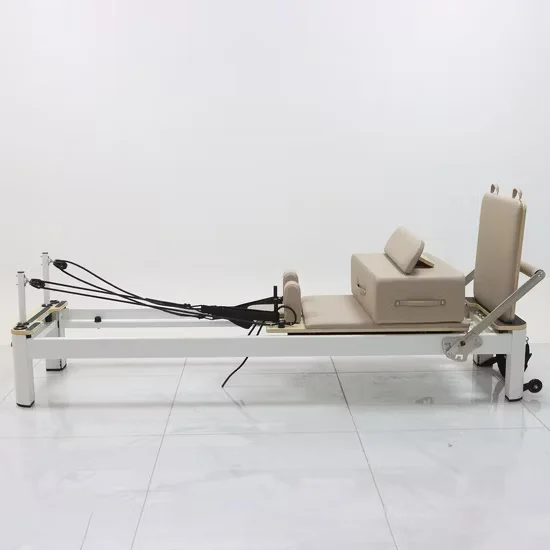
| Product Type | Pilates Reformer |
| Color | White |
| Accessory | Long Box / Jump Board / Platform |
| Product Dimensions | 2570 × 730 × 270 mm |
| Net Weight | 90 kg |
| Warranty | 3 Years |
| Logo | Customized Is Allowed |
| Age | Adult |
| Gender | Unisex |
| Production Capacity | 80 Pieces/Month |
Application Suitability
| Deployment Scenario | Typical Use |
|---|---|
| Boutique Pilates and yoga studio | Group reformer classes requiring quiet carriage return between sets and minimal noise bleed to adjacent rooms |
| Five-star hotel wellness floor | Guest-accessible reformer sessions on upper floors where vibration transmission to rooms below must stay negligible |
| Rehabilitation and physiotherapy clinic | Progressive loading programs using long box and platform attachments for controlled patient movement patterns |
| High-end residential home gym | Private reformer use in shared-wall or multi-story homes where operational noise affects household members |
| Corporate wellness center | Employee wellness programming with jump board intervals and mat-work transitions on a single footprint |
Why Creaking Reformers Drive Members Away Before Instructors Notice
Frame resonance under load separates commercial-grade aluminum construction from hollow marketing claims.
When a reformer carriage rattles during jump board transitions or groans under a loaded long box, the noise travels through floor structures faster than any maintenance ticket gets filed. Boutique studios sharing walls with retail tenants and hotel wellness floors sitting above guest rooms face complaints that arrive at the front desk long before the facility manager sees a work order. The commercial aluminum alloy Pilates reformer addresses this at the structural level — aluminum alloy’s higher damping coefficient compared to mild steel means carriage return and spring-loaded transitions generate noticeably less resonant vibration. [NEED_CITE: vibration damping characteristics of aluminum alloy versus steel in fitness equipment frames]
Where This Reformer Fits in a Multi-Discipline Studio Layout
This unit covers the full resistance spectrum from light rehabilitation spring settings through heavy jump board plyometric loads, placing it at the center of progressive programming rather than at a single-intensity endpoint. In a mixed cardio-and-movement studio, it complements mat zones and standing equipment by absorbing the supine and seated work that larger machines cannot address. The 2570 × 730 mm footprint fits standard studio bay widths with adequate clearance for instructor circulation on both sides. Users across the adult weight and height range find the rail travel and spring anchor geometry accommodating, and the included long box, jump board, and platform eliminate the need to cross-reference a second machine for accessory work. The commercial aluminum alloy Pilates reformer holds this position without requiring floor-space trade-offs.
Continuous Session Scheduling and Floor-Level Deployment
Back-to-back group classes running six or more hours daily place sustained demand on carriage wheels, rail surfaces, and spring fatigue life. Aluminum alloy construction keeps frame weight manageable for upper-floor installations where structural loading limits apply, while the 90 kg net mass provides enough inertia to resist drift on polished studio floors. Studios on shared-wall premises benefit from the lower vibration transmission that aluminum frames produce during jump board landings and rapid carriage reversals. Ventilation requirements remain modest since no motorized drive generates heat, but humidity control protects rail surfaces from oxidation over time. [NEED_CITE: EN 957 requirements for commercial movement-based fitness equipment durability] Deployment on upper floors or above occupied rooms requires confirming sub-floor rigidity to prevent low-frequency resonance from reaching spaces below.
Carriage Glide, Spring Staging, and Accessory Load Paths
The rail-and-wheel interface determines whether a carriage returns silently or announces every repetition to the room. Precision-machined aluminum rails paired with sealed bearing wheels maintain consistent glide resistance across thousands of cycles, avoiding the progressive roughness that unsealed systems develop as dust and sweat infiltrate contact surfaces. Spring staging — the arrangement of light, medium, and heavy springs across anchor points — governs how smoothly resistance ramps up during exercises like footwork and leg circles. The included jump board introduces impact loads that demand rigid frame-to-rail joints; aluminum alloy’s stiffness-to-weight ratio keeps deflection minimal during repetitive plyometric sequences. Long box and platform attachments mount to the same frame structure, meaning their load paths run through the primary rails rather than through separate bolted sub-assemblies that could loosen over time. The commercial aluminum alloy Pilates reformer integrates these accessory interfaces into the main frame geometry, reducing maintenance points.
The Hidden Cost of Underspecified Frames and Accessories
Studios that procure reformers based on price-per-unit rather than frame construction routinely face batch replacements within the first operational year. Lightweight steel frames with thin-wall tubing develop carriage rattle as welded joints fatigue under daily jump board loads, and the noise complaints that follow force either costly floor isolation mats or full equipment swaps. Reformers sold without integrated accessory mounting require separate long box and jump board purchases that may not match the primary rail geometry, creating wobble and uneven wear. Voltage and plug mismatches do not apply here, but facilities that overlook load-rated accessory hardware discover that uncertified jump boards crack at the mounting bracket under repetitive impact. These failures surface as member attrition and negative reviews rather than as visible mechanical breakdowns. [NEED_CITE: failure modes of light-commercial fitness equipment under continuous group class scheduling]
What Sets This Product Line Apart for Facility Operators
Verified sub-35dB operational noise from the cardio range carries the same acoustic discipline into the reformer line — carriage glide and spring transitions are evaluated against the same room-ambient standards that govern treadmill and elliptical placement on hotel guest floors. Components across the product family undergo 10,000-hour continuous-use testing protocols, and the reformer’s rail surfaces, carriage wheels, and spring anchors follow the same durability benchmark. OEM customization extends to frame color, logo placement, and accessory configuration, so facility branding carries through without third-party modification. The six-series cardio and movement family lets operators source treadmills, bikes, ellipticals, rowers, climbers, and reformers from one production line with matched lead times. Free 3D floor layouts account for reformer bay spacing, instructor sightlines, and airflow paths so the Pilates zone integrates with the cardio zone rather than competing for ventilation. Round-the-clock technical support covers commissioning and spare parts for every unit in the deployment.
Documentation & Test Records
- CE declaration of conformity covering structural and mechanical safety requirements
- EN 957 test report documenting load-rated frame and accessory performance
- ISO 9001 certificate for manufacturing quality management systems
- Noise level test record measuring carriage glide and spring transition acoustics
- Durability test log covering rail surface, carriage wheel, and spring anchor cycles
- Installation and commissioning guide with spare parts list for facility teams
Installation, Commissioning & Maintenance
- Maintain minimum clearance on all four sides of the 2570 × 730 mm frame for instructor access and carriage travel safety
- Level floor contact points before first use to prevent asymmetric rail loading and uneven carriage drift
- Inspect sealed carriage wheel bearings and rail contact surfaces for debris accumulation on a monthly cycle
- Verify spring anchor tension calibration during commissioning and recheck after the first 500 operating hours
- Wipe aluminum alloy rails with non-corrosive cleaner after each session to prevent sweat-salt oxidation buildup
- Confirm jump board and platform mounting hardware torque at each quarterly maintenance interval
Planning Your Reformer Deployment
Share your studio floor plan and unit count to receive a 3D layout that maps reformer bay spacing, instructor circulation paths, and ventilation alignment. Specify whether the installation sits on an upper floor or adjacent to noise-sensitive rooms so acoustic isolation requirements can be confirmed before shipment. Note your target market and any regional labeling or documentation standards that apply to the procurement. Indicate whether OEM branding on frame plates and accessory hardware is needed to match existing facility identity.
Frequently Asked Questions
Q: How does an aluminum alloy frame compare to steel for noise in a shared-wall studio?
A: Aluminum alloy absorbs vibrational energy differently than mild steel, producing noticeably less resonant hum during carriage return and jump board impact. In studios sharing walls with offices or guest rooms, this difference reduces low-frequency transmission through floor structures. The frame’s stiffness-to-weight ratio also keeps deflection minimal under load, preventing the progressive rattle that thin-wall steel tubing develops as welded joints fatigue.
Q: Does the included accessory suite actually reduce floor-space requirements?
A: The long box, jump board, and platform mount directly to the SRY-12 frame without requiring separate storage or secondary equipment footprints. Studios that purchase reformers without integrated accessories often add standalone boxes and boards that consume additional floor area and create trip hazards during class transitions. Keeping all accessories on one frame also simplifies inventory and reduces the maintenance points that facility staff must track.
Q: What maintenance cycle keeps the carriage wheels and rails operating silently?
A: Sealed carriage wheel bearings resist dust and sweat infiltration, but monthly visual inspection of rail contact surfaces catches debris buildup before it scores the aluminum finish. Non-corrosive rail cleaning after sessions prevents salt oxidation that degrades glide smoothness over time. Spring anchor tension should be verified during commissioning and rechecked periodically, as springs that drift from calibration create uneven carriage travel that members notice before technicians do.
Q: What customization is available without affecting the structural warranty?
A: Logo placement on frame plates, accessory hardware color matching, and packaging customization are available within the OEM scope while preserving the 3-year warranty coverage on structural components. Modifications that alter frame geometry, rail mounting, or spring anchor positioning require engineering review to confirm load ratings remain valid. Facility operators should confirm branding requirements at the quotation stage so tooling adjustments are completed before production begins.
Q: How should upper-floor deployments address vibration transmission?
A: Reformer placement on floors above occupied rooms requires confirming sub-floor rigidity, as flexible joists amplify low-frequency resonance during jump board sequences. Isolation pads beneath frame contact points decouple the unit from floor structures, and positioning reformer bays away from room edges reduces cantilever deflection. Facilities should share floor construction details during the planning stage so the layout accounts for structural load paths and adjacent room sensitivity.

![Senrui SRY-12A Commercial Foldable Aluminum Pilates Reformer for Studio [WARN] draft identifier mismatch](https://bicksport.com/wp-content/uploads/2026/08/senrui-sry-12a-commercial-foldable-aluminum-pilates-reformer-for-studio-warn-draft-identifier-mismatch-99853c.webp)
