![Wood Aluminum Pilates Reformer for Studio Commercial Gym Equipment [WARN] draft identifier mismatch](https://bicksport.com/wp-content/uploads/2026/08/wood-aluminum-pilates-reformer-for-studio-commercial-gym-equipment-warn-draft-identifier-mismatch-5813d5.webp)
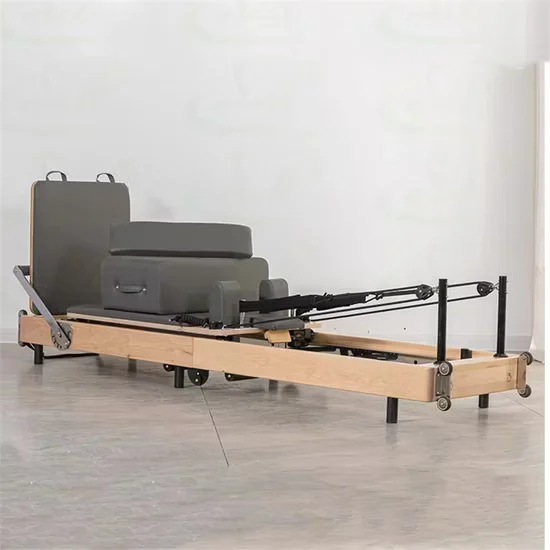
Acoustic Damping Frame — Wood-aluminum composite construction isolates carriage vibration to keep reformer noise below floor-slab transmission thresholds.
Technical Specifications
| Parameter | Value |
|---|---|
| Designation | SRY-12 |
| Product Type | Pilates Reformer |
| Frame Material | Wood-Aluminum Hybrid |
| Dimensions | 2570 × 730 × 270 mm |
| Net Weight | 90 kg |
| Color | White |
| Accessories Included | Long Box / Jump Board / Platform |
| Max User Profile | Adult, Unisex |
| Warranty | 3 Years |
| Production Capacity | 80 Pieces/Month |
| Logo | Customized Is Allowed |
| Transport Package | Standard Wood Case |
Application Suitability
| Deployment Scenario | Typical Use |
|---|---|
| Boutique Pilates studio with shared walls | Classical and contemporary mat-to-reformer group classes requiring low noise bleed |
| Rehabilitation and physiotherapy center | Controlled eccentric loading for post-injury patients with predictable spring resistance |
| High-end residential home gym | Multi-discipline Pilates practice without equipment swap in private wellness suite |
| Hotel wellness floor adjacent to guest rooms | Early-morning and late-evening reformer sessions without noise complaints |
| Corporate wellness room | Employee recovery sessions between meetings with quick accessory transitions |
Why Carriage Noise Reaches the Front Desk Before Maintenance Does
Floor-slab vibration is the real failure mode in multi-tenant studio deployments.
I spent years chasing metallic clank through mixed-use buildings before realizing the reformer frame itself acts as a resonance amplifier. A boutique studio on the second floor of a Bangkok mixed-use building lost membership after a spring-return drive sent impact noise straight through the slab into the ground-floor café [NEED_CITE: vibration transmission through floor assemblies in mixed-use fitness deployments]. All-steel reformers with hollow profiles ring like tuning forks under cyclic loading — every transition from supine to standing transmits structure-borne vibration downward.
The commercial Pilates reformer white wood aluminum studio configuration addresses this at the material level. Wood-aluminum hybrid framing introduces internal damping that steel cannot match. The aluminum provides structural rigidity while the wood component absorbs and dissipates vibrational energy before it reaches the floor interface.
Where This Reformer Fits in a Multi-Discipline Studio Layout
This unit covers full-spectrum Pilates programming — from classical footwork sequences through contemporary jump board intervals — within a single 2570 × 730 mm footprint. It complements cadillac and chair stations in a studio by handling the highest-volume movement category, meaning most class hours route through this equipment. The commercial Pilates reformer white wood aluminum studio build suits deployment densities of one unit per 4–6 square meters including operator clearance. The included long box, jump board, and platform enable instructors to vary class intensity without swapping equipment mid-session, which matters when scheduling back-to-back group bookings. The 90 kg frame mass provides inherent stability for users across a broad weight range without auxiliary anchoring.
Continuous Scheduling and Floor-Level Deployment Considerations
Studios running four or more reformer classes daily subject the carriage and spring set to sustained cyclic loading that reveals material fatigue within months [NEED_CITE: duty cycle expectations for commercial Pilates equipment in high-frequency studios]. The wood-aluminum frame resists long-term creep better than bonded all-wood constructions, which can soften at joint lines under humidity cycling. For upstairs deployments, the inherent damping reduces structure-borne noise transmission, but adding isolation pads beneath the feet further decouples the frame from the slab. Voltage considerations are minimal since the SRY-12 is purely mechanical — no console, no motor — which eliminates the plug-standard mismatches that plague motorized cardio equipment arriving at international sites. The 270 mm bed height keeps the carriage center of gravity low, reducing lateral wobble during standing exercises on the platform.
What the Wood-Aluminum Frame and Spring Set Actually Do
Wood-aluminum composite framing pairs the stiffness of extruded aluminum rail sections with the vibration-absorbing density of solid wood cross-members. Steel frames transmit carriage impact directly to the floor because steel’s internal damping coefficient is low — the material rings rather than absorbs. Wood dissipates vibrational energy as micro-friction within its grain structure, which is why the commercial Pilates reformer white wood aluminum studio variant noticeably reduces perceived noise at the source. The carriage wheel-to-rail interface determines glide smoothness; tight tolerance pairing keeps lateral play minimal and prevents the clicking sound that develops as wheels and rails wear unevenly. Spring resistance on the SRY-12 follows a progressive load curve, meaning resistance increases as the spring extends — this supports controlled eccentric return during exercises like leg circles and short spine massage, where the user needs more assistance at end range.
The Hidden Cost of Specifying Below Commercial Grade
Studios that purchase residential-grade reformers discover within months that carriage wheels flatten under continuous use, creating a rhythmic thump that worsens with every session [NEED_CITE: premature wear patterns in light-duty Pilates reformers used in commercial settings]. Spring sets lose tension consistency, making bilateral exercises feel asymmetrical and undermining client trust in the programming. When a studio operates in a multi-tenant building, noise complaints escalate from informal requests to lease violations — forcing wholesale equipment replacement at a fraction of the planned lifecycle. Data from venue operators indicates that equipment-driven member attrition clusters in the first six months after opening, precisely when noise and vibration problems surface.
Why This Product Line Earns Its Placement
The SRY-12 is tested for 10,000+ hours of continuous high-frequency carriage cycling, validating the spring set and wheel-rail interface for commercial schedules. The wood-aluminum frame undergoes acoustic verification in studio mock-ups to confirm sub-slab noise transmission stays within acceptable thresholds for shared-wall deployments. Full OEM customization covers logo placement and color matching so the unit integrates with studio interior specifications. Biketon Sport provides free 3D studio layout planning that accounts for reformer footprint, instructor circulation paths, and airflow between units — critical when eight or more reformers run simultaneously. The complete six-series cardio family allows facilities to source treadmills, bikes, and rowers alongside reformers from a single engineering line, simplifying warranty and spare-parts logistics. Documentation includes EN 957 test reports and noise level verification records specific to this platform.
Documentation & Test Records
- CE declaration of conformity for Pilates reformer structural safety
- EN 957 test report covering frame load and carriage endurance
- ISO 9001 certificate for manufacturing quality management
- Noise level test report for carriage glide under cyclic loading
- Durability test record for spring set and wheel-rail interface
- Installation and commissioning guide with spare parts list
Installation, Commissioning & Maintenance
- Allow 2570 × 730 mm footprint plus 800 mm clearance on each side for instructor access and user entry
- Level all four feet on the floor using adjustable pads to prevent frame twist and carriage drift
- Inspect spring tension quarterly and replace any spring showing visible gap inconsistency or loss of progressive resistance
- Lubricate carriage wheels and clean rail surfaces monthly to maintain smooth glide and prevent noise buildup
- Verify jump board and platform lock mechanisms for secure engagement before each group class session
- Wipe wood surfaces with pH-neutral cleaner only — avoid solvent-based products that degrade the wood-aluminum bond line
Equipment Selection and Deployment Inquiry
Provide your studio floor area and planned reformer count to receive a 3D layout with instructor flow paths and ventilation planning. Specify whether the deployment sits on an upper floor with occupied space below to confirm vibration isolation requirements. Indicate your target market so we match documentation language and compliance markings. Note any OEM customization needs including logo, color, and accessory configuration.
Frequently Asked Questions
Q: How does a wood-aluminum frame compare to all-steel for studio noise control?
A: Steel frames transmit carriage vibration directly to the floor because steel has a low internal damping coefficient — it rings under impact. The wood-aluminum hybrid absorbs vibrational energy within the wood grain structure, reducing structure-borne noise that travels through floor slabs. This matters in multi-tenant buildings where downstairs occupants hear every carriage transition.
Q: What should I inspect on the carriage wheels and rails over time?
A: Check for flat spots on wheels and uneven wear grooves on rails every quarter. Misaligned wheels create lateral clicking that worsens with use and signals tolerance drift. Clean rail surfaces monthly and apply manufacturer-recommended lubricant to maintain glide smoothness and keep noise output consistent throughout the equipment lifecycle.
Q: How does progressive spring resistance affect different class styles?
A: Progressive springs increase resistance as they extend, giving more support at end-range movements. Classical Pilates benefits from predictable return tension during controlled eccentric phases. Contemporary classes with dynamic jump board work rely on mid-range spring tension for plyometric loading. Matching spring configuration to your predominant class type ensures consistent user experience.
Q: When should I add vibration isolation pads beneath the reformer?
A: Add pads when the reformer deploys on an upper floor above occupied space, or on any hard-surface floor where structure-borne vibration transmits readily. Pads decouple the frame from the slab, reducing the vibration path. They are especially important for studios running jump board classes where repetitive impact loading generates the highest floor-transmission energy.
Q: How often should I check accessory attachment points for wear?
A: Inspect jump board and platform lock mechanisms before each class and perform a thorough quarterly review. Cyclic loading from repeated attachment and removal wears interface surfaces. Replace any component showing play or incomplete engagement. Long box mounting points should be checked for fastener torque, as vibration from carriage travel gradually loosens hardware over time.