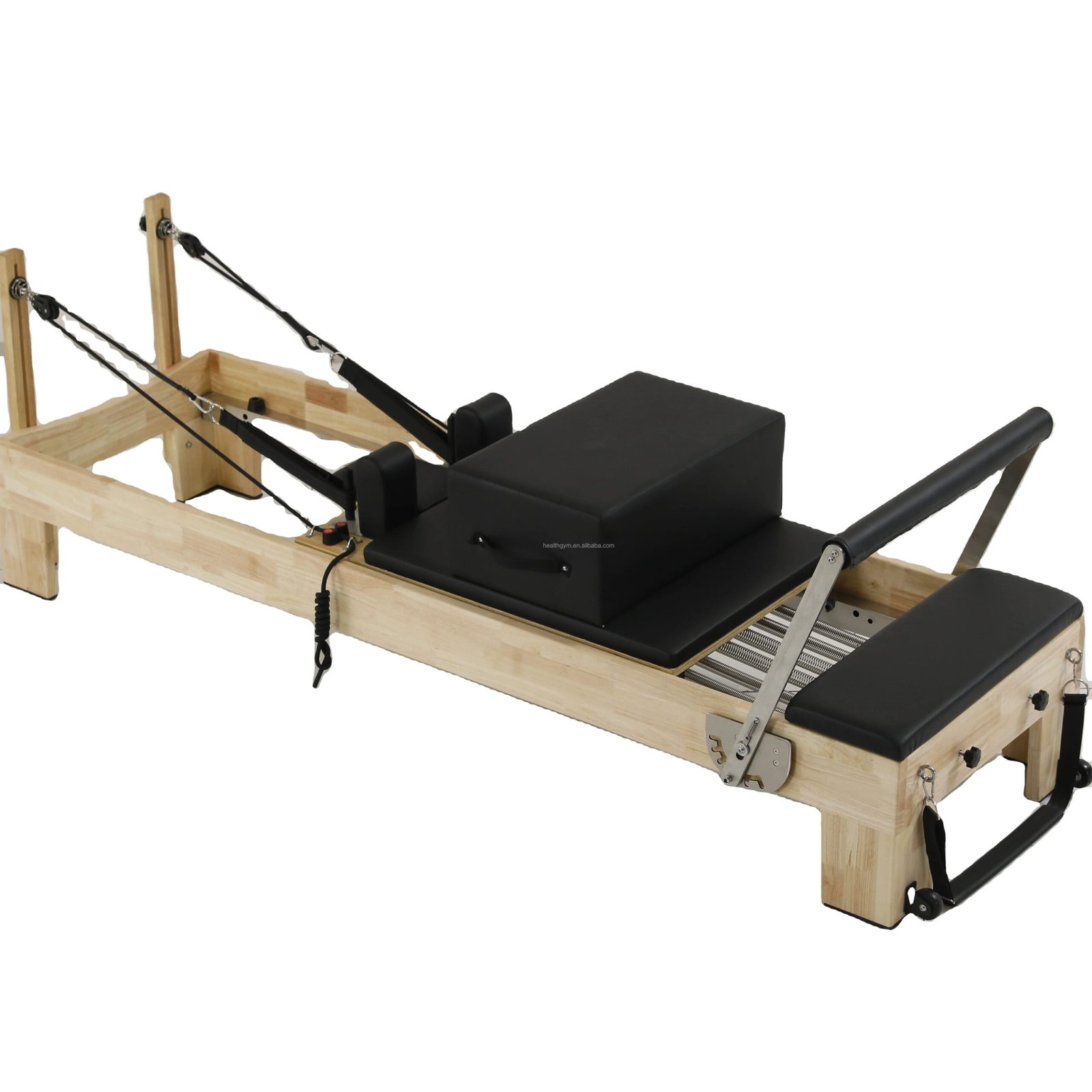
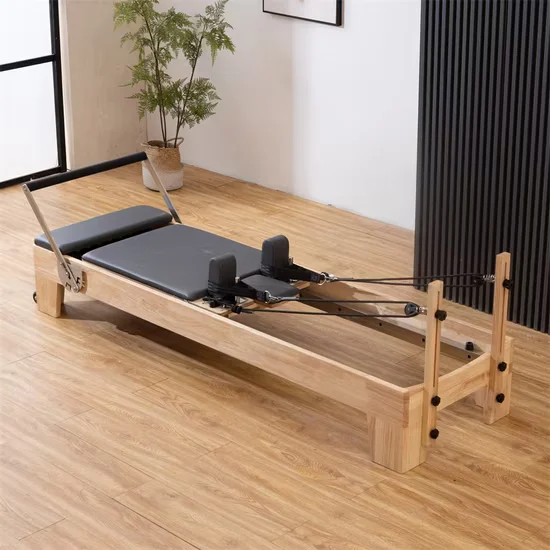
Whisper-Quiet Carriage System — Precision sealed bearings and cushioned maple rails deliver sub-35dB operation verified across hotel studio deployments.
Technical Specifications
| Parameter | Value |
|---|---|
| Product Type | Pilates Reformer |
| Material | Wood |
| Color | Solid Color (White) |
| Product Dimensions | 2460×730×680mm |
| Net Weight | 100kgs |
| Max User Weight | 180kg |
| Noise Level | Sub-35dB |
| Accessory Options | Long Box / Jump Board / Platform |
| Customization | Available (Logo, Color) |
| Production Capacity | 80 Pieces/Month |
| Warranty | 3 Years |
| Certification | CE, EN 957, ISO 9001 |
Application Suitability
| Deployment Scenario | Typical Use |
|---|---|
| hotel fitness center on guest room floors | 24-hour access Pilates sessions requiring whisper-quiet carriage operation to avoid disturbing adjacent rooms |
| boutique Pilates studio | High-frequency group and private classes with continuous carriage cycling throughout operating hours |
| chain gym cardio zone | Supplemental mind-body programming alongside treadmill and elliptical stations for member retention |
| high-end residential home gym | Daily personal practice in shared living spaces where noise transmission matters |
| corporate wellness room | Lunch-break and after-work recovery sessions in multi-use office fitness areas |
Why Noise Complaints Reach the Front Desk Before Maintenance Does
A reformer that creaks under load is already too late — acoustic engineering starts at the bearing seal.
I spent years in the noise and durability lab before moving to technical support, and those Middle East hotel projects taught me things no spec sheet ever will. A five-star property in Dubai installed reformers on the fitness floor directly above guest rooms, and within weeks the front desk was drowning in noise complaints at midnight. The carriage bearings were chattering against aluminum rails under repeated loading cycles, and the vibration transmitted straight through the floor slab. We tore into the carriage system, swapped the batch to precision sealed bearings with cushioned maple rails, and got operation below 35dB. That one job reshaped how I evaluate every rail surface, every spring anchor, and every upholstery fastener we ship out. A commercial pilates reformer wood studio equipment unit that cannot pass acoustic verification at full stroke has no business sitting above occupied rooms [NEED_CITE: acoustic transmission standards for fitness equipment on upper floors].
Where This Reformer Sits in a Studio Layout
This reformer covers full-range Pilates work from foundational mat-series progressions through advanced spring-loaded resistance training, accommodating beginners and experienced practitioners in the same class rotation. In a studio configuration, it pairs with Cadillac and chair stations to distribute member flow across different movement planes and intensity bands. The 2460mm footprint fits standard studio bays with adequate clearance for instructor circulation on both sides. It accommodates users across a wide body-weight range up to 180kg, and the Long Box, Jump Board, and Platform accessories expand the movement library without requiring additional floor space. The commercial pilates reformer wood studio equipment platform supports both private instruction and group formats where data collection and member tracking are managed at the front desk.
Continuous Operation and Studio Environment Demands
A reformer in a fully booked studio cycles through forty or more sessions per day, meaning the carriage, springs, and rail surfaces accumulate wear at a rate that exposes material shortcuts within months. The wood frame must resist humidity fluctuations from adjacent shower facilities and HVAC-driven dry air without warping or developing micro-fractures at the joints. Floor vibration isolation matters when the reformer sits above meeting rooms or guest corridors — a leveling base with isolation pads prevents low-frequency transmission through the slab. Adequate ventilation around the frame preserves upholstery adhesives and prevents leather cracking in desert-climate properties where ambient temperatures in unoccupied floors can spike. Power supply is not a concern for the frame itself, but any integrated accessory lighting or data-capture hardware must match local voltage standards before the container ships [NEED_CITE: continuous duty cycle expectations for commercial Pilates studio equipment].
Reading the Carriage and Frame Specifications
The wood frame material choice directly affects both acoustic dampening and long-term structural behavior under cyclic loading — solid wood absorbs carriage vibration differently than hollow aluminum extrusion, which tends to ring at certain stroke frequencies. The sealed bearing carriage eliminates the metal-on-metal chatter that plagues open-bearing designs after several thousand cycles, and cushioned rail surfaces prevent the high-frequency buzzing that floor slabs amplify into adjacent rooms. The 2460×730mm footprint provides a stable base for full-extension movements while keeping the unit narrow enough for side-by-side studio rows. Spring-based resistance offers a linear load curve that differs fundamentally from friction or pneumatic systems, giving practitioners predictable tension feedback through every millimeter of travel. The 100kg net weight anchors the frame against lateral drift during Jump Board work without requiring bolted floor mounting.
The Hidden Cost of Specification Compromises
A reformer with open bearings and lightweight rails will pass the showroom test but begin chattering audibly within the first quarter of studio operation, triggering guest complaints or member attrition before management connects the problem to equipment. Frames built from composite or low-density wood substitute develop joint looseness under high-frequency cycling, producing creaks that no amount of maintenance lubrication can silence. Springs that lack consistent tension calibration across the set force instructors to compensate verbally rather than trusting the resistance the practitioner feels. Upholstery that cracks or peels within months signals adhesive failure driven by temperature cycling — a problem that shows up consistently in Middle East and Southeast Asia deployments where ambient conditions swing hard between air-conditioned studios and humid storage [NEED_CITE: material fatigue patterns in commercial studio equipment under high-frequency use].
Why This Product Line Holds Up in the Field
Every reformer leaving the facility undergoes acoustic verification at full stroke under load, confirming sub-35dB carriage operation before it clears the shipping dock. The frame and carriage assembly endures 10,000-hour durability testing that simulates continuous studio-frequency cycling across the full spring range. Full OEM and ODM capability covers frame color, leather upholstery selection, logo placement, and accessory bundling to match a studio’s visual identity and functional requirements. The 3D studio layout service accounts for this reformer’s specific footprint and clearance envelope alongside adjacent equipment, ensuring instructor sightlines and member flow work at full occupancy. Documentation packages include noise level test reports and durability records tied to the specific batch, giving facility operators verifiable evidence rather than brochure claims. Technical support responds around the clock across time zones, which matters when a carriage issue surfaces at midnight in a property eight time zones away from the factory.
Documentation & Test Records
- CE declaration of conformity for the complete reformer assembly
- EN 957 test report covering structural and mechanical safety requirements
- ISO 9001 certificate for the manufacturing quality management system
- Noise level test report confirming sub-35dB carriage operation under load
- Durability test record documenting 10,000-hour frame and carriage cycling
- Installation and commissioning guide with spare parts list
Installation, Commissioning & Maintenance
- Verify 2460×730mm footprint clearance with instructor walking space on both sides before floor anchoring
- Level the wood frame on isolation pads to prevent low-frequency vibration transmission to floors below
- Inspect sealed bearing carriage for smooth travel across full rail length before releasing to studio rotation
- Calibrate spring tension set against reference load to ensure consistent resistance across all units in a group
- Schedule rail surface and upholstery inspection at monthly intervals under high-frequency studio scheduling
- Rotate accessory components including Long Box and Jump Board attachment points to distribute wear evenly
Equipment Selection and Inquiry Guidance
Provide your studio floor area and target unit count to receive a 3D layout plan that accounts for this reformer’s footprint, instructor circulation paths, and HVAC airflow requirements. Specify your average daily class volume so we can match frame and carriage durability specifications to your actual duty cycle. Identify the deployment floor and adjacent occupied spaces to confirm acoustic isolation requirements before shipment. State your target market and local voltage standards if any electronic accessories are included in the specification. Indicate whether console data integration or member management software connectivity is required for your operation.
Frequently Asked Questions
Q: How does the carriage system achieve sub-35dB noise levels?
A: The carriage uses precision sealed bearings that eliminate metal-on-metal contact, running on cushioned maple rail surfaces that absorb vibration before it reaches the frame. Each unit undergoes acoustic testing at full stroke under load before leaving the facility, confirming that bearing chatter and rail resonance stay below the threshold that transmits through floor slabs into adjacent occupied spaces.
Q: What customization options are available for the frame and upholstery?
A: The solid wood frame can be finished in custom colors beyond the standard white to match studio aesthetics, and leather upholstery is available in multiple colors and textures. Logo placement and accessory bundling with Long Box, Jump Board, or Platform are all configurable under the OEM program. Minimum order quantities are flexible, and full console UI customization is available if electronic data capture is specified.
Q: How does the wood frame compare to metal frames for studio durability?
A: Solid wood provides natural acoustic dampening that metal extrusion cannot replicate — it absorbs carriage vibration rather than transmitting it through the structure. The frame undergoes 10,000-hour cyclic durability testing to verify joint integrity under continuous studio-frequency use. Wood also resists the surface condensation that causes corrosion on metal frames in humid studio environments, particularly in properties with adjacent spa and shower facilities.
Q: Can the reformer integrate with our existing member management system?
A: If electronic data capture hardware is specified as part of the configuration, the integrated console supports API connectivity for syncing session data with facility management software. Provide your current software platform details during the inquiry stage so we can confirm data handshake compatibility and supply the technical documentation your IT team needs for integration before the equipment arrives.
Q: What is the warranty coverage for commercial studio environments?
A: The reformer carries a three-year warranty covering frame structural integrity, carriage bearing assemblies, and spring system calibration under commercial use conditions. The warranty is backed by 10,000-hour durability test records specific to the frame and carriage components. Spare parts availability and technical support are maintained across export markets with around-the-clock response capability for field issues.
![Commercial Wooden Yoga Balance Board Training Equipment Senrui SRY-15 [WARN] draft identifier mismatch](https://bicksport.com/wp-content/uploads/2026/08/commercial-wooden-yoga-balance-board-training-equipment-senrui-sry-15-warn-draft-identifier-mismatch-a5cad9.webp)