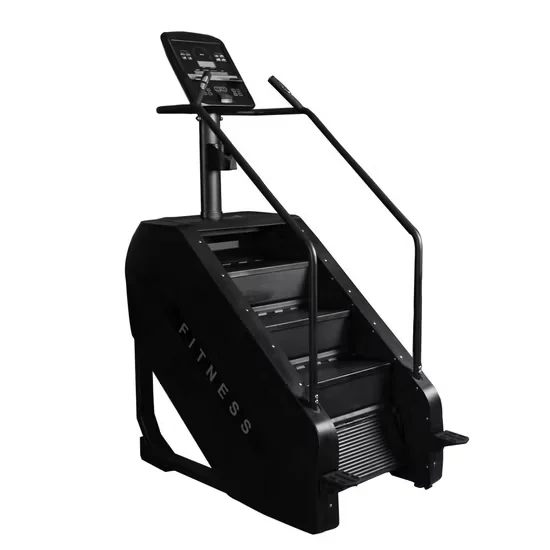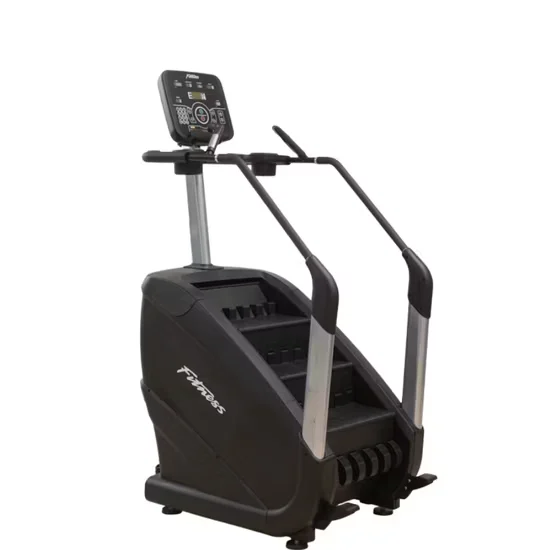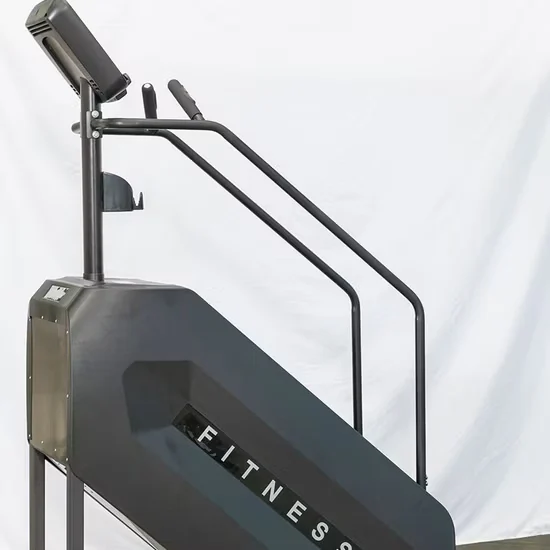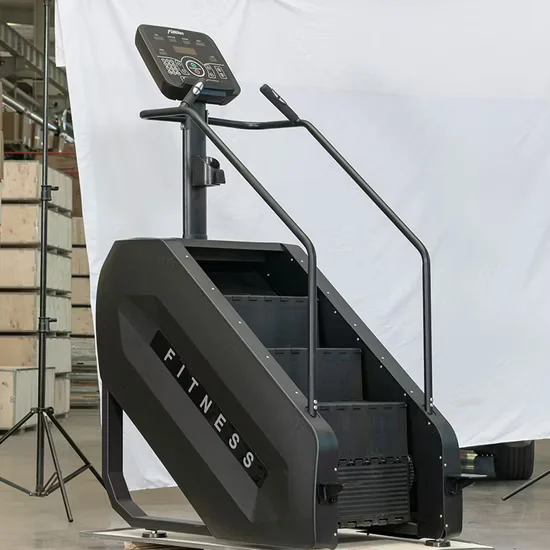
Continuous Operation Verified — Every motor in this unit is bench-tested under sustained load profiles before leaving the factory floor.
Technical Specifications
| Parameter | Value |
|---|---|
| Product Type | Stair Climber |
| Designation | SQ1017 |
| Drive Type | Motor Drive |
| Running Velocity | 15 steps/minute – 164 steps/minute |
| Step Area | 560 x 235 x 220 mm |
| Console Type | OSD (Time, Climb, Calories, Steps, Heart Rate) |
| Heart Rate | Handgrip sensor |
| Power Requirement | AC220V±10% / AC110V±10% |
| Material | Steel Pipe + PP Plastic |
| Product Dimensions | 1450 x 820 x 2080 mm |
| Net Weight | 148 kg |
| Max User Weight | 180 kg |
| Color | Black (customization available) |
| Certification | CE |
Application Suitability
| Deployment Scenario | Typical Use |
|---|---|
| Hotel fitness center on guest room floors | 24-hour self-service access with sub-35dB operation preventing noise bleed to adjacent rooms |
| Chain gym cardio zone | High-frequency interval programming with motor sustained through continuous member turnover |
| Corporate wellness room | Mixed-ability staff usage from low-cadence warm-up to high-intensity sessions |
| Sports performance training center | Athlete-conditioning blocks with heart rate feedback captured through handgrip sensors |
| High-end residential home gym | Daily personal training with motor-driven cadence covering rehabilitation to advanced conditioning |
Why Light-Duty Stepmills Fail Within Months of Gym Deployment
The motor inside the SQ1017 commercial stair climber motor drive SQ1017 is rated for continuous duty, not the peak output figures that mask thermal failure under public use.
Facilities that install residential-grade stair climbers into commercial zones encounter motor burnout within the first high-traffic season. The winding insulation degrades under sustained load, and the control board shuts down mid-session. Members step off mid-climb, and the maintenance log fills with repeat service calls [NEED_CITE: motor duty cycle classification for continuous commercial operation].
Heart rate sensors on economy units drift after weeks of sweat exposure, making interval programming unreliable for coached sessions. When the console cannot export usage data to facility management software, operators lose visibility into which machines are actually being used and which sit idle [NEED_CITE: console data integration requirements for commercial cardio].
Where This Stepmill Sits in the Cardio Training Zone
This unit covers progressive vertical loading from 15 steps per minute for joint-friendly warm-up through 164 steps per minute for high-intensity interval blocks. It pairs with treadmill and elliptical stations to create a complete cardio circuit without duplicating movement patterns. The commercial stair climber motor drive SQ1017 occupies a 1450 x 820 mm footprint, fitting standard spacing grids while the 180 kg user capacity accommodates athletic builds without frame deflection.
Continuous Deployment Requirements for Motor-Driven Step Units
Facilities running this stepmill during peak hours should expect sustained motor engagement with brief cooldown intervals between users. The reinforced steel frame transfers vibration to the floor, requiring a level surface with anti-vibration pads when installed above occupied spaces [NEED_CITE: floor loading standards for commercial cardio deployment]. Dual-voltage input accepts both 220V and 110V supplies, eliminating transformer mismatches when shipping to regions with different grid standards. The OSD console captures session data locally; operators requiring export to facility software should confirm interface compatibility before production.
Motor Drive and Step Mechanism Specifications Explained
The motor drive system in this stair climber replaces manual resistance mechanisms that require users to overcome dead spots at low cadence. A motor-driven stepmill maintains consistent belt tension across the entire 15 to 164 steps per minute range, so members experience uniform resistance whether warming up or sprinting. The 560 x 235 mm step surface provides full foot placement without crowding, accommodating users with wider stances during heavy efforts. Handgrip heart rate sensors deliver real-time feedback without requiring chest strap pairing, though readings may lag during rapid cadence transitions compared to chest strap monitors. The steel pipe frame absorbs torsional loads during asymmetric stepping patterns, preventing the lateral sway that budget frames exhibit under athletic users.
The Hidden Cost of Underspecified Step Units
Purchasing stair climbers with light-duty motors appears economical until the third month of commercial deployment, when thermal cutoffs interrupt sessions and rewinding costs exceed the original equipment price difference. Noise from unbalanced step mechanisms propagates through floor slabs, triggering complaints from adjacent hotel rooms or office spaces and forcing relocation to less accessible floors [NEED_CITE: acoustic transmission through commercial floor assemblies]. Consoles without data export capability leave operators guessing about utilization rates, resulting in underused equipment occupying premium floor space while members queue for functional units. Voltage mismatches discovered after container arrival require transformer procurement, delaying commissioning and leaving cardio zones partially equipped during the critical opening phase.
Why This Product Line Addresses Deployment Gaps
Each SQ1017 undergoes 10,000-hour durability testing on the motor, frame, and step mechanism before batch release, matching the continuous operation demands of 24-hour gym access. The sub-35dB noise floor is verified in hotel installations where stepmills operate directly above sleeping guests without complaint. OEM customization extends to the console UI, allowing facility operators to brand the interface or simplify navigation for unsupervised environments. The complete six-series cardio range means a single source supplies treadmills, bikes, ellipticals, rowing machines, stair climbers, and spinning bikes, simplifying warranty management and spare parts logistics. Free 3D cardio-zone layout planning accounts for this unit’s 1450 x 820 mm footprint plus required clearance, ensuring airflow and sightline considerations are addressed before equipment arrives. Technical support responds around the clock across time zones, so commissioning issues do not wait for the next business day.
Documentation & Test Records
- CE declaration of conformity covering electrical safety and EMC requirements
- EN 957 test report validating structural integrity and safety under cyclic loading
- ISO 9001 certificate confirming manufacturing process control
- Motor specification sheet detailing continuous duty rating and thermal characteristics
- Noise level test report documenting acoustic output under operational load
- Console technical documentation with data output specifications
- Installation and commissioning guide with calibration procedures
- Spare parts list with component-level ordering codes
Installation, Commissioning & Maintenance
- Allocate 1450 x 820 mm footprint plus clearance on all sides for safe user entry and exit
- Install on level surface with anti-vibration pads when deployed above occupied floors
- Connect to dedicated circuit matching specified AC220V or AC110V supply without shared loads
- Calibrate step mechanism and verify zero-cadence stability before releasing to member use
- Inspect step bearings and lubrication points at intervals matching facility usage density
- Wipe handgrip sensors and console surface daily to prevent sweat corrosion on contact points
Specifying the Right Stepmill for Your Facility
Provide the total cardio zone area and planned unit count to receive a 3D layout that positions this stepmill within your member flow pattern and airflow plan. Specify expected daily usage hours so the motor duty cycle is matched to your operation’s intensity. Identify the deployment floor and adjacent room functions to confirm that acoustic performance meets your noise tolerance. State the target market voltage standard so the correct power configuration ships from production. Indicate whether console data must integrate with your existing facility management platform so interface requirements are scoped before manufacturing begins.
Frequently Asked Questions
Q: What is the difference between motor drive and manual resistance in stair climbers for commercial use?
A: Motor-driven stepmills like the SQ1017 maintain consistent step tension across the entire cadence range, eliminating the dead spots that manual resistance systems produce at low speeds. This consistency matters in commercial facilities where members range from rehabilitation users at 15 steps per minute to athletes performing high-intensity intervals above 140 steps per minute. The motor also reduces mechanical wear compared to friction-based manual systems, lowering maintenance frequency under continuous public use.
Q: How does the step velocity range support both rehabilitation and high-intensity athletic training?
A: The 15 to 164 steps per minute range allows progressive loading within a single machine. Rehabilitation protocols begin at low cadence where joint loading is minimal, while athletic conditioning uses the upper range for cardiovascular stress. Motor-driven operation means the transition between these intensities happens without mechanical gear shifts, so members do not experience abrupt resistance changes that could disrupt movement patterns or cause missteps.
Q: Can the console data integrate with facility management software or member apps?
A: The OSD console captures session metrics including time, climb, calories, steps, and heart rate in real time. Whether this data exports to external platforms depends on the specific interface configuration selected during OEM customization. Operators requiring data integration should specify their facility management system and data format requirements during the quotation phase so compatibility is confirmed before production begins.
Q: What maintenance is required for the motor drive and step mechanism under daily commercial use?
A: The motor drive system requires periodic inspection of electrical connections and thermal performance verification. The step mechanism needs bearing inspection and lubrication at intervals determined by facility usage density. Handgrip heart rate sensors benefit from daily cleaning to maintain conductivity. Facilities should schedule preventive maintenance based on actual usage hours rather than calendar intervals, and the spare parts list provides component-level ordering information for consumable items.
Q: How do I confirm voltage compatibility before shipment to avoid deployment delays?
A: The SQ1017 accepts both AC220V±10% and AC110V±10% input, covering most international grid standards. During the quotation and proforma invoice stage, specify the exact deployment region and plug type so the correct power cord and internal configuration are installed at the factory. This confirmation step eliminates the need for third-party transformers and prevents commissioning delays that occur when voltage mismatches are discovered after container arrival.