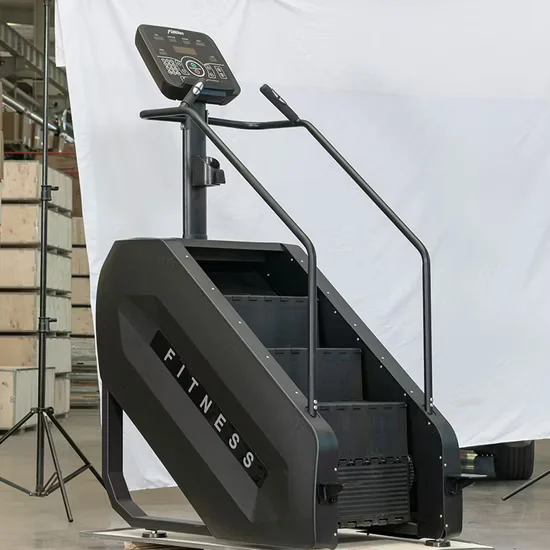
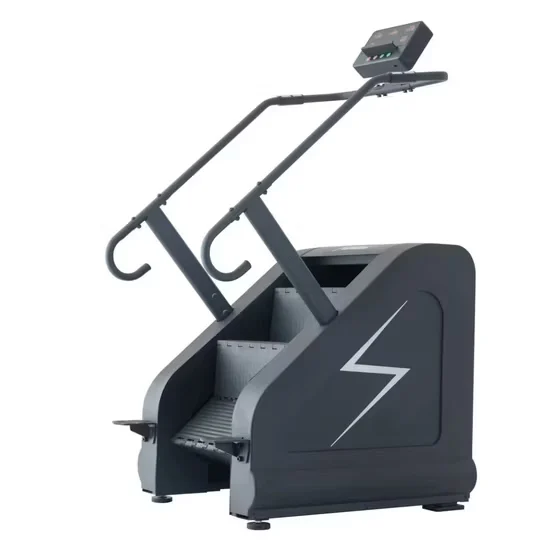
Continuous Duty Validated — Motor-driven stepmill engineered for 10,000+ hours of high-frequency gym operation under continuous commercial loading.
Technical Specifications
| Parameter | Value |
|---|---|
| Product Type | Stair Climber |
| Drive Type | Motor Drive |
| Running Velocity | 15–164 steps/minute |
| Step Area | 560 × 240 × 200 mm |
| Console Type | OSD (Time, Climb, Calories, Steps, Heart Rate) |
| Power Requirement | AC220V±10% / AC110V±10% |
| Product Dimensions | 1400 × 700 × 2000 mm |
| Net Weight | 148 kg |
| Material | Steel Pipe + PP Plastic |
| Folded | Unfolded |
| Color | Black |
| Certification | CE |
Application Suitability
| Deployment Scenario | Typical Use |
|---|---|
| International chain gym cardio zone | High-frequency vertical cardio station complementing treadmills and ellipticals |
| Hotel fitness center on guest room floors | Quiet motor-driven stepmill for 24-hour guest access without noise complaints |
| Corporate wellness room | Space-efficient vertical climbing station for employee conditioning programs |
| Sports performance training center | Step-based interval programming for athlete lower-body conditioning |
| High-end residential home gym | Dedicated climbing modality for residents seeking varied cardio options |
Why Light-Commercial Stair Climbers Fail Within Months of Gym Deployment
Motor-driven step mechanisms rated for continuous commercial duty cycles survive where light-commercial units burn out.
Facility operators frequently discover that stair climbers spec’d for light-commercial environments cannot sustain the run-times demanded by public fitness floors. The motor and drive components overheat under back-to-back user loading, leading to premature bearing wear and drivetrain failure. I’ve walked through cardio zones where half the stepmills sat behind caution tape — not from abuse, but from duty-cycle mismatch [NEED_CITE: motor duty cycle classification for continuous commercial operation]. When a commercial stair climber motor driven gym installation fails early, the replacement cost extends beyond the unit itself to member dissatisfaction and revenue loss.
Where a Vertical Stepper Fits in a Commercial Cardio Layout
A motor-driven stair climber occupies a distinct intensity band in the cardio matrix — sustained lower-body loading with higher caloric demand per minute than flat-ground walking. In a configured cardio zone, it complements treadmills for steady-state runners and ellipticals for low-impact cross-training. The vertical footprint of this commercial stair climber motor driven gym unit requires overhead clearance planning, making it suitable for zones with standard or raised ceilings. The step area accommodates a broad range of user stances, and the steel frame supports consistent loading across varied body types without lateral flex.
Continuous Run-Time and Floor Deployment Considerations
A stair climber on a public fitness floor may cycle through users for ten or more hours daily, placing sustained thermal and mechanical demands on the drive motor [NEED_CITE: EN 957 requirements for commercial cardio equipment]. The sealed drivetrain in this unit is engineered to dissipate heat across extended sessions without requiring forced cooling. Dual voltage input (AC220V±10% / AC110V±10%) allows direct deployment in markets with different mains standards without external transformers. Floor placement should account for the unit’s 148 kg net weight and vertical motion profile — a level substrate with vibration-dampening pads prevents low-frequency transmission to occupied spaces below. OSD console output provides core workout metrics, and any data integration with facility management systems should be confirmed during commissioning.
Decoding the Drive and Frame Specifications
The motor-driven step mechanism delivers adjustable velocity from 15 to 164 steps per minute, covering rehabilitation-paced climbing through high-intensity interval workloads. Unlike self-powered climbers that rely on user weight to drive the mechanism, a motor-driven system maintains consistent cadence regardless of the user’s mass, reducing drivetrain shock loading. The steel pipe frame provides torsional rigidity under repeated asymmetric stepping forces — a critical factor when hundreds of users mount and dismount daily. The OSD console displays time, climb, calories, steps, and heart rate, giving members immediate feedback without the complexity of touchscreen navigation. PP plastic components in non-load-bearing areas reduce overall unit weight while maintaining impact resistance in high-traffic environments. The 560 × 240 mm step area provides adequate surface for stable foot placement across a wide user range.
The Hidden Cost of Underspecifying Step Climbers
Light-commercial motors installed in high-traffic gyms routinely fail within months, not from defect but from thermal overload under continuous public loading [NEED_CITE: commercial cardio motor thermal failure patterns]. Operators who select equipment based on unit price alone often face compounded costs: emergency replacement orders, downtime signage, and member attrition as the cardio zone shrinks. Voltage mismatches discovered post-delivery force transformer installations or unit returns, delaying facility opening. Inadequate structural rigidity in the frame manifests as lateral sway during use, generating noise and eroding user confidence in the equipment’s safety.
Why This Line Addresses Commercial Deployment Risks
Every unit undergoes durability testing verified at 10,000 hours of continuous operation on motors, frames, and drive components. Sub-35dB noise levels are validated in hotel floor deployments, confirming suitability for noise-sensitive environments above occupied rooms. The six-series cardio family means a facility can source treadmills, bikes, ellipticals, rowers, climbers, and spinning bikes from one production line — simplifying maintenance and spare parts inventory. OEM customization covers console UI adaptation, allowing operators to match branding or language requirements. Free 3D cardio-zone layout planning addresses this stepmill’s 1400 × 700 mm footprint, overhead clearance, and airflow spacing alongside other units. Technical support operates around the clock for commissioning and operational issues.
Documentation & Test Records
- CE declaration of conformity for this stair climber model
- EN 957 test report covering structural and safety performance
- ISO 9001 certificate for manufacturing quality management
- Noise level test report with sub-35dB verification data
- 10,000-hour durability test record on motor and drivetrain
- OSD console technical documentation with data output specifications
Installation, Commissioning & Maintenance
- Confirm 1400 × 700 × 2000 mm clearance including overhead space before positioning
- Level the substrate and install vibration pads to isolate motor vibration from floor structure
- Verify AC220V±10% or AC110V±10% supply matches target market before powering the unit
- Calibrate step velocity range across the 15–164 steps/min spectrum during initial commissioning
- Inspect sealed drivetrain and motor bearings per scheduled intervals for wear indicators
- Clean OSD console surface and step treads daily to prevent sweat corrosion on steel components
Planning Your Equipment Inquiry
Provide your cardio zone square footage and planned unit count to receive a 3D layout addressing this stepmill’s overhead and airflow requirements. Specify expected daily operating hours so the motor duty-cycle can be validated against your traffic volume. Identify the deployment floor and adjacent occupied spaces to confirm noise compatibility. State your target market voltage standard to ensure correct power configuration at shipment.
Frequently Asked Questions
Q: What are the maintenance differences between motor-driven and self-powered stair climbers?
A: Motor-driven units require periodic inspection of the drive motor, sealed bearings, and step mechanism for wear. Self-powered climbers depend on user weight to drive the mechanism, which increases mechanical stress on linkages during heavy-user sessions. Motor-driven systems maintain consistent cadence across users, reducing shock loading on drivetrain components and extending service intervals in high-traffic commercial environments.
Q: How does the 15–164 steps/min range support different workout programming?
A: The lower end of the range suits warm-up protocols, rehabilitation sessions, and steady-state endurance work. Higher velocities support interval training and athletic conditioning programs that demand rapid cadence shifts. The motor maintains target speed regardless of user weight, allowing instructors to program precise step-rate targets without cadence drift caused by varying user loads on self-powered units.
Q: Can the OSD console integrate with facility management software?
A: The OSD console displays core metrics including time, climb, calories, steps, and heart rate directly on screen. Data integration capability with external facility management systems or member apps depends on the specific console configuration selected. Operators should confirm their data connectivity requirements during the customization scoping phase to ensure the appropriate interface is included at production.
Q: What noise considerations apply when deploying this climber near occupied spaces?
A: The motor-driven mechanism operates within sub-35dB thresholds verified in hotel deployments, making it suitable for floors above guest rooms or residential units. Proper installation on leveled substrates with vibration-dampening pads prevents low-frequency structural transmission. Confirming the deployment environment during the layout planning phase ensures appropriate isolation measures are specified before equipment arrival.
Q: How does dual voltage input affect international deployment?
A: The unit accepts AC220V±10% and AC110V±10% input, covering the two primary mains standards across export markets. This eliminates the need for external step-down or step-up transformers, which introduce additional failure points and occupy floor space. Voltage configuration should be confirmed at order to ensure correct internal wiring and plug standard for the destination market.
![High-Strength Commercial Stair Machine for Hotel Gyms [WARN] draft identifier mismatch](https://bicksport.com/wp-content/uploads/2026/08/high-strength-commercial-stair-machine-for-hotel-gyms-warn-draft-identifier-mismatch-99a47f.webp)