

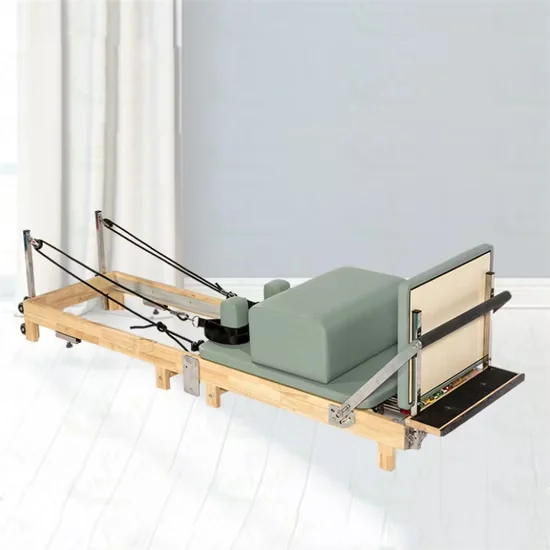
Commercial-Grade Foldable Design — SRY-02 reformer Pilates machine delivers reinforced steel frame stability with modular accessory compatibility for high-frequency studio deployment.
Technical Specifications
| Parameter | Value |
|---|---|
| Designation | SRY-02 |
| Product Type | Foldable Reformer Pilates Machine |
| Product Dimensions | 2460 x 730 x 680 mm |
| Net Weight | 100 kg |
| Accessory | Long Box / Jump Board / Platform |
| Color | Solid Color (customizable) |
| Logo | Customized Is Allowed |
| Warranty Time | 3 Years |
| Foldable | Yes |
| Origin | China |
| Certification | CE, ISO 9001 |
Application Suitability
| Deployment Scenario | Typical Use |
|---|---|
| Boutique Pilates studio | Back-to-back group reformer classes with quick accessory swaps |
| Hotel wellness center on guest room floors | Space-limited programming with foldable storage between sessions |
| Rehabilitation and physiotherapy clinic | Patient recovery protocols using adjustable spring resistance |
| High-end residential home gym | Private Pilates practice with minimal footprint when not in use |
| Corporate wellness room | Multi-discipline fitness equipment sharing limited square footage |
Why Carriage Rail Wear Forces Studios into Early Equipment Replacement
Sealed bearing carriage systems maintain smooth glide performance under continuous daily class schedules.
When studios deploy light-duty reformers, carriage rails develop uneven wear patterns within the first year of back-to-back classes. Instructors start hearing grinding noises during footwork sequences, and clients complain about jerky carriage movement that disrupts flow. Facilities then face unplanned equipment downtime while sourcing replacement parts, often losing member retention during the repair window. The foldable reformer Pilates machine commercial operators select must account for thousands of carriage cycles per week [NEED_CITE: carriage rail hardness standards for commercial Pilates equipment].
How This Reformer Fits Into a Multi-Discipline Studio Layout
The SRY-02 covers full-range Pilates programming from rehabilitation-grade gentle resistance to athletic jump board sequences, occupying the core movement zone in boutique studios. It complements mat work stations and tower apparatus by providing spring-loaded carriage resistance that targets deep stabilizer muscles. The foldable reformer Pilates machine commercial facilities deploy in multi-purpose rooms pairs well with cardio equipment like rowing machines when space requires flexible zoning. Its reinforced steel frame accommodates users across diverse body weights and training intensities without carriage drift or spring fatigue.
Continuous Daily Operation and Studio Environment Requirements
Boutique studios running five to seven group classes daily subject carriage systems to sustained load cycles that expose material weaknesses. The sealed bearing carriage on the SRY-02 maintains glide smoothness through high-frequency setup and breakdown when instructors reconfigure rooms between sessions. Foldable mechanisms require durable hinge points tested for repeated deployment, otherwise studios encounter loosening joints that compromise frame stability [NEED_CITE: foldable mechanism durability testing for commercial fitness equipment]. Proper floor leveling prevents uneven carriage drift that accelerates rail wear, while adequate spacing around the 2460 x 730 mm footprint ensures safe limb extension during overhead reach sequences.
Spring Resistance Range and Frame Construction Standards
The SRY-02 uses a multi-spring resistance system where instructors adjust tension by engaging or disengaging individual springs, providing graduated load progression from rehabilitation protocols to athletic conditioning. Commercial-grade springs maintain consistent tension curves through thousands of compression cycles, unlike light-duty alternatives that lose resistance calibration. The reinforced steel frame supports dynamic jump board exercises where impact forces multiply body weight during plyometric sequences. Modular accessory attachment points accept the long box for seated work, jump board for cardio intervals, and platform for standing balance work without requiring separate equipment purchases. Full OEM/ODM customization allows facility operators to specify color finishes and logo placement that align with brand identity.
The Hidden Cost of Specifying Light-Duty Reformer Frames
Studios that purchase residential-grade reformers for commercial deployment encounter frame fatigue within months of daily class schedules. Weld points develop stress fractures under repeated jump board impact, creating safety liabilities that force facilities into emergency equipment replacement. Carriage rails on light-duty models show visible scoring that produces uneven glide, generating client complaints about jerky movement that disrupts controlled exercise execution. The resulting unplanned downtime and reputational damage from negative reviews outweigh any initial cost savings from specifying lower-grade equipment [NEED_CITE: commercial vs residential Pilates equipment duty cycle classification].
Why Facilities Select This Product Line for Studio Deployment
The SRY-02 addresses spatial constraints in boutique studios and hotel wellness rooms through its foldable frame design, allowing facilities to reconfigure multi-purpose spaces between class formats. Its reinforced steel frame and sealed bearing carriage system withstand continuous daily operation across multiple class sessions without glide degradation. The modular accessory system expands exercise programming options without requiring additional equipment purchases or storage space. Full OEM/ODM customization including color, logo, and specification options enables brand-aligned facility deployment. Facilities receive complete documentation including CE declaration of conformity, EN 957 test reports, and installation guides that streamline commissioning. The 3-year warranty provides coverage confidence for high-frequency commercial deployment scenarios.
Documentation & Test Records
- CE declaration of conformity for European market compliance
- EN 957 test report validating safety and performance standards
- ISO 9001 certificate confirming quality management systems
- Noise level test report for studio acoustic environment planning
- Durability test records documenting carriage cycle performance
- Installation and commissioning guide with spare parts list
Installation, Commissioning & Maintenance
- Allow minimum 600 mm clearance around 2460 x 730 mm footprint for safe limb extension and instructor circulation
- Verify floor levelness before deployment to prevent carriage drift and uneven rail wear
- Test all spring attachment points and accessory mounting hardware during initial commissioning
- Inspect carriage rail surfaces monthly for scoring or debris accumulation that impedes smooth glide
- Lubricate carriage bearings per manufacturer schedule to maintain consistent movement quality
- Clean upholstery and frame surfaces after each class to prevent sweat corrosion on steel components
Equipment Selection and Deployment Planning
Facility operators should provide studio square footage and equipment count to receive 3D layout recommendations covering equipment spacing and member flow. Specify anticipated daily class frequency to match frame durability requirements with actual usage intensity. Confirm whether the reformer will be stored folded between sessions or remain permanently deployed to assess hinge mechanism duty requirements. Clarify target market voltage standards if any electronic accessories or lighting integration is planned for the deployment environment.
Frequently Asked Questions
Q: What materials and construction standards ensure long-term carriage glide smoothness?
A: The SRY-02 uses a reinforced steel frame with sealed bearing carriage systems designed for high-frequency studio operation. Commercial-grade rails maintain dimensional stability through thousands of compression cycles, preventing the scoring and uneven wear patterns that plague light-duty alternatives. Proper floor leveling during installation prevents drift that accelerates rail degradation.
Q: How does the foldable mechanism hold up under daily studio setup and breakdown cycles?
A: The foldable frame incorporates durable hinge points tested for repeated deployment without loosening or structural compromise. Studios running multiple class formats daily benefit from quick reconfiguration capability without sacrificing frame rigidity during use. Regular inspection of hinge hardware ensures continued smooth operation throughout the equipment service life.
Q: Can the reformer accommodate clients with varying body weights and resistance needs?
A: The multi-spring resistance system allows instructors to adjust tension by engaging different spring combinations, supporting rehabilitation protocols through athletic conditioning. The reinforced steel frame accommodates diverse body weights during dynamic jump board sequences without carriage drift or frame flex. Spring replaceability ensures long-term tension calibration accuracy.
Q: What OEM customization options are available for facility branding and color matching?
A: Full OEM/ODM customization includes solid color finish selection, logo placement, and specification adjustments to match facility brand identity. Studios and wellness centers can coordinate equipment aesthetics with interior design schemes without compromising structural performance. Customization scoping occurs during the quotation phase before production commitment.
Q: How does the accessory system expand exercise programming without additional equipment investment?
A: The modular accessory system accepts a long box for seated and supine work, jump board for plyometric cardio intervals, and platform for standing balance sequences. Attachment points are integrated into the frame design, eliminating the need for separate equipment purchases or dedicated storage space. This modularity maximizes exercise variety within limited studio footprints.

![Senrui SRY-20B Foldable Reformer Pilates Machine for Studio [WARN] draft identifier mismatch](https://bicksport.com/wp-content/uploads/2026/08/senrui-sry-20b-foldable-reformer-pilates-machine-for-studio-warn-draft-identifier-mismatch-f418d7.webp)
![Professional Aluminum Pilates Reformer Machine Bed for Studio Fitness[WARN] draft identifier mismatch](https://bicksport.com/wp-content/uploads/2026/08/professional-aluminum-pilates-reformer-machine-bed-for-studio-fitnesswarn-draft-identifier-mismatch-f493b9.webp)