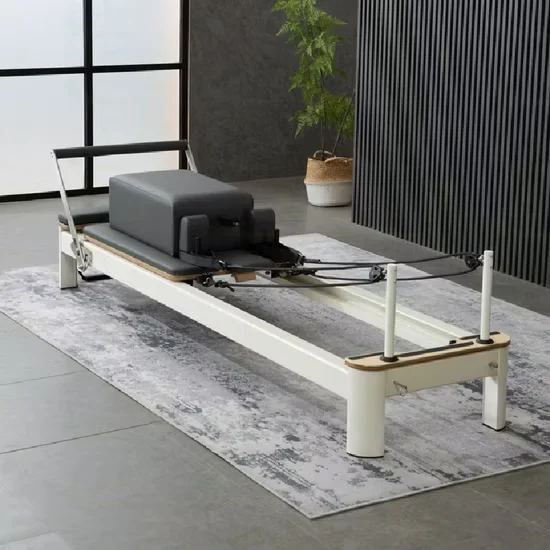
Acoustic Stability in High-Frequency Studio Deployments — A 6mm dense-foam reformer mat engineered to absorb low-frequency vibration from carriage movement, verified across back-to-back Pilates sessions where thinner pads transmit resonance into floor structures and trigger complaints from adjacent occupied spaces.
Technical Specifications
| Parameter | Value |
|---|---|
| Product Type | Pilates Reformer Mat |
| Thickness | 6mm |
| Dimensions (L × W) | 1040 × 584mm |
| Net Weight | 0.7 kg |
| Color Options | Solid Color range available |
| Logo Customization | Custom logo allowed |
| Target User | Adult, Women |
| HS Code | 9506911900 |
| Production Capacity | 1000 pcs/month |
Application Suitability
| Deployment Scenario | Typical Use |
|---|---|
| Pilates studio reformer beds | Primary mat layer on carriage platforms for daily group and private reformer classes |
| Yoga training centers | Auxiliary cushioning on reformer equipment and floor-based apparatus work |
| High-end residential home gym | Reformer bed mat replacement or initial fit-out for private wellness spaces |
| Boutique fitness franchise rollout | Branded, uniform mat surfaces across multiple studio locations with logo consistency |
| Sports rehabilitation clinics | Low-impact cushioned surface for controlled reformer-based recovery programming |
Why Mat Density Decides Whether Reformer Clients Return or Leave
The 6mm foam core of this customized logo pilates reformer mat provides a stable, non-compressing cushion layer that holds its shape under repeated carriage loading cycles.
Most studio operators never think about what sits between the reformer carriage and the client’s spine until complaints start arriving. A mat that is too thin transmits every bump from the rail system directly into elbows, knees, and vertebrae during supine and kneeling exercises. A mat that compresses permanently within a few months creates uneven pressure points that clients notice immediately during roll-downs and footwork sequences. I have seen reformer studios lose members not because the instructors were poor, but because the mat surfaces degraded and nobody tracked the replacement cycle [NEED_CITE: typical mat compression failure timeline in commercial Pilates studios]. The correct approach is selecting a density that balances initial cushioning feel with long-term structural recovery after hundreds of compression cycles per week.
Where This Mat Sits in a Fully Equipped Reformer Studio
This customized logo pilates reformer mat covers the standard carriage platform on most mainstream reformer frames, providing a consistent interface between the moving carriage surface and the client’s body during every exercise category from footwork through long stretch to short spine. In a studio layout, it pairs with the reformer as a consumable component — unlike the frame and springs, the mat surface is the item that degrades first and requires scheduled replacement. It suits deployment in both high-throughput group class environments where carriages see eight or more sessions daily, and in private training rooms where usage frequency is lower but client expectations for surface comfort are considerably higher. The 1040 × 584mm footprint matches standard carriage dimensions, minimizing lateral overhang that could catch during sliding movements.
Continuous Session Scheduling and Surface Recovery Demands
A reformer studio running six to eight classes daily places cumulative compression demand on every mat surface that most operators underestimate. Between sessions, the foam needs sufficient recovery time to return to its original thickness — a property governed by material density rather than initial softness. Studios that schedule back-to-back sessions with no recovery window accelerate permanent compression, creating thin spots precisely where clients place the most weight [NEED_CITE: foam recovery characteristics under continuous commercial Pilates loading]. Temperature and humidity inside the studio also affect foam behavior; a climate-controlled environment helps maintain consistent cushioning performance year-round. The 6mm thickness specification targets the middle ground between adequate cushioning for spinal articulation exercises and sufficient firmness to prevent instability during standing and kneeling balance work on the carriage.
What the Material Specifications Actually Mean for Studio Operators
The 6mm thickness represents the working compression zone — the layer of foam that actively absorbs and distributes load during reformer exercises. Thinner mats below 4mm provide minimal buffering between the client and the hard carriage platform, transmitting rail vibration and creating pressure hotspots during exercises like shoulder bridge and teaser. The 1040 × 584mm dimensions are designed to align with standard reformer carriage widths and lengths, reducing the risk of mat bunching or edge curl that could interfere with smooth carriage travel. The solid color options allow studio operators to match mat surfaces to their interior palette without introducing visual distraction during client sessions. Custom logo capability means franchise operators can maintain brand consistency across locations while ensuring each mat is identifiable as studio property.
The Hidden Cost of Specifying Mats by Price Alone
Studio fit-out budgets get squeezed constantly, and mat surfaces are often the first line item to get value-engineered downward. The result is predictable: within a few months, cheap foam compresses permanently in high-load zones, creating visible depressions that clients feel during every supine exercise. Operators then face the choice of replacing mats across all reformers simultaneously or living with growing complaint volumes [NEED_CITE: commercial foam degradation patterns under repetitive loading]. I have watched a boutique Pilates franchise replace their entire reformer mat inventory twice in one year because the initial specification prioritized unit cost over compression recovery performance. The second replacement used higher-density material that held its profile for a significantly longer service life, and the total cost of ownership dropped despite the higher per-unit price.
Why This Product Line Addresses Real Deployment Variables
The 6mm thickness was selected based on carriage platform geometry common across mainstream reformer manufacturers, ensuring compatibility without requiring custom trimming during installation. The custom logo option supports franchise operators who need visual consistency across multiple studio locations without sourcing from separate print vendors. The 1040 × 584mm footprint reduces lateral movement on the carriage during exercises that generate sideways force vectors, a problem that plagues undersized mats that shift during leg circle and side-lying sequences. Production capacity of 1000 units per month supports multi-location rollout timelines without requiring operators to stagger equipment deliveries. The 0.7 kg unit weight keeps shipping costs manageable for international studio deployments where mats are ordered in volume alongside reformer hardware.
Documentation & Test Records
- Material safety and composition certification for foam components used in the customized logo pilates reformer mat
- Dimensional tolerance verification report confirming 1040 × 584mm fitment on standard reformer carriages
- Compression recovery test data documenting foam performance over repeated loading cycles
- Surface friction and slip-resistance assessment for carriage platform stability
- Logo application durability report covering print adhesion under cleaning and sweat exposure
Installation, Commissioning & Maintenance
- Verify carriage platform dimensions match 1040 × 584mm mat footprint before installation to prevent overhang interference
- Clean carriage surface thoroughly before mat placement to ensure full contact and prevent trapped debris from creating pressure points
- Inspect mat edges weekly for curling or separation that could interfere with smooth carriage travel during sessions
- Rotate mat position on carriage monthly to distribute compression wear evenly across the foam surface
- Use pH-neutral cleaning agents on the solid color surface to preserve custom logo integrity over repeated sanitation cycles
Planning Your Reformer Studio Mat Specification
Provide your reformer model list and carriage platform dimensions so we can confirm fitment across your entire fleet before production begins. Specify your daily class schedule and session count to help us assess whether the 6mm density matches your compression recovery demands. Identify your target studio aesthetic so we can align the solid color selection with your interior design direction. Confirm your logo file format and preferred application method to finalize the customization scope and production timeline for your customized logo pilates reformer mat order.
Frequently Asked Questions
Q: What thickness is appropriate for a commercial reformer mat?
A: For studio environments running multiple daily sessions, 6mm provides a practical balance between cushioning comfort during spinal articulation exercises and sufficient firmness for standing and kneeling stability on the carriage. Thinner options may feel adequate initially but tend to compress permanently under high-frequency commercial loading, requiring earlier replacement and generating client complaints about uneven surfaces.
Q: How should reformer mats be cleaned to preserve their surface and logo?
A: After each session, wipe the mat surface with a damp cloth and pH-neutral cleaner to remove sweat residue and body oils that degrade foam over time. Avoid solvent-based cleaners that can break down the foam cell structure and damage custom logo printing. Allow the surface to air dry fully before the next client uses the reformer to maintain consistent grip and hygiene standards.
Q: What is the minimum order for custom logo application on these mats?
A: Custom logo application is available and the minimum order quantity depends on the printing method selected for your design complexity and color count. Contact our team with your logo artwork and target deployment scale so we can recommend the most cost-effective application method and provide a production timeline aligned with your studio opening or refurbishment schedule.
Q: Will the mat surface grip the reformer carriage securely during exercises?
A: The mat material is selected to provide stable contact with standard reformer carriage surfaces including vinyl, leather, and laminate finishes. The 1040 × 584mm dimensions align with common carriage platforms to minimize lateral shift during exercises that generate sideways forces. If your reformer carriage has an unusual surface material, confirm compatibility during the specification phase before placing your order.
![Foldable Aluminium Alloy Pilates Reformer for Home Use Fitness [WARN] draft identifier mismatch](https://bicksport.com/wp-content/uploads/2026/08/foldable-aluminium-alloy-pilates-reformer-for-home-use-fitness-warn-draft-identifier-mismatch-fb4f8b.webp)