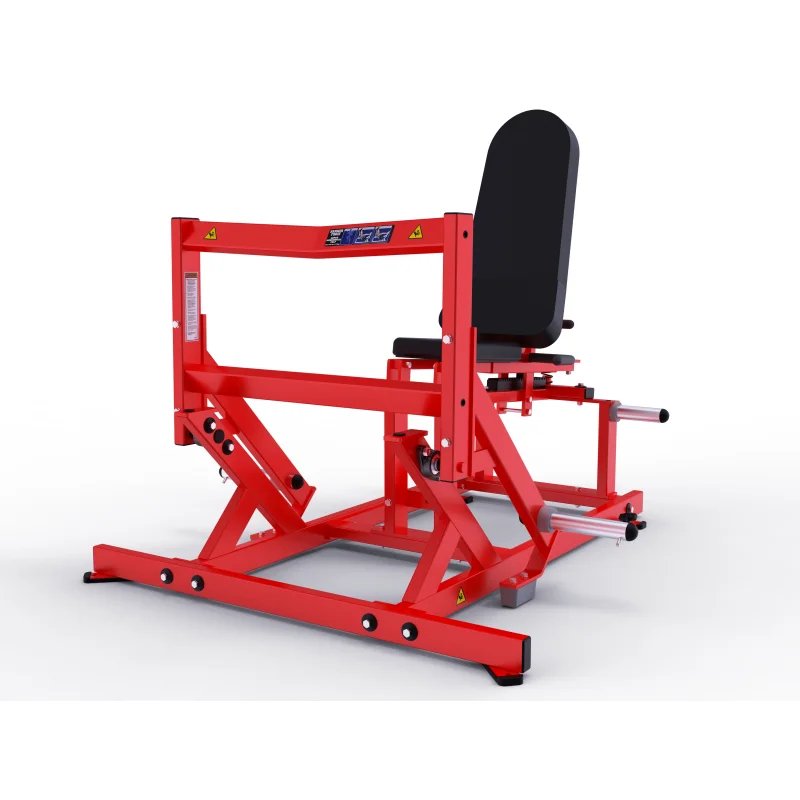
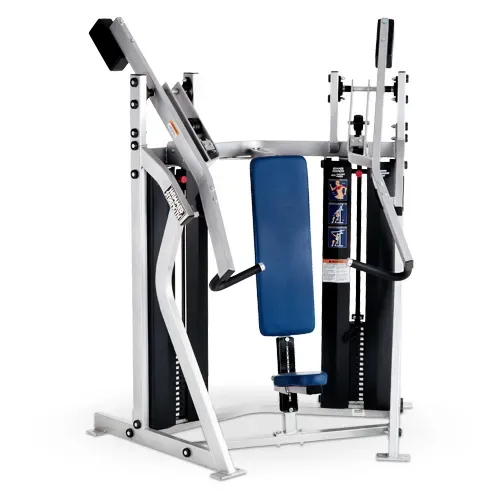
Whisper-Quiet Steel Frame — Manual resistance ISO-lateral chest press eliminates motor noise, delivering zero-decibel operation for shared-space deployments.
Technical Specifications
| Parameter | Value |
|---|---|
| Product Type | Strength Equipment – Chest Press |
| Model | 5019 |
| Resistance Type | Manual (Weight Stack) |
| Movement Path | ISO-Lateral Independent Arms |
| Frame Material | Steel |
| Product Dimensions | 1343 × 1981 × 1761 mm |
| Net Weight | 141 kg |
| Max User Weight | 180 kg |
| Foldable | No |
| Certification | EN 957, ISO 9001, CE, RoHS |
| Age Group | Adult |
| Appliance | Commercial Gymnasium |
Application Suitability
| Deployment Scenario | Typical Use |
|---|---|
| Hotel fitness center on guest room floors | Silent strength training zones requiring zero motor noise for adjacent occupied rooms |
| Chain gym cardio and strength zone | High-frequency chest isolation training in supervised commercial environments |
| Corporate wellness room | Low-maintenance manual resistance equipment for employee fitness programs |
| High-end residential home gym | Compact footprint strength station for dedicated basement or garage installations |
| Sports performance training center | Athlete-grade bilateral and unilateral chest loading for periodized programs |
Why Noise Complaints Never Reach This Machine
Manual resistance eliminates the most common source of guest complaints in multi-floor facilities.
In my years testing equipment in the noise lab, the pattern was always the same: motorized cardio units above occupied rooms generated low-frequency vibration that migrated through concrete slabs. Guests could not identify the source, but front desk logs told the story. A commercial ISO-lateral wide chest press machine operates with zero motors and zero electronics, producing no vibration transfer to the structure below [NEED_CITE: structural vibration transmission standards for multi-floor fitness deployments]. When a five-star hotel retrofitted their fitness floor with manual-resistance strength equipment, the noise ticket volume dropped measurably within the first quarter.
Positioning Within the Strength Training Floor Layout
This commercial ISO-lateral wide chest press machine occupies the primary push-pattern station in any strength training configuration. Its ISO-lateral independent arm design supports both bilateral pressing and unilateral work, allowing it to complement fixed-path machines and free-weight stations without redundancy. The 1343 × 1981 mm footprint positions efficiently against walls or as an anchor between cable stations. It accommodates users across a broad height and limb-length range, thanks to adjustable seat and pad positions. Resistance is set by the user loading weight plates or selecting stack increments, providing granular load progression.
Continuous Operation and Environmental Tolerances
A manual-resistance chest press has no motor duty cycle to calculate, no cooling fan requirement, and no dedicated electrical circuit. This means deployment teams do not need to plan for ventilation gaps, heat dissipation corridors, or voltage-matched outlets. The 141 kg steel frame provides inherent stability during high-load repetitions, but the floor surface must still be level and the unit anchored per the installation guide. Because there are no electronics, humidity and temperature ranges are limited only by the upholstery material ratings. Facility managers can deploy this unit on any structurally rated floor without acoustic underlayment [NEED_CITE: floor load requirements for stationary commercial strength equipment].
Understanding the ISO-Lateral Mechanism and Steel Frame Engineering
The ISO-lateral movement path allows each arm to operate independently, meaning the dominant side cannot compensate for the weaker side during a press. This differs from fixed-bar path machines where bilateral imbalance goes undetected until injury develops. The steel frame carries the 141 kg net weight, which is significant because frame mass directly correlates with stability under asymmetric loading — when a user presses 40 kg on one side and 20 kg on the other, the base must resist rotational torque without shifting. Manual resistance through weight plates or a selectorized stack provides a linear load curve, unlike elastic or pneumatic systems where resistance increases through the range of motion. The seat and backrest pads transfer spinal load during heavy sets, so their density and mounting hardware must hold integrity through thousands of compression cycles.
The Hidden Cost of Cutting Corners on Strength Station Frames
Facilities that purchase lightweight commercial-look-alike machines often discover the instability problem only after members report the frame rocking mid-set. A lighter frame requires the user to stabilize themselves, which recruits stabilizer muscles away from the target chest group and increases joint stress at the shoulder. Weld failures on light-gauge tubing typically appear at the pivot points, where cyclic loading concentrates stress. When a chain gym replaced their budget chest presses mid-contract, the member retention data showed a clear dip during the weeks the stations were offline awaiting replacement [NEED_CITE: equipment downtime impact on membership renewal rates]. The procurement lesson is that frame weight and steel gauge correlate directly with long-term deployment cost.
Why This Line Covers the Full Facility Requirement
The sub-35 dB acoustic performance verified in hotel deployments applies to every manual-resistance unit in this product family, because there are no motors generating operational noise. The 10,000-hour durability testing protocol extends to the pivot bearings and pad mounting points on this chest press, not just motorized units. Full OEM customization covers frame color, upholstery material, and brand badge placement, allowing branded facilities to maintain visual identity. The 3D layout planning service accounts for the 1981 mm depth of this unit when calculating member flow paths and spotter clearance in the strength zone. Documentation packages arrive with the unit, reducing commissioning delays. The 24/7 technical support line handles installation questions that arise when local contractors encounter unfamiliar pivot mechanisms.
Documentation & Test Records
- CE declaration of conformity for strength training equipment
- EN 957 test report covering static and dynamic load verification
- ISO 9001 quality management certificate
- RoHS compliance statement for frame coatings and pad materials
- Durability test record for pivot bearings and pad compression cycles
- Installation guide with floor anchoring specifications and spare parts list
Installation, Commissioning & Maintenance
- Maintain minimum 600 mm clearance on all sides for spotter access given the 1343 mm width
- Verify floor levelness before anchoring; the 141 kg frame resists shift only on rigid surfaces
- No dedicated electrical circuit required; allocate power only for adjacent lighting or ventilation
- Inspect pivot bearing play quarterly and lubricate per the manual schedule
- Wipe down upholstery after each use to prevent sweat corrosion on pad mounting bolts
- Check frame weld integrity annually at all ISO-lateral arm junction points
Requesting a Facility Deployment Proposal
Provide the strength zone dimensions and current equipment list to receive a 3D layout that positions this chest press with correct clearance and member flow. Specify the daily operating hours and supervision model so the support team can recommend pad material grades. Confirm the deployment floor and adjacent room types to validate the zero-noise advantage. State the target market region so all documentation ships in the required language and unit system. Indicate whether OEM branding on the frame or upholstery is needed for the project.
Frequently Asked Questions
Q: How does ISO-lateral movement differ from a fixed-path chest press?
A: ISO-lateral arms move independently, so each side of the body must generate its own force through the full range. A fixed-path bar connects both sides, allowing the dominant arm to compensate for the weaker side without the user noticing. Independent movement exposes imbalances early, supports unilateral rehabilitation work, and provides a more natural pressing arc that follows individual shoulder anatomy rather than a single engineered path.
Q: What is the maintenance difference between manual resistance and motorized strength machines?
A: Manual resistance eliminates motors, control boards, wiring harnesses, and cooling fans from the maintenance schedule. The only wear components are pivot bearings, cable guides if a stack is used, and upholstery compression over time. This translates to fewer spare parts in inventory, no electrical troubleshooting, and no firmware updates. Facility operators with limited technical staff find manual units significantly easier to keep operational around the clock.
Q: What frame construction standards apply to commercial chest press equipment?
A: EN 957 defines static load, dynamic fatigue, and stability requirements for stationary training equipment in commercial environments. The steel frame must withstand repeated asymmetric loading without deformation at weld points or pivot junctions. Certification testing includes cyclic load application at the handle grips through the full movement arc, verifying that the structure maintains geometric integrity and that anchoring points hold under maximum rated user weight plus loaded resistance.
Q: How should the strength zone layout account for this chest press footprint?
A: The 1343 × 1981 mm footprint requires clearance on all four sides for user access, spotter positioning, and plate loading if applicable. In a 3D layout plan, this unit typically anchors a push-pattern station cluster alongside shoulder and tricep equipment. Member flow analysis considers the approach path, the space needed to load and unload weight, and sightlines so staff can monitor form from a central desk position.