

Whisper-Quiet Deployment — Steel frame and magnetic resistance tested for sub-35dB operation in shared commercial spaces.
Technical Specifications
| Parameter | Value |
|---|---|
| Product Type | Incline Chest Press Machine |
| Material | Steel |
| Resistance Type | Manual |
| Product Dimensions | 1350mm × 1650mm × 1350mm |
| Net Weight | 92kg |
| Foldable | Unfolded |
| Max User Weight | 180kg |
| Power Source | Manual |
| Exercise Part | Chest |
| Age Group | Adult |
| Gender | Unisex |
| Certification | CE, ISO 9001, RoHS |
Application Suitability
| Deployment Scenario | Typical Use |
|---|---|
| Chain gym strength zone | High-frequency chest isolation training across peak hours |
| Hotel fitness center on guest room floors | Low-noise upper body work without disturbing adjacent rooms |
| Corporate wellness room | Compact footprint for targeted chest exercises during lunch breaks |
| High-end residential home gym | Durable steel construction for daily personal training routines |
| Sports performance training center | Biomechanically guided incline pressing for athlete programs |
Why Noise Complaints Reach the Front Desk Before Maintenance Does
Structural vibration transmits through floor slabs long before a bearing fails audibly.
When a commercial incline pec fly machine gym unit develops play in its pivot joints, the resulting harmonic resonance travels through concrete far more efficiently than airborne sound. I once traced a five-star hotel complaint to a selectorized unit whose guide rods had worn unevenly — the friction noise was negligible at the machine, but the floor-borne vibration registered clearly in the suite below. Specifying equipment with sealed bearings and reinforced weld joints eliminates this transmission path before guests ever notice [NEED_CITE: structural vibration transmission in multi-story fitness deployments].
Positioning Within a Strength Training Floor
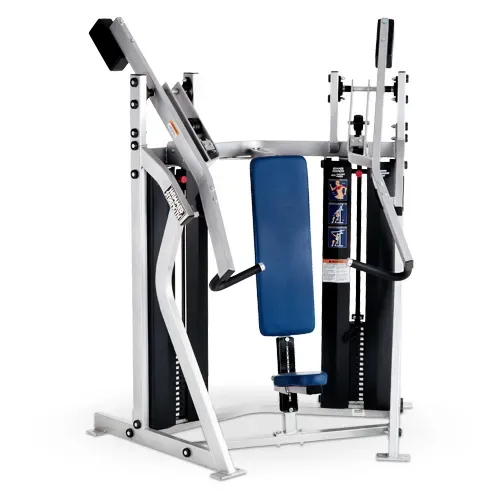
This commercial incline pec fly machine gym unit targets the upper pectoral fibers through a fixed incline pressing arc, complementing flat bench and cable crossover stations already present in most strength zones. It suits moderate to high-density deployment where members cycle through isolation movements in supersets. The 1350mm × 1650mm footprint fits standard spacing grids without requiring oversized safety perimeters, and the steel frame accommodates users up to 180kg across a broad range of torso lengths.
Continuous Operation and Floor-Level Deployment Constraints
A selectorized chest press in a 24-hour gym may see 150+ sets daily, placing sustained cyclic loads on every pivot bushing and guide rod. Units deployed on suspended floor slabs require vibration isolation pads to prevent structure-borne noise from reaching occupied spaces below. Manual resistance systems avoid the heat buildup that motorized units generate in poorly ventilated corners, though ambient airflow still matters for user comfort during extended sessions. Facilities should verify that the deployment surface is level within tolerance to prevent asymmetric loading on the frame welds [NEED_CITE: cyclic load fatigue standards for commercial strength equipment].
Reading the Resistance and Frame Specifications
Manual resistance on this unit means the user’s own force input drives the movement — there is no motor, flywheel, or magnetic brake generating parasitic noise or requiring electrical service. The 92kg net weight reflects a steel frame substantial enough to resist lateral deflection during heavy unilateral pressing. CE and ISO 9001 certifications confirm that the welds, fasteners, and pivot hardware meet recognized commercial durability standards. RoHS compliance ensures that surface coatings and plastic components contain no restricted substances, which matters for facilities pursuing green building certifications. The unfolded configuration means the unit ships and installs as a single rigid assembly, eliminating folding hinge mechanisms that introduce maintenance points.
The Hidden Cost of Underspecified Strength Equipment
Light-commercial frames in high-traffic gyms develop pivot play within months, producing the clicking and rattling that drives members toward competitor facilities. I have seen operators replace entire selectorized rows because the original units used sintered bushings instead of sealed bearings — the maintenance labor alone exceeded the cost differential of specifying commercial-grade hardware from the start. Units that lack proper weld reinforcement at high-stress joints can develop hairline cracks invisible during casual inspection, creating liability exposure that no amount of preventive maintenance catches in time [NEED_CITE: fatigue failure patterns in commercial strength equipment frames].
Why This Product Line for Your Facility
Every unit undergoes 10,000-hour durability testing on pivots, bushings, and frame welds — verifying that the commercial incline pec fly machine gym unit holds alignment through years of cyclic loading. The sub-35dB noise floor applies across the entire cardio and strength range, so you can specify matching quiet performance from treadmills to chest presses. Our 3D layout service covers this unit’s 1350mm × 1650mm footprint along with sightlines and member flow paths, ensuring the strength zone does not become a bottleneck. Full OEM customization extends to frame color and upholstery, so the equipment aligns with your interior design specification. Technical support responds around the clock with parts and troubleshooting guidance.
Documentation & Test Records
- CE declaration of conformity covering structural and mechanical safety requirements
- EN 957 test report validating load ratings and pinch-point clearances
- ISO 9001 certificate confirming manufacturing quality management processes
- RoHS compliance documentation for coatings and polymer components
- Durability test record for pivot bearings and frame weld fatigue cycles
- Installation and commissioning guide with recommended anchor specifications
Installation, Commissioning & Maintenance
- Allow minimum clearance on all sides of the 1350mm × 1650mm footprint for safe user entry and exit
- Verify floor levelness before anchoring; use shims if deviation exceeds tolerance at any foot pad
- Inspect all pivot bushings and fasteners after the first 500 use cycles and retorque to specification
- Apply recommended lubricant to guide rods and pivot points per the maintenance schedule in the commissioning guide
- Wipe down steel frame and upholstery after each use to prevent sweat-induced corrosion on weld seams
- Check selectorized pin and cable routing monthly for wear or misalignment
Requesting a Facility-Specific Proposal
Share your strength zone floor area and existing equipment list so we can generate a 3D layout incorporating this unit’s footprint and member circulation paths. Indicate daily operating hours and expected user volume so we can confirm that the manual resistance configuration matches your throughput requirements. Specify the deployment floor level and adjacent room types so we can advise on vibration isolation pad selection. Confirm your target market’s electrical standards even though this unit is manually powered, in case your layout includes motorized equipment from the same product line.
Frequently Asked Questions
Q: What separates commercial strength equipment from light-commercial alternatives?
A: Commercial units use sealed bearings, reinforced weld patterns, and thicker-gauge steel to withstand continuous multi-user operation throughout extended operating hours. Light-commercial frames often rely on sintered bushings and thinner tubing that degrade under the same duty cycle, producing pivot play, noise, and eventual structural fatigue that compromises both user experience and safety margins.
Q: How do I evaluate frame durability before purchasing?
A: Request the fatigue test record showing how many load cycles the frame and pivot hardware endured before any deflection exceeded tolerance. Verify that welds are continuous rather than spot-welded at high-stress junctions. Check the net weight as a proxy for material gauge — heavier frames generally indicate thicker steel and more substantial reinforcement at load-bearing joints.
Q: What are the maintenance advantages of manual resistance over selectorized systems?
A: Manual resistance eliminates the cable, pulley, and weight stack mechanisms that require regular inspection and adjustment in selectorized units. There are no cables to fray, no weight selectors to misalign, and no guide rods to lubricate. The trade-off is that users must load external plates or rely on body weight, which suits facilities prioritizing low maintenance over convenience.
Q: How should I plan strength zone layout for efficient member flow?
A: Position compound movement stations along primary sightlines and place isolation equipment like incline presses in secondary zones to prevent congestion. Allow adequate clearance between units for safe loading and spotting. Consider ceiling height requirements for overhead movements and ensure ventilation reaches all stations to maintain air quality during peak occupancy periods.
![Hammer Strength Plate-Loaded ISO-Lateral Kneeling Leg Curl Gym Equipment [WARN] draft identifier mismatch](https://bicksport.com/wp-content/uploads/2026/08/hammer-strength-plate-loaded-iso-lateral-kneeling-leg-curl-gym-equipment-warn-draft-identifier-mismatch-247b68.webp)
![Hammer Strength ISO-Lateral Front Lat Pulldown Gym Equipment [WARN] draft identifier mismatch](https://bicksport.com/wp-content/uploads/2026/08/hammer-strength-iso-lateral-front-lat-pulldown-gym-equipment-warn-draft-identifier-mismatch-b890da.webp)
![2019 Hammer Strength Smith Machine 45 Commercial Integrated Gym Trainer [WARN] draft identifier mismatch](https://bicksport.com/wp-content/uploads/2026/08/2019-hammer-strength-smith-machine-45-commercial-integrated-gym-trainer-warn-draft-identifier-mismatch-fd8e91.webp)