
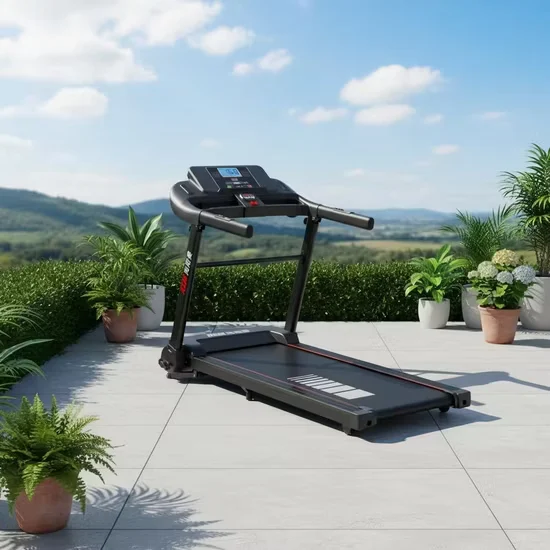
Low-Profile Foldable Frame — MT026M collapses to under 400mm in height, enabling storage against walls or beneath furniture in space-constrained home fitness environments.
Technical Specifications
| Parameter | Value |
|---|---|
| Designation | MT026M |
| Product Type | Foldable Treadmill |
| Motor Power | 1.5HP (peak or continuous not specified in source) |
| Speed Range | 1–12 km/h |
| Running Surface | 1200 x 460 mm |
| Console Type | LCD (Speed / Distance / Time / Calories / Pulse) |
| Programs | 12 |
| Product Unfold Dimensions | 1465 x 750 x 1150 mm |
| Product Folded Dimensions | 1465 x 750 x 390 mm |
| Net Weight | 46.0 kg |
| Foldable | Yes |
| Material | ABS |
| Certification | CE, RoHS |
| OEM/ODM | Available |
Application Suitability
| Deployment Scenario | Typical Use |
|---|---|
| High-end residential home gym | Daily personal training in apartments or rooms where foldability is essential between sessions |
| Corporate wellness room | Low-volume employee fitness use during breaks with equipment stored away after hours |
| Boutique studio recovery zone | Light warm-up or cool-down walking between coached sessions with minimal foot traffic |
Why the Drive System Matters in a Foldable Motorized Treadmill 1.5HP Home Use Setup
A foldable treadmill lives or dies by how well its motor and deck isolation handle the physics of a lighter frame.
Foldable treadmills deployed in shared residential spaces or home offices generate two problems that surface within weeks: low-frequency vibration transferring through floor joists, and motor strain from insufficient thermal mass in a compact housing. The MT026M foldable motorized treadmill 1.5HP home use configuration addresses this through a lighter frame that requires careful attention to placement surface and duty cycle expectations [NEED_CITE: vibration transmission characteristics of lightweight treadmill frames on residential flooring]. When the running surface sits directly above occupied rooms or beside shared walls, buyers must verify actual noise output before committing to a deployment, because marketing specifications rarely reflect real-world acoustic behavior under continuous walking or running loads.
Positioning This Unit Within a Compact Cardio Layout
The MT026M covers steady-state walking through moderate running at speeds up to 12 km/h, fitting the cardiovascular warm-up and active recovery intensity bands. In a small home gym or corporate wellness room, it pairs with free-weight stations or resistance equipment rather than competing with other cardio machines for floor space. The 1200 x 460 mm running surface accommodates users of average to moderately tall stature for walking and jogging, though taller users performing full-stride running may find the deck length restrictive. As a foldable motorized treadmill 1.5HP home use unit, it stores vertically when not in use, returning the room to its original function.
Continuous Operation and Environmental Placement Requirements
A unit at this weight class and motor rating is engineered for intermittent daily sessions rather than all-day continuous operation in a shared facility. Deploying it in a hotel guest floor or high-traffic commercial cardio zone exceeds the thermal capacity typical of this motor class [NEED_CITE: motor duty cycle classification for continuous commercial operation]. The 46 kg net weight means the frame relies on the floor surface for stability, requiring a level and firm substrate rather than thick carpet. Adequate clearance behind the unit is necessary for heat dissipation from the motor housing, and the power connection must match local voltage standards before the unit leaves the production line.
Reading the Motor and Console Specifications Accurately
The 1.5HP motor rating requires clarification on whether it represents peak output or continuous duty — peak horsepower describes short-burst capacity, while continuous duty determines what the motor sustains under an extended running session without thermal degradation. The LCD console displays speed, distance, time, calorie estimates, and pulse readings, providing essential workout feedback without external connectivity. Pulse data is captured through handgrip sensors, which offer convenience but introduce reading variance compared to chest-strap monitors during high-movement running. The 12 preset programs adjust speed intervals automatically, removing the need for manual console input mid-session. The foldable motorized treadmill 1.5HP home use design prioritizes compact storage over the belt isolation and frame mass found in full commercial units.
The Hidden Cost of Underspecified Drive Components
Deploying a home-rated treadmill in a corporate wellness room with six-hour daily usage leads to motor winding failure within months, requiring full unit replacement rather than a simple component swap. Noise complaints in residential deployments often trace back to insufficient motor-to-frame isolation, forcing facility managers to relocate equipment or replace entire batches. When LCD consoles lack data export capability, usage patterns remain invisible to facility operators, preventing informed decisions about equipment rotation or maintenance scheduling [NEED_CITE: facility management data integration requirements for cardio equipment]. Voltage mismatches discovered after shipment result in transformer costs or complete electrical rework at the destination.
Why This Product Line Addresses the Selection Gap
The MT026M sits within a six-series cardio family, meaning a facility sourcing multiple disciplines can consolidate specifications and spare parts through one engineering team. The OEM scope covers console interface customization, allowing corporate wellness operators to align the display with internal branding or programming guidelines. Sub-35dB operation has been verified in hotel deployments for the commercial range, and while this foldable unit targets a different use class, the same acoustic engineering discipline informs the drive isolation approach. The foldable motorized treadmill 1.5HP home use unit benefits from the same 10,000-hour component testing protocol applied across the product family. Free 3D cardio-zone layout planning covers the spatial and airflow requirements specific to this unit’s footprint and ventilation needs, ensuring it is not placed in a dead-air corner where heat accumulates around the motor housing.
Documentation & Test Records
- CE declaration of conformity covering electrical safety and electromagnetic compatibility
- RoHS compliance documentation confirming restriction of hazardous substances in components
- Motor specification sheet detailing winding class, thermal protection, and duty cycle rating
- Console technical documentation with LCD segment map and program logic description
- Noise level test record measured under defined load and speed conditions
- Installation and commissioning guide with leveling, belt tension, and first-run calibration steps
Installation, Commissioning & Maintenance
- Maintain minimum clearance behind and beside the 1465 x 750 mm unfolded footprint for heat dissipation and safe mounting
- Place on a level, rigid surface with a vibration-dampening mat to reduce low-frequency transfer to the floor structure
- Confirm local voltage and plug standard match the motor specification before connecting to a dedicated circuit
- Run the belt at low speed without load during first commissioning to verify tracking and listen for drive irregularities
- Inspect belt tension and apply manufacturer-specified lubricant at intervals defined in the maintenance schedule
- Wipe the LCD console and handgrip pulse sensors after each session to prevent sweat corrosion on contact surfaces
Specifying the Right Unit for Your Deployment
Provide the available floor area and intended daily usage hours so the motor duty rating can be matched to your operational reality. Specify the deployment floor level and adjacent room occupancy to confirm whether the acoustic profile suits the environment. State your target market voltage and plug standard to prevent post-shipment electrical rework. Indicate whether workout data export to facility management software is required, as this determines whether the standard LCD console meets your operational needs or a connectivity-capable model is more appropriate.
Frequently Asked Questions
Q: What is the difference between peak and continuous motor horsepower, and why does it matter?
A: Peak horsepower measures the maximum output a motor delivers in short bursts, while continuous horsepower indicates sustained output during extended use. A motor rated only at peak may overheat during long running sessions. Always request the continuous duty specification sheet before deploying any treadmill in environments where daily use exceeds thirty minutes per session.
Q: Can a foldable treadmill handle daily use in a shared residential or hotel environment?
A: Foldable treadmills are engineered for personal or low-volume use rather than continuous multi-user operation. In hotel or shared residential settings, verify the motor duty cycle rating and actual noise output under load. Units rated for light commercial or home use may require earlier replacement when subjected to high-frequency daily operation.
Q: Does the LCD console support external app connectivity for workout data sync?
A: The standard LCD console on this model displays speed, distance, time, calories, and pulse locally without external connectivity. If workout data export to facility management software or personal training apps is required, specify this during the inquiry stage so a console variant with appropriate data output can be evaluated.
Q: How does running surface length affect stride comfort for different user heights?
A: A 1200 mm running surface accommodates walking and jogging for most users comfortably. Taller individuals performing full-stride running may find the deck length restrictive and may naturally shorten their stride. For environments serving users above average height at running speeds, a longer deck should be considered during equipment selection.

![W08 Electric Folding Treadmill for Home Use DC Motor Walking Machine [WARN] draft identifier mismatch](https://bicksport.com/wp-content/uploads/2026/08/w08-electric-folding-treadmill-for-home-use-dc-motor-walking-machine-warn-draft-identifier-mismatch-d6c377.webp)
![Wear-Resistant Mt296 ABS Electric Treadmill for Warm-up and Gym Use [WARN] draft identifier mismatch](https://bicksport.com/wp-content/uploads/2026/08/wear-resistant-mt296-abs-electric-treadmill-for-warm-up-and-gym-use-warn-draft-identifier-mismatch-7e7732.webp)