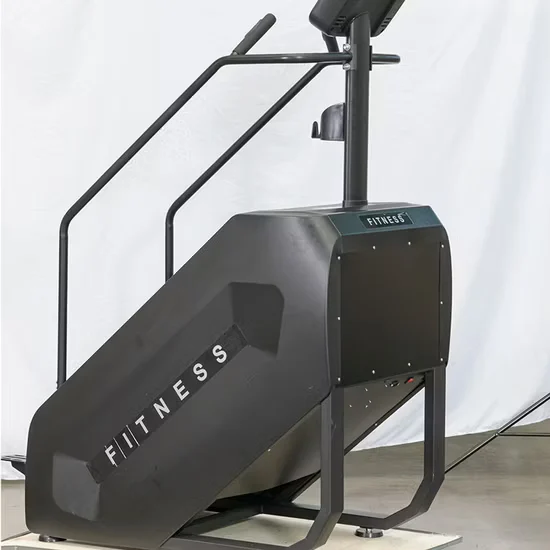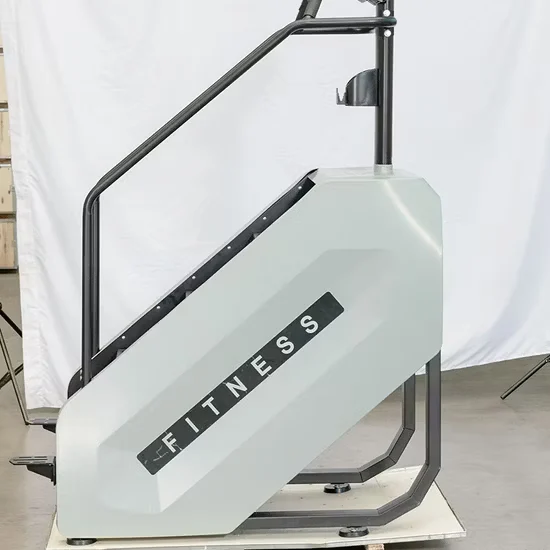
Engineered Duty Cycles — Every motor in this stair climber is tested for 10,000 hours of continuous operation before leaving the factory floor.
Technical Specifications
| Parameter | Value |
|---|---|
| Designation | SQ1017 |
| Product Type | Stair Climber |
| Type of Drive | Motor Drive |
| Running Velocity | 15 steps/Minute – 164 steps/Minute |
| Max User Weight | 180kg |
| Step Area | 560 x 235 x 220mm |
| Console Display (OSD) | Time, Climb, Calories, Steps, Heart Rate |
| Mains Input | AC220V±10% / AC110V±10% |
| Material | Steel Pipe + PP Plastic |
| Product Dimensions | 1450 x 820 x 2080mm |
| Net Weight | 148kg |
| Folded | Unfolded |
| Color | Black |
| Customization | Available (logo, color, console UI, specification) |
| Certification | CE |
Application Suitability
| Deployment Scenario | Typical Use |
|---|---|
| Hotel fitness center on guest room floors | 24-hour guest access with low-noise operation requirements |
| Chain gym cardio zone | High-frequency member use during peak and off-peak hours |
| Corporate wellness room | Employee fitness breaks with moderate daily traffic |
| High-end residential home gym | Shared cardio equipment for multi-unit residential buildings |
| Sports performance training center | Interval and steady-state conditioning for athletes |
What Peak Horsepower Hides About Continuous Duty in a Commercial Stair Climber
A motor rated for peak output tells you nothing about what it can sustain through a 16-hour operating day.
Light-duty stair climbers often carry motors that perform adequately during a 20-minute demo but overheat when subjected to continuous back-to-back users in a commercial environment. I have seen facility managers replace entire cardio fleets within a year because the motor duty cycle was never matched to actual deployment conditions [NEED_CITE: motor duty cycle classification for continuous commercial operation]. The SQ1017 commercial stair climber motor drive is engineered around sustained thermal thresholds rather than peak bursts, which is the only specification that matters when the equipment runs from early morning to late night without interruption.
Where This Stepmill Fits in a Mixed Cardio Layout
This unit fills the vertical climbing niche that treadmills and ellipticals leave open, recruiting glutes, quads, and calves through a full extension pattern that seated equipment cannot replicate. The step speed range from 15 to 164 steps per minute supports both low-intensity steady-state sessions and high-intensity interval blocks, making it a versatile anchor in any cardio zone. It pairs naturally with rowing machines for posterior chain balance and complements exercise bikes for users recovering from lower-body impact. The 180kg user weight capacity and generous 560 x 235mm step area accommodate a broad range of body types. The commercial stair climber motor drive delivers workout metrics including time, climb distance, calories, step count, and heart rate through the onboard console, giving facility managers visibility into actual usage patterns.
Operational Demands Across Different Deployment Environments
Facilities running cardio equipment for 16 or more hours daily need motors that maintain thermal stability under continuous load without tripping thermal cutoffs. In hotel environments where the fitness center sits directly above or beside occupied guest rooms, structure-borne vibration and airborne noise become primary selection criteria — not just for the motor but for the entire step mechanism and frame resonance [NEED_CITE: EN 957 requirements for commercial cardio equipment]. Adequate clearance around the 1450 x 820mm footprint allows passive airflow to reach the motor housing and prevents heat accumulation that shortens component lifespan. The dual voltage input (AC220V±10% / AC110V±10%) eliminates the plug-standard surprises that delay commissioning when equipment arrives in a different market. Console data output should be verified against the facility management platform before deployment to avoid stranded workout sessions.
Motor Drive Mechanics and Step Speed Engineering
Motor-driven stair climbers use an electric motor to control step descent rate, meaning the user works against a powered mechanism rather than relying on body weight alone to drive a hydraulic or mechanical resistance system. This design delivers consistent resistance feel regardless of user weight, unlike manual systems where heavier users experience different loading characteristics. The 15 to 164 steps per minute range spans from rehabilitation-paced stepping to aggressive interval work, and the motor maintains set speed without the drift common in friction-based systems. Steel pipe construction throughout the frame and step assembly provides the rigidity needed to prevent flex under maximum load, while PP plastic components reduce weight in non-structural areas. The console tracks heart rate alongside performance metrics, giving trainers the feedback needed to program intensity accurately without relying on external monitors that users frequently forget to wear.
The Hidden Cost of Underspecified Equipment
Purchasing stair climbers rated for light commercial or home use and deploying them in 24-hour hotel fitness centers leads to motor burnout within months, not years. Noise from underbuilt step mechanisms generates guest complaints that force management to relocate or remove equipment entirely. Consoles that capture workout data but cannot output it to facility management software create operational blind spots — managers see machines in use but cannot track which units are overutilized and approaching maintenance thresholds [NEED_CITE: facility management system integration standards for commercial cardio]. Voltage mismatches discovered after the container arrives mean weeks of downtime while transformers or replacement power supplies are sourced locally. These failures are not equipment defects; they are specification failures that occur when the procurement decision ignores deployment conditions.
Why This Product Line Earns Its Place in Commercial Deployments
Every unit undergoes 10,000-hour durability testing on motors, sealed bearings, and step mechanisms before it ships, which is the baseline for equipment expected to run continuously in public facilities. The motor drive system in this commercial stair climber maintains consistent speed under variable loading, preventing the lurching feel that frustrates users on lesser equipment. Console firmware supports data output for integration with third-party facility management platforms, so workout sessions do not sit stranded on the machine. OEM customization extends to console UI, allowing hotel and gym brands to match the interface to their visual identity. Free 3D cardio zone layout planning accounts for the 1450 x 820mm footprint, required safety clearances, and airflow paths so the unit performs reliably in its deployed position. Technical support responds around the clock because commercial facilities do not operate on business hours.
Documentation & Test Records
- CE declaration of conformity for stair climber safety and electrical compliance
- EN 957 test report covering structural integrity and performance requirements
- ISO 9001 certificate for manufacturing quality management systems
- Noise level test report for deployment in noise-sensitive environments
- Motor specification sheet with duty cycle and thermal ratings
- Console technical documentation with data output format details
Installation, Commissioning & Maintenance
- Maintain minimum clearance around the 1450 x 820 x 2080mm frame for airflow and user safety
- Level the floor surface and install vibration-damping pads to minimize structure-borne noise transfer
- Confirm mains input matches local AC220V or AC110V supply before connecting the motor drive
- Calibrate step speed range and console sensor readings during initial commissioning
- Inspect step mechanism and motor connections at scheduled intervals per maintenance guide
- Configure console data output format to match facility management software requirements
Equipment Selection and Deployment Planning
Provide your cardio zone square footage and target unit count to receive a 3D layout that accounts for stair climber spacing, member flow, and ventilation requirements. Specify expected daily operating hours so we can confirm the motor duty cycle matches your deployment intensity. Identify the floor level and adjacent occupied spaces to determine whether additional vibration isolation measures are needed for the 148kg unit. Confirm your local voltage standard and plug type to ensure the correct power configuration ships with the equipment.
Frequently Asked Questions
Q: What is the difference between motor drive and manual resistance in stair climbers?
A: Motor drive systems use an electric motor to control step descent rate, delivering consistent resistance regardless of user weight. Manual or mechanical systems rely on the user’s body weight to drive the mechanism, which creates variable loading and inconsistent feel across different users. Motor-driven units maintain set speed precisely, making them more suitable for programmed interval training in commercial environments.
Q: How does step speed range affect workout intensity and user experience?
A: The 15 to 164 steps per minute range on this unit covers everything from slow rehabilitation-paced stepping to aggressive athletic intervals. Lower speeds allow beginners and rehabilitating users to build confidence, while higher speeds challenge conditioned athletes. A wide range means a single machine serves the entire membership base without requiring multiple dedicated units.
Q: Can the console sync with gym management or member tracking systems?
A: The console tracks time, climb distance, calories, steps, and heart rate. Data output compatibility with specific facility management platforms should be confirmed during the specification stage. We provide console technical documentation detailing output formats so your IT team can verify integration before equipment arrives on site.
Q: What maintenance is required for the motor drive and step mechanism?
A: Motor-driven stair climbers require periodic inspection of electrical connections, step mechanism bearings, and drive components. The sealed bearing design reduces routine lubrication needs. Maintenance intervals depend on daily operating hours and user volume. A detailed spare parts list and maintenance schedule ship with every unit.
Q: How to plan stair climber placement for airflow and user comfort in commercial spaces?
A: The 1450 x 820mm footprint requires clearance on all sides for user safety and passive motor cooling. Positioning units away from walls improves airflow and reduces heat buildup during peak usage periods. Our 3D cardio zone layout service models sightlines, member flow, and ventilation to optimize placement before equipment ships.

![Professional Large Step Area Stair Climber for Fitness CentersSQ1017 Commercial Motor Drive Stair Climber for Fitness Centers [WARN] draft identifier mismatch](https://bicksport.com/wp-content/uploads/2026/08/professional-large-step-area-stair-climber-for-fitness-centerssq1017-commercial-motor-drive-stair-climber-for-fitness-centers-warn-draft-identifier-mismatch-547172.webp)
![Stair Machine Climbing Stepper for Commercial Gym Equipment [WARN] draft identifier mismatch](https://bicksport.com/wp-content/uploads/2026/08/stair-machine-climbing-stepper-for-commercial-gym-equipment-warn-draft-identifier-mismatch-548bcd.webp)