
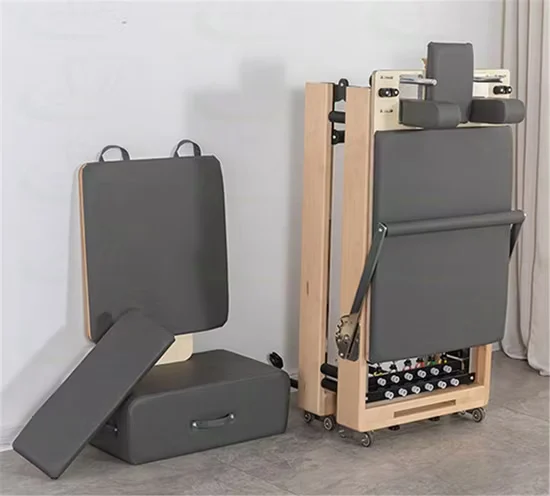
Whisper-Qualified Deployment — spring-resistance mechanics verified for noise-sensitive residential and shared-space installations where motorized equipment is restricted.
Technical Specifications
| Parameter | Value |
|---|---|
| Designation | SRY-02 |
| Product Type | Pilates Reformer |
| Dimensions | 2400 × 600 × 350 mm |
| Net Weight | 100 kg |
| Color | Solid Color |
| Target User | Adult, Unisex |
| Foldable | Yes |
| Warranty | 3 Years |
| HS Code | 9506911900 |
Application Suitability
| Deployment Scenario | Typical Use |
|---|---|
| High-end residential home gym | Daily Pilates and flexibility training in apartment or villa fitness rooms |
| Small Pilates studio | Group or semi-private reformer sessions with spring-resistance programming |
| Yoga and movement studio | Complement to mat work for resistance-based flexibility and core conditioning |
| Corporate wellness room | Low-impact movement sessions for employee recovery and stress relief |
| Boutique hotel wellness suite | In-room or spa-adjacent Pilates offering for guest use |
What Makes a Foldable Pilates Reformer Survive Daily Studio Rotation
Spring tension consistency and carriage glide determine whether a foldable Pilates reformer for home use holds up past the first quarter.
Most reformer buyers focus on upholstery and frame aesthetics, then discover six months later that the carriage stutters on the rail, the springs sag under repeated loading, or the folding hinge develops lateral play. In small studios and residential gyms, the equipment is often moved and folded daily, which accelerates wear on any component not engineered for cyclic loading [NEED_CITE: EN 957 requirements for cyclic fatigue testing on resistance training equipment]. The consequence is a reformer that feels rough, generates audible friction, and forces the operator into premature spring replacement or full unit retirement.
Where This Reformer Fits in a Resistance Training Zone
The SRY-02 covers low-to-moderate intensity resistance work spanning core stabilization, flexibility, and controlled strength movements. In a mixed-equipment layout it complements free-weight and cable stations by targeting stabilizer muscles and joint mobility that high-load equipment cannot address. Its 2400 mm length and foldable frame allow placement against walls in compact home gyms or shared studio floors where permanent footprint is a concern. The adult unisex loading range accommodates users across a broad body-mass spectrum, making it suitable for mixed-membership environments.
Noise, Floor Loading, and Deployment Constraints
A spring-resistance reformer produces no motor noise, which removes it entirely from the acoustic concerns that govern treadmill and elliptical placement on upper floors or above occupied rooms. The primary acoustic signature comes from carriage-to-rail contact and spring stretch-and-release cycles; smooth rail surfaces and maintained wheel bearings keep this well below conversational levels. Floor loading concentrates on four feet across a 2400 × 600 mm footprint, requiring a level surface to prevent lateral drift during use [NEED_CITE: floor load distribution requirements for resistance training equipment in multi-story buildings]. When folded, the unit’s storage profile reduces clearance demands, but operators should verify ceiling height and wall-lean clearance before committing to a location. No dedicated electrical circuit is required, simplifying deployment in retrofit spaces.
Spring Mechanics and Rail Surface Engineering
The resistance curve on a spring-driven reformer is governed by spring rate and pre-tension settings, which differ fundamentally from the linear or digitally-variable output of motorized resistance systems. Multiple springs engaged in parallel expand the available load range, while individual spring swap or removal enables fine-grained progression. Rail surface finish and wheel material pairing dictate carriage smoothness; harder wheel compounds reduce rolling resistance but transmit more vibration, while softer compounds dampen noise at the cost of slightly higher friction. The folding mechanism introduces a structural discontinuity in the rail path, and its hinge tolerance directly affects whether the carriage transitions across the fold point without detectable interruption.
The Cost Hidden Inside Budget Spring and Rail Choices
Reformers specified on price alone tend to surface their compromises through spring fatigue, where resistance drops noticeably after several hundred stretch cycles, forcing operators to recalibrate programming or replace springs ahead of schedule. Rail surfaces that lack adequate hardness treatment develop micro-grooves under carriage wheels, producing a grinding feel that users notice immediately [NEED_CITE: surface hardness standards for linear rail systems in fitness equipment]. Folding mechanisms on under-specified units develop play at the hinge, causing the carriage to catch or deviate at the fold line, which interrupts exercise flow and signals poor build quality to experienced practitioners.
Why This Product Line Earns Studio and Residential Placement
The SRY-02’s foldable footprint addresses the spatial reality of home gyms and small studios where every square meter must justify its allocation. Spring-resistance operation removes electrical dependency and acoustic concerns, allowing deployment on any floor without noise-mitigation infrastructure. The three-year warranty reflects confidence in spring fatigue life and rail durability under recurring use cycles. Biketon Sport’s facility engineering background ensures that frame welding, hinge tolerance, and spring anchoring receive the same validation rigor applied to its commercial cardio range. Documentation includes dimensional drawings, spring rate charts, and maintenance schedules so operators can plan long-term upkeep.
Documentation & Test Records
- CE declaration of conformity for resistance training equipment
- EN 957 test report covering structural integrity and fatigue cycles
- ISO 9001 certificate for manufacturing quality management
- Spring fatigue test record with cycle count and tension decay data
- Assembly and folding mechanism commissioning guide
- Spare parts list with spring and carriage wheel replacement SKUs
Installation, Commissioning & Maintenance
- Verify 2400 × 600 mm footprint clearance plus 800 mm lateral access on each side
- Level floor surface required; shim feet to eliminate carriage drift before first use
- No electrical circuit needed; confirm wall-anchor point for folded storage stability
- Inspect rail surface and carriage wheels at 90-day intervals for wear grooves
- Lubricate rail contact surfaces per manufacturer schedule using specified grease grade
- Check folding hinge bolt torque quarterly to prevent lateral play development
Equipment Selection and Quotation Process
Provide your available floor area and intended daily session count so we can confirm whether the foldable configuration matches your throughput requirements. Specify deployment floor level and adjacent room usage to validate acoustic suitability. Confirm target market destination so spring rate labeling and documentation language align with local regulatory expectations. Indicate whether you require bulk spring-rate variants for mixed-ability user groups within a single facility.
Frequently Asked Questions
Q: What is the practical difference between spring resistance and cord-based resistance on a Pilates reformer?
A: Springs deliver a progressive resistance curve that increases as they stretch, matching the strength curve of many Pilates movements. Cord or bungee systems offer more linear resistance and can be lighter, but they lack the same tactile feedback and progressive loading that experienced practitioners rely on for controlled eccentric work and precise intensity grading across different exercises.
Q: How does the foldable design affect rail smoothness compared to a fixed-frame reformer?
A: A well-engineered foldable reformer maintains rail alignment across the hinge point so the carriage transitions without interruption. The critical factor is hinge tolerance and locking rigidity; if the fold joint is machined and secured properly, users cannot detect the fold line during use. Compromised hinge tolerances introduce catch points that degrade the experience.
Q: What maintenance does the carriage and rail system require over time?
A: Carriage wheels accumulate debris and develop flat spots under sustained load, requiring periodic inspection and rotation. Rail surfaces should be cleaned of dust and lubricant residue at intervals dictated by usage frequency. Spring tension should be verified quarterly against baseline values, and any spring showing measurable tension loss below specification should be replaced as a matched set.
Q: What user weight range does this reformer accommodate?
A: The SRY-02 is specified for adult unisex use within the structural limits of its frame and spring configuration. Operators should confirm the maximum user weight rating with the factory specification sheet before deploying in environments where users exceed standard body-mass ranges, as spring rate selection must correspond to the expected loading to maintain effective resistance through full range of motion.


![Fitness Equipment Maple Wood Pilates Bed Reformer for Yoga Studio [WARN] draft identifier mismatch](https://bicksport.com/wp-content/uploads/2026/08/fitness-equipment-maple-wood-pilates-bed-reformer-for-yoga-studio-warn-draft-identifier-mismatch-6090a0.webp)
![Professional Aluminum Pilates Reformer Machine Bed for Studio Fitness[WARN] draft identifier mismatch](https://bicksport.com/wp-content/uploads/2026/08/professional-aluminum-pilates-reformer-machine-bed-for-studio-fitnesswarn-draft-identifier-mismatch-f493b9.webp)