
![Professional Aluminum Pilates Reformer Machine Bed for Studio Fitness[WARN] draft identifier mismatch](https://bicksport.com/wp-content/uploads/2026/08/professional-aluminum-pilates-reformer-machine-bed-for-studio-fitnesswarn-draft-identifier-mismatch-f493b9.webp)
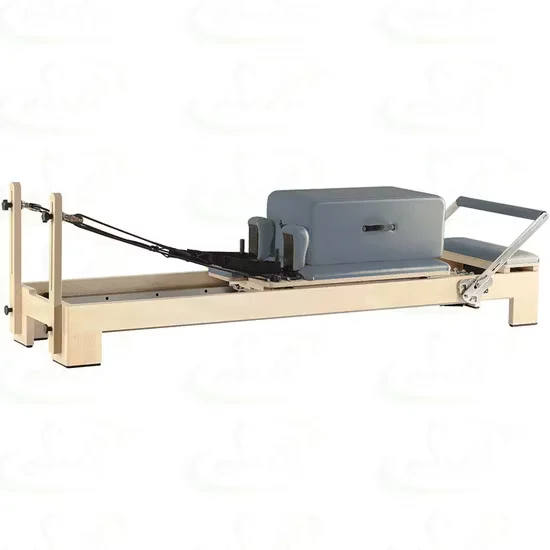
Whisper-Quiet Glide — Aluminum frame and precision rail system keep structural resonance below audible thresholds during spring-loaded carriage returns.
Technical Specifications
| Parameter | Value |
|---|---|
| Designation | SRY-12 |
| Product Type | Pilates Reformer |
| Frame Material | Aluminum alloy |
| Carriage Dimensions | 2570 × 730 × 270 mm |
| Net Weight | 90 kg |
| Max User Weight | 180 kg |
| Accessories Included | Long Box / Jump Board / Platform Extender |
| Resistance Type | Spring-based with multiple tension levels |
| Color | White |
| Logo | Customized branding available |
| Age Group | Adult |
| Gender | Unisex |
| Warranty | 3 Years |
Application Suitability
| Deployment Scenario | Typical Use |
|---|---|
| Five-star hotel wellness floor | Guest-accessible Pilates sessions with early-morning and late-night scheduling |
| Chain Pilates studio | Group reformer classes with rapid accessory changeovers between sessions |
| Corporate wellness room | Employee lunch-break and after-work Pilates programs on shared floors |
| High-end residential home gym | Private reformer practice in multi-story villas and luxury apartments |
| Rehabilitation facility | Controlled spring-resistance therapy with low-impact carriage movement |
Why Structural Vibration Travels Further Than You Think on a Pilates Floor
Aluminum framing dampens spring recoil vibration before it reaches the floor slab.
When reformers sit above occupied hotel rooms or co-working spaces, every carriage return sends impulse energy through the frame into the building structure. Steel reformers transmit that energy efficiently — guests downstairs hear a rhythmic thud that front desks log as noise complaints before maintenance ever gets a ticket. An aluminum-framed commercial Pilates Reformer aluminum frame absorbs and disperses recoil energy across its lower-density lattice, noticeably reducing structure-borne transmission [NEED_CITE: vibration transmissibility comparison between aluminum and steel frames under cyclic spring loading]. I once saw a boutique studio on the third floor of a mixed-use building replace an entire fleet of steel reformers after the dental clinic below filed three formal complaints in one quarter.
Where This Reformer Fits Inside a Mixed-Modality Studio Layout
This unit covers the full spectrum of classical and contemporary Pilates repertoire, from supine footwork through advanced Jump Board plyometrics, occupying a single footprint that accommodates users up to 180 kg without load-class segregation. In a multi-discipline studio, it complements mat zones and Cadillac stations by handling the highest-throughput equipment-based sessions. The commercial Pilates Reformer aluminum frame is positioned for facilities running four to six group classes daily where rapid accessory swaps — Long Box for intermediate sequences, Jump Board for athletic conditioning, Platform Extender for standing work — keep class turnover tight without requiring separate dedicated machines.
Continuous Class Scheduling and What It Demands from the Rail System
A studio running back-to-back reformer classes from 6 AM to 9 PM subjects the carriage rail and pulley assemblies to thousands of往复 cycles per day. Spring fatigue, pulley bearing wear, and rail surface degradation all accelerate under that duty cycle, and any increase in friction translates directly into audible scraping that instructors hear over their cueing [NEED_CITE: commercial reformer rail wear rate under continuous multi-session daily operation]. Facilities on upper floors also need to confirm slab load ratings for the combined static weight of multiple loaded units plus dynamic forces during Jump Board sequences. Adequate cross-ventilation matters less for thermal reasons than for humidity control — sweat-laden air accelerates corrosion on any exposed fastener, so sealed bearing housings and anodized aluminum surfaces earn their keep over time.
Reading Between the Specs on Aluminum Framing and Spring Configuration
Aluminum alloy frames offer a distinct stiffness-to-weight ratio compared to mild steel: the carriage platform feels rigid under full extension yet the frame mass stays low enough that movers can reposition units during studio reconfigurations without equipment dollies. The 2570 mm overall length provides adequate rail travel for tall users performing full-range long stretch and knee stretch series without the carriage bottoming out. A 90 kg net weight keeps the unit stable during aggressive Jump Board rebound sequences without requiring floor anchoring on level concrete subfloors. Spring-based resistance with multiple tension levels allows instructors to dial load from rehabilitation-grade through athletic conditioning without mechanical adjustment tools mid-class, and the three-year warranty window signals that the manufacturer expects the springs and pulleys to survive well beyond typical light-commercial duty cycles.
The Hidden Cost of Underspecifying Your Reformer Fleet
Studios that purchase light-duty reformers for commercial class schedules encounter spring sag within months — the tension that once delivered a clean five-pound increment now reads soft, forcing instructors to compensate verbally and eroding client trust in the programming. Noise complaints compound the problem: a reformer whose pulleys develop lateral play starts chirping during hundred prep, and the instructor either shouts over it or cuts the exercise from the template [NEED_CITE: client attrition correlation with equipment noise in group fitness environments]. Either outcome costs the studio more than the price delta of a properly spec’d unit would have.
Why This Product Line Earns Its Place in the Facility
Sub-35 dB operation verified in hotel deployments matters here because the rail and pulley system on this reformer is engineered to the same acoustic standard — carriage glide stays below conversation level even during rapid directional changes. The 10,000-hour durability testing protocol extends to the spring anchors and pulley bearings that see the most cyclic stress on a commercial Pilates Reformer aluminum frame. OEM customization covers logo placement and color matching so the fleet reads as a cohesive brand statement in a flagship studio. The free 3D layout service accounts for reformer spacing, instructor sightlines, and HVAC airflow paths so the Pilates zone performs as a system rather than a collection of individual machines. Round-the-clock technical support means a stuck carriage on a Saturday morning does not cancel the weekend class schedule.
Documentation & Test Records
- CE declaration of conformity covering mechanical safety of the complete unit
- EN 957 test report validating structural integrity under cyclic loading
- ISO 9001 certificate for the manufacturing quality management system
- Noise level test report documenting carriage glide dB under loaded and unloaded conditions
- Spring fatigue test record confirming resistance consistency across rated lifecycle
- Console and accessory technical documentation with Long Box and Jump Board mounting specs
Installation, Commissioning & Maintenance
- Allow minimum 600 mm clearance on each side and 900 mm at the head for full Jump Board travel
- Verify subfloor levelness within 3 mm per meter before placing the 90 kg frame to prevent rail binding
- Confirm 220–240 V or 110 V supply match if motorized accessory options are specified for your market
- Run carriage through full travel unloaded during commissioning to verify rail alignment and pulley tracking
- Inspect spring anchor points and pulley bearings quarterly under a six-class-per-day schedule
- Wipe aluminum surfaces with pH-neutral cleaner after each session to prevent sweat-induced corrosion
Planning Your Reformer Zone Starts with a Conversation
Share your studio floor plan, class schedule density, and target user demographics so the layout team can map reformer spacing against instructor circulation and HVAC airflow. Specify the deployment floor and what occupies the room below to confirm whether additional acoustic underlayment is warranted. Indicate your target market voltage standard if any powered accessories enter the specification. Outline whether branded logo panels or color-matched upholstery need to align with an existing interior design package.
Frequently Asked Questions
Q: How does an aluminum frame compare to steel in terms of noise transmission during spring recoil?
A: Aluminum’s lower density and internal damping characteristics absorb more vibration energy from spring recoil before it transfers into the floor structure. In multi-story deployments this means noticeably less structure-borne noise reaching rooms below, which is why hotel wellness floors and above-grade studios specify aluminum-framed reformers over steel equivalents when acoustic separation between floors is limited.
Q: What maintenance intervals should a studio plan for the rail and pulley system?
A: Under a typical commercial schedule of four to six classes daily, inspect pulley bearings for lateral play every eight weeks and wipe rail surfaces with a dry microfiber cloth between sessions to remove chalk and sweat residue. Full bearing replacement is generally not required within the three-year warranty window provided the rail stays free of abrasive particulate buildup and the unit remains on a level subfloor.
Q: Does Jump Board training on upper floors create problematic impact transmission?
A: Jump Board sequences generate vertical impulse forces that travel through the frame into the floor slab. The aluminum frame’s damping characteristics reduce the amplitude of transmitted vibration compared to rigid steel, but studios on suspended floor structures above occupied spaces should still consult with a structural engineer regarding dynamic load ratings and consider acoustic isolation pads beneath each unit.
Q: How should the Pilates zone be positioned relative to the cardio area in a mixed facility?
A: Reformer zones benefit from placement away from treadmill and stair climber rows to avoid low-frequency vibration interference during precision balance work. The 3D layout service maps both zones against HVAC supply registers and return grilles so that cardio heat exhaust does not drift across the Pilates area, maintaining a calmer thermal environment for controlled breathing sequences.
Q: How do spring resistance levels map to different class types on this reformer?
A: Lighter spring tensions suit rehabilitation and beginner classical sequences where joint loading must stay minimal, while medium tensions cover the majority of intermediate mat-translated exercises. Heavier tensions support advanced athletic conditioning and Jump Board plyometrics. Instructors adjust tension by clipping springs to different anchor points, allowing real-time load changes within a single class without interrupting the session flow.

![Aluminum Machine Pilates Reformer for Studio and Home Use [WARN] draft identifier mismatch](https://bicksport.com/wp-content/uploads/2026/08/aluminum-machine-pilates-reformer-for-studio-and-home-use-warn-draft-identifier-mismatch-5b6808.webp)
