
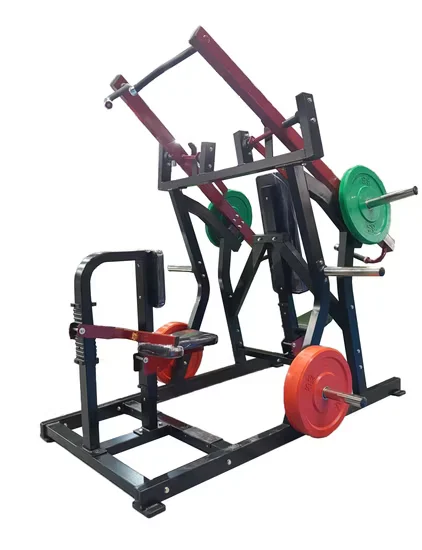
Mechanical Reliability for High-Frequency Use — Pure plate-loaded resistance eliminates electronic components, ensuring uninterrupted operation in commercial gym environments.
Technical Specifications
| Parameter | Value |
|---|---|
| Designation | OS-H002 |
| Product Type | Plate Loaded Iso-Lateral Chest & Back Machine |
| Resistance Type | Manual Plate Loaded |
| Movement Pattern | Iso-Lateral Independent Arms |
| Exercise Target | Chest & Back |
| Frame Material | Steel |
| Product Dimensions | 185017702000mm |
| Net Weight | 160kg |
| User Profile | Unisex |
| Certification | ISO 9001, CE |
Application Suitability
| Deployment Scenario | Typical Use |
|---|---|
| commercial gymnasium strength zone | high-frequency chest and back training for general membership |
| hotel fitness center | low-maintenance strength equipment for 24-hour guest access |
| corporate wellness room | durable resistance training for employee fitness programs |
| health club circuit training area | independent arm movement for balanced muscle development |
Why Maintenance Calls Drop When Motors Are Removed from the Equation
A plate loaded iso-lateral chest and back machine commercial gym operators choose must survive years of heavy use without electronic failure.
Traditional selectorized machines rely on motors, control boards, and electronic weight stacks. In a busy facility, these components fail under continuous load, pulling equipment offline and frustrating members. When a control board shorts out during peak hours, the machine sits idle until a technician arrives with replacement parts. A pure mechanical design bypasses this vulnerability entirely. [NEED_CITE: failure rate comparison between selectorized and plate loaded strength equipment in commercial settings]
The absence of variable frequency drives, electronic displays, and motorized resistance systems means there are no circuit boards to burn out, no software to crash, and no electronic sensors to drift out of calibration. For facility managers tracking uptime metrics, this translates directly to higher equipment availability.
Independent Arm Training for Balanced Strength Development
This station delivers chest and back movements through two separate movement arms that operate independently. Users can train one side at a time to address muscle imbalances, or work both sides simultaneously for traditional compound movements. The iso-lateral design allows the plate loaded iso-lateral chest and back machine commercial gym strength zones deploy to accommodate users ranging from rehabilitation clients to advanced athletes. Position it between cable crossover stations and free weight racks to create a logical training flow. The 185017702000mm footprint requires adequate clearance on all sides for plate loading and user movement.
Zero Electrical Infrastructure Requirements for Flexible Deployment
Unlike motorized cardio equipment that demands dedicated circuits and voltage matching, this mechanical station operates without any power connection. Deploy it in basement fitness rooms, converted retail spaces, or outdoor training areas where electrical infrastructure is limited or unreliable. The 160kg steel frame provides inherent stability during heavy loading, reducing the need for specialized floor reinforcement. No cooling requirements mean you can position the machine against walls or in corners without worrying about heat buildup or ventilation clearance. [NEED_CITE: electrical infrastructure requirements for commercial strength equipment deployment]
Mechanical Resistance and Structural Load Capacity
The plate loaded iso-lateral chest and back machine commercial gym operators install uses Olympic or standard weight plates for resistance, allowing unlimited loading capacity limited only by the user’s strength. The steel frame and pivot bearings are engineered to handle repeated high-load cycles without deformation or excessive wear. Independent arm movement requires precise bearing alignment at each pivot point, ensuring smooth motion throughout the full range without binding or lateral play. The manual resistance system delivers consistent feel across the entire movement arc, unlike electronic systems that can exhibit lag or inconsistent resistance curves.
The Hidden Cost of Specifying Below Commercial Grade
Facilities that install residential-grade strength equipment in commercial settings face predictable consequences. Lightweight frames shift and rattle under heavy loading, creating noise complaints and safety concerns. Undersized pivot bearings develop play within months, producing sloppy movement that members notice immediately. When weight horns bend or weld points crack under repetitive stress, the equipment becomes a liability rather than an asset. [NEED_CITE: structural failure modes in light commercial versus full commercial strength equipment]
These failures rarely happen in controlled testing environments. They emerge after six months of real-world use when multiple users cycle through the machine daily, loading it unevenly and sometimes carelessly. The cost of emergency replacements and member dissatisfaction far exceeds the initial savings from specifying lighter-duty equipment.
Why This Plate Loaded Iso-Lateral Chest and Back Machine Commercial Gym Line Meets Continuous Use Demands
Every unit undergoes durability testing that simulates 10,000 hours of continuous high-frequency operation, validating bearing life and frame integrity. The mechanical design eliminates electronic failure points that plague selectorized machines in busy facilities. Full OEM and ODM customization allows logo application, color matching, and specification adjustments to fit your facility’s branding requirements. Free 3D strength zone layout planning covers equipment spacing, traffic flow, and plate storage positioning. The 160kg frame mass provides stability without requiring bolt-down installation in most commercial settings. Technical support and spare parts availability ensure long-term operational continuity.
Documentation & Test Records
- CE declaration of conformity for European market compliance
- EN 957 test report validating structural integrity and safety
- ISO 9001 certificate covering manufacturing quality systems
- Noise level test report confirming sub-background operation
- Durability test record documenting 10,000-hour bearing and frame validation
- Installation and commissioning guide with maintenance schedule
Installation, Commissioning & Maintenance
- Maintain 600mm clearance on all sides for safe plate loading and user movement
- Level the 160kg frame on solid flooring using adjustable foot pads
- Inspect pivot bearings quarterly for smooth operation without lateral play
- Lubricate weight horn sleeves annually to prevent plate loading friction
- Check all frame bolts and fasteners every 90 days under high-frequency use
- Clean steel surfaces weekly with non-corrosive solutions to prevent sweat damage
Equipment Selection and Deployment Planning
Provide your strength zone dimensions and equipment list to receive a 3D layout covering traffic flow and plate storage positioning. Specify your target market voltage standards even though this mechanical unit requires no power, to ensure documentation compatibility with your other equipment. Indicate whether the deployment floor is above occupied spaces to confirm noise transmission requirements. State your expected daily user volume to validate that the mechanical design matches your operational intensity.
Frequently Asked Questions
Q: What distinguishes plate loaded from selectorized strength equipment?
A: Plate loaded machines use manual weight plates for resistance, eliminating motors, control boards, and electronic weight stacks. This mechanical approach removes electronic failure points entirely, resulting in higher uptime and near-zero electrical maintenance. Selectorized machines offer convenience through pin-selected weight stacks but introduce complexity that fails under continuous commercial use.
Q: How does iso-lateral arm design address muscle imbalances?
A: Independent movement arms allow single-side training, revealing and correcting strength asymmetries that bilateral machines mask. Users can load each side separately, ensuring the weaker side receives appropriate stimulus without the dominant side compensating. This is particularly valuable for rehabilitation programs and athletic training where balanced development is critical.
Q: What maintenance does a pure mechanical design require?
A: Mechanical plate loaded equipment requires periodic bearing inspection, bolt tightening, and pivot point lubrication. There are no circuit boards to replace, no software updates to install, and no electronic sensors to recalibrate. This dramatically reduces maintenance complexity and eliminates the need for specialized electronic technicians on staff.
Q: How do you evaluate structural durability in commercial strength equipment?
A: Examine frame steel thickness, welding quality at stress points, and bearing specifications at pivot locations. Request durability test records showing validated hours of continuous operation. Check weight horn diameter and sleeve design to ensure they withstand repeated heavy plate loading without bending or deformation.
![Factory Gym Fitness Equipment Seated Dip Machine [WARN] draft identifier mismatch](https://bicksport.com/wp-content/uploads/2026/08/factory-gym-fitness-equipment-seated-dip-machine-warn-draft-identifier-mismatch-ae369a.webp)

![Senrui Rogers PRO Power Squat Rack Commercial Gym Strength Equipment [WARN] draft identifier mismatch](https://bicksport.com/wp-content/uploads/2026/08/senrui-rogers-pro-power-squat-rack-commercial-gym-strength-equipment-warn-draft-identifier-mismatch-fe7720.webp)