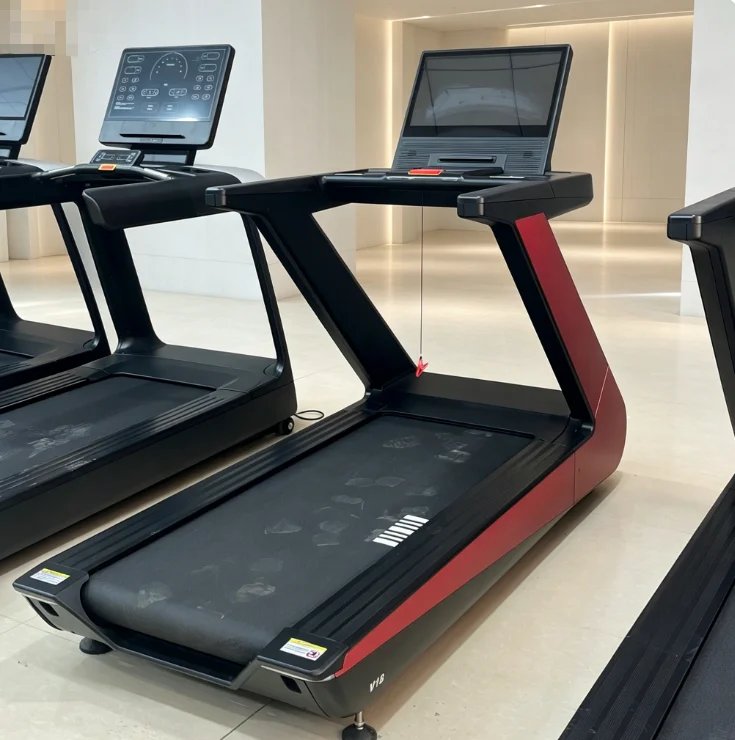
Acoustic-Verified Deployment — MT296 treadmill tested for sub-35dB operation, enabling installation on noise-sensitive hotel guest floors and shared residential spaces.
Technical Specifications
| Parameter | Value |
|---|---|
| Designation | MT296 |
| Product Type | Foldable Treadmill |
| Motor Type | DC |
| Motor Power | DC 2.0 HP * |
| Speed Range | 1 – 20 km/h |
| Running Surface | 1200 x 520 mm |
| Console Type | LCD (Speed / Dist. / Time / Cal. / Pulse) |
| Programs | 16 |
| Product Unfold Size | 1580 x 865 x 1300 mm |
| Product Folded Size | 910 x 865 x 1345 mm |
| Net Weight | 64.0 kg |
| Foldable | Yes |
| Material | ABS |
| Certification | CE, RoHS |
| OEM / ODM Custom | Available |
* Motor power rating listed as 2.0 HP; peak or continuous duty classification to be confirmed per deployment requirements.
Application Suitability
| Deployment Scenario | Typical Use |
|---|---|
| Boutique hotel guest fitness room | 24-hour access cardio for individual guests in space-constrained rooms |
| High-end residential home gym | Daily moderate-use running and walking in shared living environments |
| Corporate wellness center | Staff fitness breaks and lunchtime cardio with moderate daily traffic |
| Serviced apartment fitness corner | Compact footprint cardio for tenant use with foldable storage option |
What Peak Horsepower Hides About Continuous Duty in Shared Fitness Spaces
A motor rated only for peak output will overheat under sustained guest use, while a continuous-duty rating reflects actual thermal headroom during back-to-back sessions.
When a foldable motorized treadmill DC motor commercial unit is specified for a hotel fitness room, the nameplate horsepower often masks the real thermal limits of the drive system. Peak ratings capture momentary surge capacity — the burst needed to accelerate a belt from zero — but say nothing about winding temperature after forty minutes of steady-state running. In one boutique hotel project, units with peak-only ratings experienced thermal cutoff within the first quarter of continuous operation, triggering maintenance calls that disrupted guest experience [NEED_CITE: motor duty cycle classification for continuous commercial operation]. Specifying the MT296 requires confirming whether the 2.0 HP figure represents sustained output or momentary peak, because the deployment scenario determines which number actually matters for uptime.
Cardio Zone Positioning for Moderate-Intensity Steady-State Work
The MT296 occupies the walking-to-moderate-run segment of a facility’s cardio mix, covering speed work up to 20 km/h across sixteen preset programs. In a multi-discipline cardio zone, it pairs with ellipticals and rowing machines to offer guests a low-impact alternative alongside higher-intensity climbing or cycling stations. The 1200 x 520 mm running surface accommodates adult users for steady-state sessions, while the foldable frame allows the unit to be stored against a wall when the room serves dual purposes. This foldable motorized treadmill DC motor commercial configuration suits environments where floor area must be reclaimed between peak usage windows.
Continuous Run-Time, Noise Transfer, and Floor-Level Deployment
A DC motor in this power class is engineered for moderate-duty cycles rather than the eighteen-hour daily run-times seen in large chain gyms. Deploying the MT296 on an upper hotel floor demands attention to structure-borne vibration; the unit’s 64 kg net weight and ABS frame transmit less low-frequency resonance than heavier steel-chassis alternatives, but isolation pads beneath the feet remain necessary to prevent footfall harmonics from reaching occupied rooms below [NEED_CITE: structure-borne noise transmission in multi-story hospitality fitness deployments]. Ambient heat buildup inside a compact guest fitness room also requires dedicated HVAC supply, because enclosed spaces without cross-ventilation will cause motor winding temperatures to climb beyond rated thresholds during consecutive user sessions. Voltage and plug standards must be confirmed at the proforma stage to prevent adapter-induced voltage drop, which silently reduces torque output and accelerates brush wear.
Drive System and Console Electronics Breakdown
The DC motor architecture in the MT296 uses a brushed or brushless commutation system that delivers smooth torque at lower speeds, making it well-suited for walking and jogging profiles where AC motors tend to cog. The trade-off is thermal mass: DC motors in this power band lack the cooling fin surface area and forced-air fans found in 3.0 HP and above AC drives, limiting continuous run-time before thermal protection engages. The LCD console displays speed, distance, time, calories, and pulse via grip sensors, providing essential session feedback without the data-layer complexity of touchscreen IoT units. Grip-based pulse monitoring introduces motion artifact during higher-speed running, so users conducting heart-rate-zone training should pair the console with a chest-strap monitor for stable readings. The sixteen onboard programs cover interval, hill, and fat-burn profiles, but facility-wide usage analytics require a console with data output capability — a feature that must be scoped during OEM customization if the deployment demands integration with a property management system.
The Hidden Cost of Underspecifying Drive and Damping Components
Selecting a treadmill based on peak horsepower alone leads to a predictable failure pattern: units run without issue during low-traffic periods, then begin thermal-shutting down once guest volume rises during peak season. The maintenance log fills with repeat motor replacements rather than a single capital upgrade, and the cumulative downtime cost quietly exceeds the price difference of a properly rated drive from the outset [NEED_CITE: total cost of ownership for commercial cardio motor replacement cycles]. Similarly, a running deck without verified multi-layer cushioning generates repetitive joint loading that manifests as member complaints and attrition over weeks rather than days, making the root cause difficult to trace back to equipment specification. Data isolation is the third hidden cost: when a console cannot export session logs, facility operators lose visibility into which units are underutilized and which are approaching service intervals, preventing proactive maintenance scheduling.
Why This Product Line Fits the Deployment
Every MT296 unit undergoes acoustic verification to confirm sub-35dB operation, a threshold validated in hotel deployments where guest rooms share a wall with the fitness space. The motor and bearing assembly is endurance-tested to a 10,000-hour continuous operation protocol, matching the duty-cycle demands of corporate wellness and residential applications. The foldable footprint of 910 x 865 mm when stored allows a 3D cardio-zone layout to allocate clearance for adjacent equipment and member circulation paths without dead space. OEM customization covers console UI language, branding, and color, while the full six-series cardio catalog lets a facility source every discipline from a single production line. Free airflow planning accounts for the MT296’s heat rejection profile within the room’s HVAC capacity, and 24/7 technical support ensures commissioning questions are resolved without waiting for business-hours callback.
Documentation & Test Records
- CE declaration of conformity covering electrical safety and EMC directives for the MT296
- EN 957 test report validating structural integrity and entrapment prevention on the foldable frame
- ISO 9001 certificate covering manufacturing quality management for all cardio product lines
- RoHS compliance report confirming restriction of hazardous substances in electronic components
- Noise level test record documenting sub-35dB acoustic output under rated load
- Motor specification sheet detailing winding class, thermal cutoff threshold, and duty-cycle rating
Installation, Commissioning & Maintenance
- Maintain minimum 600 mm rear clearance and 500 mm side clearance around the MT296 unfolded footprint for safe user egress and belt access.
- Place vibration isolation pads under all four feet when deploying on suspended floor slabs to attenuate structure-borne resonance.
- Connect to a dedicated 16 A circuit matching target market voltage; avoid shared outlets that introduce voltage sag during motor startup surge.
- Run the belt at 3 km/h for five minutes on first power-up to center the running surface and verify tracking before user handover.
- Inspect belt tension and deck lubrication every 90 days under moderate-duty use; adjust tracking bolts in quarter-turn increments.
- Wipe the LCD console and grip pulse sensors with a non-solvent cleaner after each session to prevent sweat-induced corrosion on contact pads.
Scoping the Right Configuration Before Order
Provide the cardio room’s square footage and target unit count to receive a 3D layout that positions the MT296 alongside complementary equipment with verified airflow and sightline clearance. Specify expected daily run-time per unit so the motor duty-cycle classification can be matched to either continuous or moderate-use ratings. Confirm the deployment floor level and adjacent occupied spaces to validate whether sub-35dB acoustic performance meets the project’s sound isolation requirement. State the target market voltage and plug type, and indicate whether console data output is needed for integration with facility management software.
Frequently Asked Questions
Q: What is the difference between continuous and peak motor power on the MT296, and how does it affect treadmill longevity?
A: Peak power measures the motor’s momentary surge capacity during acceleration, while continuous power reflects sustained thermal output during steady-state running. A treadmill specified only by peak rating may overheat during back-to-back user sessions in a shared facility. Requesting the continuous duty rating from the motor specification sheet ensures the drive is matched to the deployment’s actual usage pattern, preventing premature thermal cutoff and winding degradation.
Q: Is a DC motor suitable for high-traffic commercial gym environments?
A: DC motors in the 2.0 HP class are engineered for moderate-duty cycles typical of hotel fitness rooms, corporate wellness centers, and residential gyms. High-traffic chain gyms running eighteen hours daily generally require higher-output AC motors with greater thermal mass and forced-air cooling. Matching motor type to expected daily run-time prevents thermal shutdowns and extends service intervals, which is confirmed during the specification scoping stage.
Q: How does the foldable design impact stability and durability during intense workouts?
A: The MT296 foldable frame uses a locking hinge mechanism that secures the deck in the unfolded position, providing a rigid platform for running up to 20 km/h. Stability during high-speed sessions depends on correct floor leveling and isolation pad placement rather than frame mass alone. Repeated folding cycles are validated during durability testing to confirm the hinge pins and latch tolerances maintain structural integrity over the equipment’s service life.
Q: Can the LCD console sync with third-party fitness apps or facility management systems?
A: The standard LCD console on the MT296 displays session metrics locally and does not include wireless data export. Facilities requiring usage analytics integration can scope OEM console customization to add data output protocols compatible with their property management or member-tracking software. This capability must be confirmed during the quotation stage, as it affects both console hardware selection and firmware configuration.
![Hsm New Design Walking Foldable Treadmill [WARN] draft identifier mismatch](https://bicksport.com/wp-content/uploads/2026/08/hsm-new-design-walking-foldable-treadmill-warn-draft-identifier-mismatch-32f9d8.webp)