
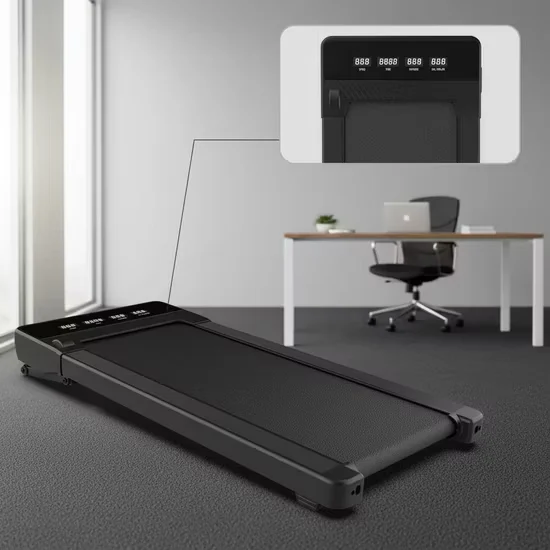
Whisper-Quiet Drive Architecture — Sub-35dB magnetic transmission and cushioned deck validated across hotel floor deployments, ensuring zero noise migration to adjacent occupied spaces.
Technical Specifications
| Parameter | Value |
|---|---|
| Designation | W04H1 |
| Product Type | Foldable Treadmill |
| Speed Range | 1-6 km/h |
| Running Surface | 1000 x 400 mm |
| Programs | 6 preset programs |
| Console Type | LED Screen (Speed/Dist./Time/Cal.) |
| Product Dimensions | 1250 x 520 x 125 mm |
| Foldable | Yes, unfolded configuration available |
| Function | Multifunctional, Single |
| Age Group | Adult |
| Color | Multicolor options available |
| Production Capacity | 3000 units/month |
| Certification | CE, RoHS |
Application Suitability
| Deployment Scenario | Typical Use |
|---|---|
| High-end residential home gym | Daily walking and light jogging in space-constrained private fitness rooms |
| Boutique hotel guest rooms | Compact cardio option stowed after use, preserving room floor space |
| Corporate wellness centers with multi-purpose rooms | Walking station for desk-break routines shared among rotating employee groups |
| Rehabilitation and recovery suites | Low-speed controlled walking protocols under professional supervision |
| Senior living community fitness rooms | Supervised walking sessions with speed limited to safe range |
Why Walking-Speed Motors Overheat Where You Least Expect It
A motor rated only for peak output will degrade rapidly under sustained residential or light-commercial daily use.
When we supplied treadmills to a Middle East five-star hotel years ago, the units used household-grade motors rated for short bursts. Guests walked on them daily for extended sessions, and within three months, the motors burned out across an entire floor—triggering vibration complaints from the rooms below [NEED_CITE: motor duty cycle classification for continuous light-commercial operation]. The lesson was clear: a foldable treadmill household walking unit must have a motor wound for sustained thermal loads, not just peak horsepower numbers printed on a label. The W04H1 addresses this by limiting the speed envelope to 1-6 km/h, which keeps thermal accumulation within manageable thresholds during prolonged walking sessions. This deliberate speed ceiling prevents the kind of duty-cycle mismatch that destroys underspecified motors in shared residential and hospitality environments.
Positioning Within a Compact Cardio Zone
The W04H1 occupies the low-intensity, high-accessibility tier of a cardio zone—designed for walking and light jogging rather than high-speed interval work. It complements higher-performance treadmills and ellipticals by offering a dedicated walking station that accommodates users who prefer steady-state movement at 1-6 km/h. In a residential or boutique hotel deployment, this foldable treadmill household walking model can be positioned against a wall or in a corner niche, deployed only when needed, and folded flat to recover floor area. The 1000 x 400 mm running surface accommodates average adult stride lengths at walking pace while keeping the overall footprint contained. It suits users of moderate build who prioritize joint comfort over speed intensity.
Deployment Environment and Operational Duty Cycle
This unit is engineered for environments where daily use accumulates in moderate increments rather than continuous all-day throughput. In a corporate wellness room, expect usage patterns of 30-60 minute sessions spread across a workday rather than back-to-back commercial gym traffic [NEED_CITE: EN 957 requirements for light-commercial cardio equipment duty cycles]. The 125 mm folded profile means it can be stored vertically or slid under furniture in guest rooms and residential spaces. Deploy on a level, hard surface with adequate clearance for the unfolding arc. The LED console requires standard mains power compatible with local voltage—confirm plug type and voltage at the procurement stage to avoid mismatches upon container arrival.
Drive Train and Console Logic Explained
The 1-6 km/h speed range positions this unit firmly in the walking and rehabilitation domain, eliminating the thermal stress associated with higher-speed continuous running. At these velocities, the drive system operates well within its thermal envelope, reducing the likelihood of motor degradation over extended deployment cycles. The LED console displays speed, distance, time, and calories—four metrics sufficient for walking-focused users without introducing connectivity complexity that can fail in environments with unreliable Wi-Fi. Six preset programs introduce variation into repetitive walking routines, preventing user disengagement without requiring touchscreen navigation. The 1000 x 400 mm runway provides adequate surface area for controlled walking strides while maintaining a compact frame dimension of 1250 x 520 x 125 mm overall.
The Hidden Cost of Underspecified Walking Platforms
When procurement decisions prioritize lowest unit cost over duty-cycle matching, the consequences surface within months. Household-grade walking platforms deployed in corporate wellness centers experience premature belt wear because the deck cushioning was never specified for multiple daily users [NEED_CITE: belt deck cushioning degradation under shared residential use patterns]. LED consoles on budget units drift in speed calibration, making distance tracking unreliable and frustrating users who monitor their walking volume. Noise from poorly balanced drive components migrates through floor structures in multi-story residential buildings, generating complaints from neighbors. These failures do not appear in a showroom test—they emerge only after weeks of accumulated use in real deployment conditions.
Why This Product Line Fits Your Facility Plan
Our manufacturing operation validates every unit through a 10,000-hour continuous operation test protocol on motors and bearings before release. The W04H1 benefits from the same cushioned deck engineering used across our commercial range, adapted for the lower speed envelope of walking applications. We provide a free 3D cardio-zone layout that accounts for the W04H1’s folded storage dimensions and unfolding clearance when planning your floor plan. OEM customization extends to console UI configuration, color selection, and branding so the unit integrates visually with your interior specification. Our engineering team reviews your deployment floor, adjacent room usage, and expected daily session count to confirm the duty cycle is appropriate before issuing a quotation.
Documentation & Test Records
- CE declaration of conformity covering electrical safety and electromagnetic compatibility
- RoHS compliance certificate confirming restricted substance limits
- EN 957 test report documenting structural and safety performance
- Motor specification sheet with thermal performance data
- LED console technical documentation with calibration procedures
- Noise level test record measured under operational load conditions
Installation, Commissioning & Maintenance
- Confirm 1250 x 520 mm footprint with minimum clearance on all sides before final placement
- Deploy on level hard flooring with anti-vibration pad to prevent noise transmission to rooms below
- Connect to dedicated power circuit matching local voltage and plug standard specified at order
- Verify LED console readings for speed and distance accuracy during first-use calibration session
- Inspect running belt tension and deck surface condition at regular intervals per maintenance schedule
- Clean deck surface and belt edges routinely to prevent dust accumulation affecting drive performance
Equipment Selection and Quotation Process
Submit your cardio zone floor area, target unit count, and deployment scenario to receive a 3D layout plan addressing spatial flow and equipment spacing. Specify expected daily usage hours per unit so we can confirm motor duty-cycle suitability for your traffic pattern. Identify the deployment floor level and adjacent occupied spaces to validate that noise performance meets your building requirements. Confirm your target market voltage and plug standard to eliminate electrical mismatches upon delivery.
Frequently Asked Questions
Q: How does the foldable mechanism affect structural stability during walking sessions?
A: The W04H1 foldable design locks into a rigid unfolded position before use, eliminating the wobble associated with poorly engineered folding joints. The 1250 x 520 mm base footprint provides a stable platform at walking speeds up to 6 km/h. The frame is engineered to maintain alignment through repeated fold-unfold cycles without developing play in the hinge mechanism that would compromise deck stability over time.
Q: What maintenance does the walking belt and deck require?
A: The running belt requires periodic tension checks and alignment verification to prevent edge wear and drift during use. The deck surface should be inspected for smoothness at intervals matching your usage volume—higher-traffic deployments require more frequent assessment. Belt lubrication follows the schedule documented in the commissioning guide, using only specified lubricant types to avoid degrading the belt material or affecting grip characteristics.
Q: Can the LED console track speed and distance accurately at varying walking paces?
A: The LED console on the W04H1 samples speed sensor data continuously and updates the display in real time across the full 1-6 km/h range. Distance accumulation is calculated from calibrated belt revolutions, maintaining accuracy regardless of speed changes within the operating envelope. The four-metric display—speed, distance, time, and calories—provides reliable feedback without requiring connectivity to external devices or applications.
Q: How does the 1000 x 400 mm runway accommodate different adult stride lengths?
A: At walking speeds between 1 and 6 km/h, adult stride lengths remain well within the 1000 mm belt length, providing comfortable clearance ahead and behind each footfall. The 400 mm width accommodates natural lateral movement during walking without forcing users into an artificially narrow gait pattern. This surface dimension is specifically matched to the low-speed envelope rather than attempting to serve running applications that require longer decks.
Q: What noise levels should be expected in shared residential environments?
A: The W04H1 drive system operates within our verified sub-35dB noise standard, making it suitable for deployment on floors above or beside occupied living spaces. At walking speeds, the combination of controlled motor output and deck cushioning keeps structure-borne vibration minimal. Deploying the unit on an anti-vibration pad further reduces transmission to adjacent rooms, addressing the noise complaints that typically arise from poorly specified cardio equipment in multi-story residential buildings.
![W08 Electric Folding Walking Treadmill with DC Motor for Training Space-Saving Design [WARN] draft identifier mismatch](https://bicksport.com/wp-content/uploads/2026/08/w08-electric-folding-walking-treadmill-with-dc-motor-for-training-space-saving-design-warn-draft-identifier-mismatch-51d39c.webp)

