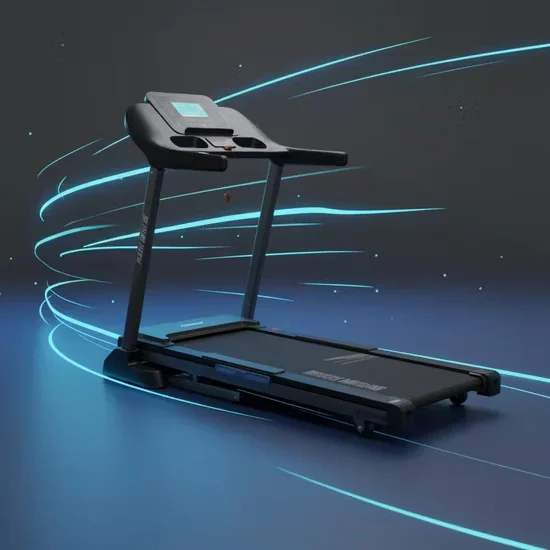
Quiet DC Drive Platform — folded to 220 mm for under-bed storage while delivering 16 structured workout programs on a space-constrained residential footprint.
Technical Specifications
| Parameter | Value |
|---|---|
| Product Type | Foldable Treadmill |
| Motor Type | DC |
| Motor Power | 1.5HP (peak or continuous not specified in source) |
| Speed Range | 1–16 km/h |
| Running Surface | 1200 x 450 mm |
| Console Type | LCD (Speed / Distance / Time / Calories) |
| Programs | 16 preset programs |
| Product Unfolded Size | 1500 x 740 x 1150 mm |
| Product Folded Size | 1810 x 740 x 220 mm |
| Net Weight | 42.0 kg |
| Material | ABS |
| Foldable | Yes |
| Certification | CE, RoHS |
Application Suitability
| Deployment Scenario | Typical Use |
|---|---|
| High-end residential home gym | Daily personal cardio in apartments where floor space is limited and the unit must fold away after each session |
| Small-space residential fitness | Bedroom or living room deployment with under-bed storage enabled by the 220 mm folded profile |
| Boutique office wellness room | Low-traffic personal cardio for individual employees during breaks, folded when not in use |
| Co-living shared fitness area | Compact cardio option for shared residential buildings where equipment must be stored to reclaim common space |
What Peak Horsepower Hides About Continuous Duty in Foldable Platforms
The 1.5HP rating on a foldable electric treadmill DC motor home use unit demands clarification before deployment decisions are finalized.
I have seen procurement teams compare treadmill spec sheets by peak horsepower alone, only to discover months later that a motor rated for intermittent home use overheats when three family members run back-to-back sessions. DC motors in foldable platforms are engineered for duty cycles measured in short bursts, not the sustained thermal loads of continuous operation. When a residential fitness room sees higher-than-expected usage density, the gap between peak and continuous output becomes the difference between reliable daily service and a motor winding failure [NEED_CITE: motor duty cycle classification for continuous commercial operation].
Where This Unit Fits in a Residential Cardio Layout
The W08 occupies the personal cardio slot in a home fitness environment, covering walking through steady-state running at speeds up to 16 km/h. It pairs with resistance or strength equipment that addresses the muscular loading a runner neglects, forming a balanced two-piece home setup. The 1200 x 450 mm running surface accommodates walking and jogging gaits for most adult users, though taller runners will notice the length during full-stride sprints. This foldable electric treadmill DC motor home use unit suits low-to-moderate daily usage density rather than multi-user commercial rotation.
Deployment Environment and Electrical Considerations
Running a DC motor foldable unit in a bedroom or apartment living room means noise transmits directly through floor joists to the room below. The lightweight 42 kg frame reduces structural loading but also means vibration damping depends on the mat and subfloor rather than the machine mass itself. Ensure the dedicated outlet matches local voltage standards before plugging in, as the DC motor controller expects stable input to regulate speed accurately. The LCD console operates independently without facility management system integration, making this unit appropriate where usage data does not need to feed into a centralized tracking dashboard [NEED_CITE: EN 957 requirements for residential cardio equipment].
Decoding the Drive and Control Specifications
The DC motor in this platform delivers speed regulation through electronic voltage control, which keeps the drive compact enough for a foldable frame but introduces thermal limits under sustained loading. The distinction between peak and continuous horsepower matters here: a 1.5HP peak rating indicates the maximum instantaneous output the motor can deliver during acceleration, not the thermal equilibrium it can sustain over a 45-minute session. The LCD console displays speed, distance, time, and calories without network connectivity, which keeps the electronics simple and reduces failure points in a home environment. The 16 preset programs structure speed intervals automatically, removing the need for manual adjustment mid-run. ABS material in the shroud and deck housing keeps weight at 42 kg, enabling the unit to fold and roll into storage without mechanical assistance. The 1200 x 450 mm belt area provides adequate width for walking and jogging but requires users to maintain centered foot placement during higher-speed work.
The Hidden Cost of Underspecification
Deploying a treadmill with an unspecified duty-cycle motor in a setting that sees daily sustained use leads to thermal degradation of the winding insulation over time. In residential buildings, noise that seems acceptable in a showroom becomes the subject of neighbor complaints once the unit operates at running speeds on an upper floor. A console that cannot export workout data leaves personal fitness tracking dependent on manual entry, creating gaps that undermine training consistency. Voltage mismatches discovered after delivery force adapter solutions that introduce their own failure points and void warranty coverage in some jurisdictions [NEED_CITE: voltage and plug standard compliance for imported fitness equipment].
Why This Product Line Addresses the Gap
The sub-35dB acoustic verification from our hotel deployments directly applies here: a foldable unit in a bedroom must not exceed ambient noise thresholds when guests or family members occupy adjacent rooms. Components tested for 10,000 hours of continuous operation set a durability baseline that distinguishes commercial-grade engineering from light-duty alternatives. The six-series cardio family means this treadmill can be specified alongside ellipticals or bikes from the same manufacturer, ensuring consistent build quality across a residential fitness space. OEM customization extends to console interface elements, allowing residential integrators to match the unit to the aesthetic of a furnished home gym. Free 3D layout planning accounts for the 1500 mm unfolded length and the clearance needed behind the unit for safe mounting and dismounting. Technical support available around the clock covers the firmware and electrical questions that arise during initial setup.
Documentation & Test Records
- CE declaration of conformity covering electrical safety and electromagnetic compatibility for this DC motor platform
- EN 957 test report validating structural and mechanical safety under rated user loading
- RoHS compliance documentation confirming restricted substance limits in electronic and ABS components
- Noise level test record documenting acoustic output at walking and running speeds
- Motor specification sheet detailing voltage input range and thermal protection thresholds
- Console technical documentation covering LCD display parameters and preset program logic
Installation, Commissioning & Maintenance
- Maintain a minimum clearance of 600 mm behind the 1500 mm unfolded length for safe user dismount and airflow
- Place a high-density vibration mat under the 42 kg frame to reduce structure-borne noise transmission to floors below
- Verify the dedicated outlet matches the DC motor controller voltage requirement before first power-on
- Run the belt at low speed for initial tension and tracking verification before progressing to running speeds
- Inspect belt alignment and deck lubrication at intervals determined by weekly usage frequency
- Wipe the ABS shroud and LCD console with a damp cloth after each session to prevent sweat corrosion
Specifying the Right Unit for Your Space
Provide the room dimensions and intended daily usage duration so we can confirm whether the DC motor duty cycle matches your expected session length. Indicate the deployment floor level and adjacent room occupancy so acoustic requirements can be verified against test data. Specify the target market voltage and plug standard to ensure electrical compatibility before shipment. Clarify whether personal workout data needs to integrate with any external tracking platform or whether standalone LCD output meets the requirement.
Frequently Asked Questions
Q: What is the difference between peak and continuous horsepower in treadmill motors?
A: Peak horsepower measures the maximum instantaneous output a motor delivers during acceleration or incline surges. Continuous horsepower reflects the thermal equilibrium the motor sustains over extended sessions without overheating. Foldable treadmill platforms often list peak values because their DC motors are sized for intermittent personal use rather than sustained commercial operation. Always confirm which rating appears on the specification sheet.
Q: How does a DC motor compare to AC for sustained treadmill operation?
A: DC motors achieve speed control through voltage regulation, keeping the drive compact and lightweight for foldable frames. AC motors manage heat dissipation more effectively under continuous loading, making them standard in commercial gym treadmills. For daily sessions exceeding 45 minutes or multi-user environments, AC platforms offer greater thermal headroom. DC remains appropriate for personal residential use with moderate session duration.
Q: What noise level should I expect from a foldable treadmill in an apartment setting?
A: Noise output depends on motor type, belt tension, deck cushioning, and the acoustic properties of the floor structure beneath the unit. Foldable platforms with lighter frames transmit more vibration to the subfloor than heavy commercial units. A dedicated vibration isolation mat reduces structure-borne transmission to rooms below. Request measured noise data at typical walking and running speeds before finalizing placement.
Q: Can the LCD console sync data with fitness apps or facility management systems?
A: The LCD console on this model displays speed, distance, time, and calories locally without wireless or wired data export capability. This standalone configuration reduces electronic complexity and failure points in a home setting. Users who require app integration or facility management system connectivity should evaluate models equipped with IoT-enabled consoles that support the relevant communication protocols.
![MT296 Electric Treadmill Exercise Machine for Fitness Training [WARN] draft identifier mismatch](https://bicksport.com/wp-content/uploads/2026/08/mt296-electric-treadmill-exercise-machine-for-fitness-training-warn-draft-identifier-mismatch-ed9f4c.webp)