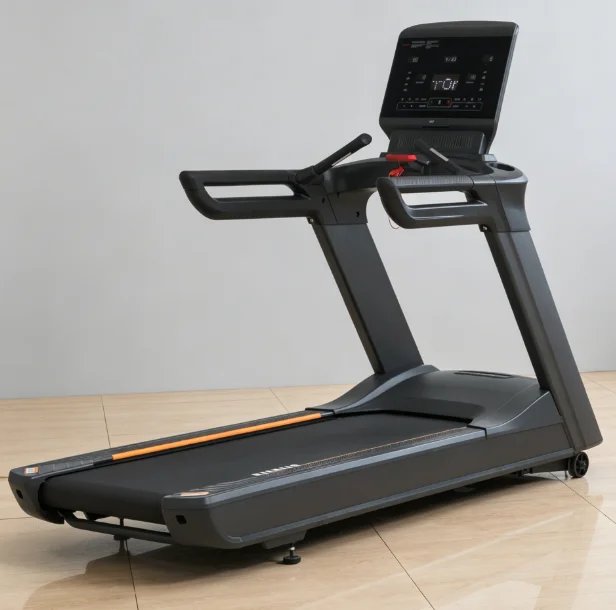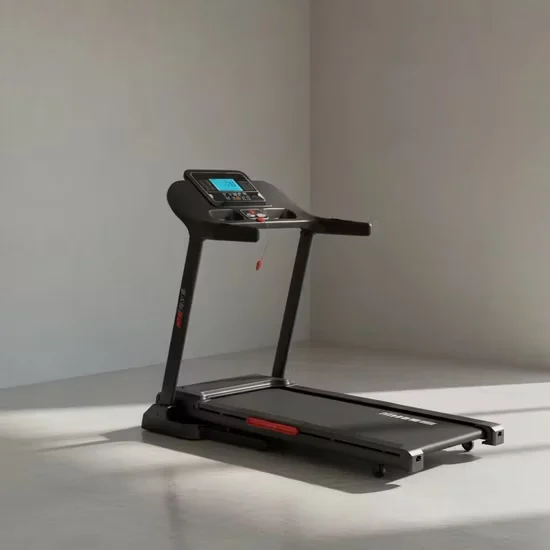
Quiet DC Drive — engineered for continuous operation in space-constrained facilities where noise and footprint dictate equipment selection.
Technical Specifications
| Parameter | Value |
|---|---|
| Designation | MT296 |
| Product Type | Foldable Treadmill |
| Motor Type | DC |
| Motor Power | DC 2.0 HP* |
| Speed Range | 1–20 km/h |
| Running Surface | 1200 × 520 mm |
| Console Type | LCD (Speed / Dist. / Time / Cal. / Pulse) |
| Programs | 16 |
| Product Unfold Size | 1580 × 865 × 1300 mm |
| Product Folded Size | 910 × 865 × 1345 mm |
| Net Weight | 64.0 kg |
| Max User Weight | 100–160 kg |
| Material | ABS |
| Foldable | Yes |
| Certification | CE, RoHS |
| OEM/ODM Custom | Yes |
| Color Options | Multicolor |
*Peak or continuous rating not specified in source documentation; confirm duty classification before specifying for continuous commercial operation.
Application Suitability
| Deployment Scenario | Typical Use |
|---|---|
| High-end residential home gym | Daily personal training with foldable storage after sessions |
| Corporate wellness room | Staff fitness breaks with space-efficient stowing between peak hours |
| Boutique studio recovery zone | Cool-down and steady-state cardio between group classes |
| Hotel fitness center on guest room floors | Overnight guest use where quiet operation and compact footprint are mandatory |
| Light-commercial fitness facility | Moderate-traffic cardio deployment with flexible floor space management |
What Peak Horsepower Hides About Continuous Duty in a Commercial Foldable Treadmill DC Motor MT296
A 2.0 HP rating means nothing if the motor cannot sustain output across an eight-hour facility schedule.
I spent years replacing burnt-out motors across South Asian facilities. Light-commercial treadmills equipped with residential-grade DC drives would fail within months when pushed to continuous daily use — members complained, operators replaced units in bulk, and the real cost was never the motor itself but the downtime and reputational damage [NEED_CITE: motor duty cycle classification for continuous commercial operation]. The commercial foldable treadmill DC motor MT296 enters this gap by pairing a DC drive with a foldable frame, aimed at facilities that need moderate-duty cardio without the spatial footprint of full commercial units. Before committing to any treadmill at this tier, confirm whether the published horsepower is peak or continuous, because the difference determines whether the drive survives six months or six weeks under real facility conditions.
Where the MT296 Sits in a Mixed Cardio Floor
This commercial foldable treadmill DC motor MT296 targets steady-state and moderate-intensity running or walking, covering speeds from 1 to 20 km/h across 16 preset programs. In a cardio zone it complements ellipticals and rowing machines by offering a familiar movement pattern for users who prefer belt-based training. The foldable frame suits multi-use spaces where the unit must be stowed between sessions — corporate wellness rooms and residential fitness areas benefit most. The 1200 × 520 mm running surface accommodates most adult users, though taller runners should verify stride comfort at higher speeds. The LCD console tracks speed, distance, time, calories, and pulse, providing essential feedback without app dependency.
Continuous Runtime and Deployment Environment Requirements
The DC motor in this unit suits moderate duty cycles — expect reliable performance under several hours of daily use rather than all-day continuous traffic [NEED_CITE: EN 957 requirements for commercial cardio equipment]. Deploy it on level flooring with adequate clearance behind the unit for the foldable frame mechanism to operate safely. Ventilation matters: DC motors generate heat under sustained load, so avoid enclosed alcoves without airflow. Verify the local voltage standard and plug configuration before shipment; mismatches discovered after delivery cause entire batches to sit idle. For facilities on upper floors, the foldable design reduces transport complexity, but confirm that the 64 kg net weight is manageable for your logistics pathway. The LCD console operates independently without facility management software integration, which simplifies setup but limits usage data collection.
Drive System and Control Specifications Explained
The DC motor delivers smooth acceleration across the 1–20 km/h range, a characteristic advantage over AC drives at this power tier where low-speed torque consistency matters for walking and jogging users. DC drives typically operate with less electrical noise, contributing to the quiet profile expected in hotel and residential deployments. The LCD console provides straightforward metric display — speed, distance, time, calories, and pulse — without touchscreen complexity, reducing failure points in high-humidity environments. Pulse is read through handlebar sensors, which offer convenience but may drift during vigorous running compared to chest-strap monitors [NEED_CITE: heart rate sensor accuracy across grip-based and strap-based systems]. The 16 preset programs introduce workload variety without requiring external connectivity, suitable for facilities where members prefer self-guided sessions. The foldable hinge mechanism introduces a structural joint that must be inspected periodically for wear under repeated daily folding cycles.
The Hidden Cost of Underspecing at This Tier
Facilities that select treadmills purely on published horsepower without verifying continuous duty ratings consistently face premature motor failure — the pattern repeats across boutique studios and residential gyms alike [NEED_CITE: premature motor failure rates in light-commercial treadmill deployments]. Noise from underpowered drives escalates as bearings and belts compensate for thermal stress, generating complaints from adjacent occupied spaces. Foldable mechanisms on underspeced frames develop play over months, creating wobble during high-speed use and eroding user confidence. When consoles lack any data export capability, facility operators lose visibility into usage patterns, making it impossible to justify equipment rotation or expansion decisions. Voltage mismatches remain one of the most preventable yet costly deployment failures, stranding entire shipments until transformers or rewiring are arranged.
Why This Product Line Addresses the Gap
Biketon Sport engineers cardio equipment around verified acoustic performance — units are tested to operate below 35 dB, a threshold that prevents noise complaints in hotel and residential deployments. The 10,000-hour durability protocol on motors, frames, and bearings provides a baseline for continuous-use confidence that separates commercial-grade engineering from repackaged residential hardware. The full six-series cardio family means a facility can source treadmills, ellipticals, bikes, rowers, stair climbers, and spinning bikes from one product line, ensuring consistent console logic and maintenance schedules. OEM and ODM customization extends to console UI, allowing facility branding and interface adjustments. The free 3D cardio zone layout and airflow planning service addresses spatial deployment at the planning stage — for the MT296 specifically, this means calculating foldable clearance zones and ensuring adequate ventilation around the DC motor housing. Technical support operates around the clock, critical for facilities in different time zones.
Documentation & Test Records
- CE declaration of conformity for the MT296 foldable treadmill platform
- EN 957 test report covering structural and safety performance
- ISO 9001 certificate for manufacturing quality management
- RoHS compliance documentation for hazardous substance restriction
- Motor specification sheet with duty cycle and thermal rating data
- LCD console technical documentation with wiring and interface details
Installation, Commissioning & Maintenance
- Maintain minimum clearance around the 1580 × 865 mm unfolded footprint on all sides for safe user access and foldable mechanism travel
- Level the floor surface before installation; the 64 kg frame requires stable contact to prevent wobble during high-speed operation
- Confirm voltage and plug standard match local supply; install a dedicated circuit for continuous-use deployments to prevent voltage sag
- Calibrate speed readings against a known reference during first commissioning to verify the 1–20 km/h range accuracy
- Inspect the foldable hinge mechanism and belt tension quarterly under moderate-duty use schedules
- Wipe the LCD console and handlebar pulse sensors daily to prevent sweat corrosion and ensure reliable heart rate readings
Planning Your Deployment
Share your cardio zone dimensions and equipment count to receive a 3D layout with airflow planning that accounts for the MT296 foldable clearance requirements. Specify your expected daily runtime so the motor duty classification can be matched to your operational reality. Identify the deployment floor and adjacent occupied spaces to confirm that acoustic performance meets your environment’s requirements. State your target market voltage standard and plug configuration to eliminate post-delivery mismatches.
Frequently Asked Questions
Q: What is the difference between peak and continuous motor power for treadmill selection?
A: Peak horsepower indicates the maximum output the motor can deliver in short bursts, while continuous horsepower reflects what it can sustain over extended sessions. For commercial environments with back-to-back users, continuous rating determines real-world longevity. Always request the continuous duty specification from the manufacturer before comparing treadmills at this tier, as a high peak number alone does not guarantee reliable daily performance.
Q: How does a foldable treadmill frame maintain structural rigidity during high-speed running?
A: Foldable frames rely on reinforced hinge mechanisms and locking pins to eliminate lateral play during use. The MT296 uses a steel-reinforced folding joint designed to hold alignment under the 100–160 kg user weight range. Periodic inspection of the hinge and lock points ensures that repeated folding cycles do not introduce wobble. Facilities with high daily fold-unfold counts should schedule hinge checks at shorter intervals.
Q: Can the LCD console data export to facility management software or member apps?
A: The MT296 LCD console displays speed, distance, time, calories, and pulse in real time but does not include built-in connectivity for external software integration. This design prioritizes reliability and reduces electronic failure points in environments where humidity and dust are concerns. Facilities requiring usage data collection should plan for separate tracking systems or consider units with IoT-enabled consoles from the same product line.
Q: What maintenance schedule is recommended for DC motor treadmills in commercial environments?
A: DC motor treadmills in moderate commercial use benefit from quarterly belt tension and alignment checks, monthly deck lubrication inspection, and weekly visual inspection of the power cable and console connections. The foldable hinge mechanism should be examined for wear at each quarterly interval. Motor brush condition, if applicable to the specific DC drive configuration, should be assessed annually by qualified technicians to prevent unexpected failure.

![SR-1003B Commercial Treadmill Multifunctional Equipment for Gym Use [WARN] draft identifier mismatch](https://bicksport.com/wp-content/uploads/2026/08/sr-1003b-commercial-treadmill-multifunctional-equipment-for-gym-use-warn-draft-identifier-mismatch-df2e0b.webp)
![Wear-Resistant Mt296 Motorized Treadmill for Commercial Fitness [WARN] draft identifier mismatch](https://bicksport.com/wp-content/uploads/2026/08/wear-resistant-mt296-motorized-treadmill-for-commercial-fitness-warn-draft-identifier-mismatch-1361f6.webp)