
![Wear-Resistant Mt296 Motorized Treadmill for Commercial Fitness [WARN] draft identifier mismatch](https://bicksport.com/wp-content/uploads/2026/08/wear-resistant-mt296-motorized-treadmill-for-commercial-fitness-warn-draft-identifier-mismatch-1361f6.webp)
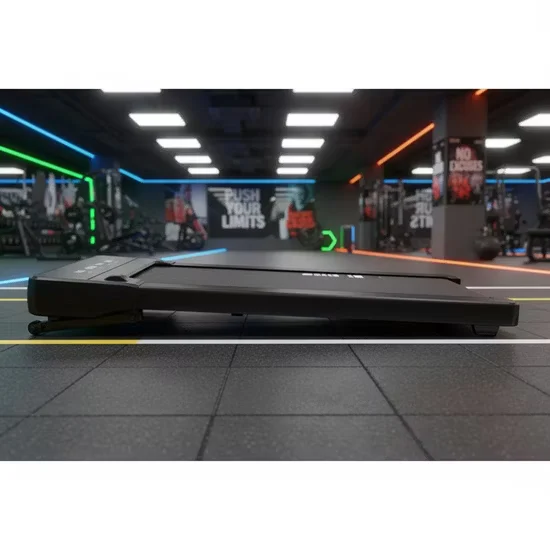
Space-Saving Foldable Frame — The MT296 reduces its floor footprint by nearly half when stowed, verified against its 910 mm folded depth for tight hotel fitness closets and multi-use residential rooms.
Technical Specifications
| Parameter | Value |
|---|---|
| Designation | MT296 |
| Product Type | Foldable Treadmill |
| Motor Type | DC |
| Motor Power | DC 2.0 HP * |
| Speed Range | 1–20 km/h |
| Running Surface | 1200 x 520 mm |
| Console Type | LCD (Speed / Dist. / Time / Cal. / Pulse) |
| Programs | 16 |
| Product Unfold Size | 1580 x 865 x 1300 mm |
| Product Folded Size | 910 x 865 x 1345 mm |
| Net Weight | 64.0 kg |
| Foldable | Yes |
| Material | ABS |
| Certification | CE, RoHS |
| OEM/ODM | Available |
* Peak or continuous output not specified in source documentation; confirm duty rating before high-volume deployment.
Application Suitability
| Deployment Scenario | Typical Use |
|---|---|
| Hotel fitness center on guest room floors | Low-profile cardio for early-morning and late-night use where noise transmission to adjacent rooms is a primary concern |
| High-end residential home gym | Foldable deployment in multi-purpose rooms requiring equipment stowage between sessions |
| Corporate wellness room | Moderate-volume walking and jogging for employees during breaks and before/after shifts |
| Light-commercial wellness center | Space-constrained cardio zones where full-size treadmills exceed available square footage |
What Peak Horsepower Hides About Continuous Duty in Foldable Commercial Treadmills
A DC motor rated at peak output behaves very differently under sustained load than one rated for continuous duty.
When a boutique hotel equips its guest-floor fitness room, the front desk rarely hears about a motor specification sheet — they hear about the treadmill that shut down at 6 AM when three guests used it back to back. The distinction between peak and continuous horsepower determines whether a foldable motorized treadmill DC motor commercial platform survives a morning rush or triggers a maintenance call before breakfast service ends. Facilities that specify based on peak ratings alone often discover the thermal cutoff engages well before the expected duty cycle completes [NEED_CITE: motor duty cycle classification for continuous commercial operation]. We have seen deployments where units rated for light-commercial use required replacement within the first year because the actual daily run-time exceeded the motor’s thermal capacity.
Where the MT296 Fits in a Mixed Cardio Zone
This foldable motorized treadmill DC motor commercial unit covers walking through moderate-speed jogging on a 1200 x 520 mm running surface, positioning it for users who prioritize stride comfort at lower intensities rather than sprint training. In a compact cardio zone, it pairs with an elliptical or stationary bike to cover low-impact alternatives, letting the treadmill handle the weight-bearing cardiovascular segment. The 16 preset programs support structured interval sessions, and the LCD console captures speed, distance, time, calories, and pulse for basic workout verification. Its folded footprint allows placement against a wall between use periods, which matters in hotel fitness rooms where the same square footage may serve multiple functions throughout the day.
Continuous Run-Time and Deployment Environment Requirements
A DC motor platform in this class suits facilities with moderate daily user volume — typically corporate wellness rooms or residential gyms where the treadmill runs for intervals rather than continuous back-to-back sessions. Deploying the MT296 on an upper hotel floor requires attention to vibration transfer through the subfloor; a dedicated rubber isolation mat beneath the unit reduces structure-borne noise transmission to the room below. The LCD console operates as a standalone display without facility management software integration, so usage tracking relies on manual logging or member self-reporting [NEED_CITE: console data integration standards for commercial cardio]. Voltage and plug configuration must be confirmed for the destination market before production, as mismatches discovered after container arrival create costly rewiring delays. Adequate clearance behind and beside the unfolded frame — referencing the 1580 x 865 mm operating footprint — ensures safe mounting and dismounting.
DC Drive Mechanics and Running Surface Engineering
The DC motor configuration delivers smooth acceleration from 1 km/h up to 20 km/h, with torque delivery suited to walking and jogging loads rather than sustained high-speed running. DC motors generally produce lower acoustic output at moderate speeds compared to equivalent AC drives, which matters when the treadmill operates near occupied guest rooms or shared residential walls. The 1200 x 520 mm running surface provides adequate stride length for users up to moderate height, while the 520 mm width maintains a narrower overall frame profile that supports the foldable design. ABS material in the shroud and console housing keeps the net weight at 64.0 kg, enabling the folding mechanism to function without excessive lifting effort. The LCD console presents five real-time metrics — speed, distance, time, calories, and pulse — through a straightforward segmented display that avoids the failure points associated with touchscreen panels in high-humidity environments. Heart rate monitoring via pulse sensors on the handlebars provides basic exertion feedback, though chest-strap telemetry would offer greater accuracy for interval programming [NEED_CITE: heart rate sensor accuracy comparison across grip and chest-strap methods].
The Hidden Cost of Specifying Below the Actual Duty Cycle
Facilities that select cardio equipment based on brochure specifications rather than verified continuous-duty ratings face predictable consequences. Motors sized for peak output overheat under repeated use, triggering thermal shutdowns that interrupt member sessions and generate complaint logs. Noise levels that seem acceptable during a showroom demonstration often exceed guest tolerance when the same unit operates at 5 AM on a floor with sleeping occupants two walls away. We have participated in remediation projects where an entire treadmill deployment was swapped to a different drive platform after noise complaints reached the front desk consistently within the first month [NEED_CITE: acoustic performance verification for cardio equipment on occupied floors]. Voltage mismatches represent another avoidable failure — units shipped with the wrong plug standard or frequency rating sit idle until an electrician completes rewiring, delaying the fitness center opening.
Why This Product Line for Your Cardio Deployment
The MT296 benefits from a manufacturing process that includes in-house motor assembly and frame welding, giving direct control over the components that most affect noise and durability. Each unit undergoes testing protocols aligned with 10,000-hour continuous operation benchmarks applied across the broader cardio range. The foldable frame design addresses the spatial reality of hotel and residential fitness rooms where equipment must coexist with other room functions. OEM customization extends to console UI configuration, allowing facility operators to match branding or simplify the interface for unsupervised guest use. A 3D cardio zone layout service evaluates the MT296’s unfolded and folded clearances alongside adjacent equipment spacing, ensuring member flow and sightlines are planned before the order is finalized. Technical support operates around the clock for commissioning questions and spare parts coordination.
Documentation & Test Records
- CE declaration of conformity covering the MT296 electrical and mechanical safety requirements
- EN 957 test report validating structural and performance criteria for stationary training equipment
- ISO 9001 certificate documenting quality management across the production process
- RoHS compliance documentation confirming restriction of hazardous substances in all components
- Motor specification sheet detailing DC drive characteristics and thermal performance data
- Installation and commissioning guide with foldable mechanism inspection procedures
Installation, Commissioning & Maintenance
- Maintain minimum clearance around the 1580 x 865 mm unfolded footprint for safe user mounting and dismounting
- Place a rubber isolation mat beneath the frame to dampen vibration transfer on upper-floor deployments
- Confirm voltage and plug type match the facility supply before connecting the DC motor circuit
- Inspect the folding hinge and locking pins during initial commissioning and at quarterly intervals
- Lubricate the running belt per the maintenance schedule to preserve surface friction and reduce motor load
- Clean the LCD console with a dry microfiber cloth to prevent moisture ingress around the display bezel
Planning Your Cardio Equipment Inquiry
Provide the available square footage and target unit count so the 3D layout team can map the MT296’s folded and unfolded clearances against your floor plan. Specify the expected daily run-time per unit to confirm whether the DC motor duty cycle aligns with your usage pattern. Indicate the deployment floor level and adjacent room types so acoustic requirements can be matched. State the destination market voltage and plug standard to avoid post-shipment electrical mismatches. Confirm whether console data output is required for your facility management system.
Frequently Asked Questions
Q: What is the difference between continuous and peak motor power for daily facility use?
A: Peak horsepower represents the maximum output a motor can deliver for short bursts, while continuous horsepower reflects sustained output under load without overheating. Facilities with back-to-back users need continuous ratings that match actual run-time patterns. Always request the motor specification sheet to verify which rating applies before committing to a deployment volume.
Q: How does a DC motor compare to AC in noise output for commercial environments?
A: DC motors typically operate at lower acoustic levels during moderate-speed walking and jogging, making them suitable for noise-sensitive placements like hotel guest floors. AC motors handle higher continuous loads but may generate more audible hum at lower speeds. The choice depends on your daily usage density and the proximity of occupied rooms to the cardio zone.
Q: Can the LCD console sync with facility management software?
A: The MT296 LCD console displays speed, distance, time, calories, and pulse as standalone metrics without built-in data export or software integration. Facilities requiring automated usage logging should evaluate whether manual tracking meets operational needs or whether a console upgrade with connectivity is necessary for their management platform.
Q: What noise level should be expected on upper floors near guest rooms?
A: Actual noise levels depend on subfloor construction, isolation matting, and user speed. Deployments on occupied floors should include a rubber vibration mat and request the manufacturer’s noise level test report to verify suitability. Field verification after installation remains the most reliable confirmation that acoustic performance meets guest comfort thresholds.
Q: How does the foldable mechanism affect long-term frame durability?
A: Folding hinges and locking pins introduce additional wear points compared to fixed-frame treadmills. Regular inspection of these joints during scheduled maintenance prevents looseness that could affect running surface stability. Facilities with high daily use should evaluate whether the space savings justify the additional maintenance intervals compared to a permanent-placement unit.

![Healthmate New Design Foldable Treadmill with Hydraulic Cylinder for Household [WARN] draft identifier mismatch](https://bicksport.com/wp-content/uploads/2026/08/healthmate-new-design-foldable-treadmill-with-hydraulic-cylinder-for-household-warn-draft-identifier-mismatch-67327d.webp)
