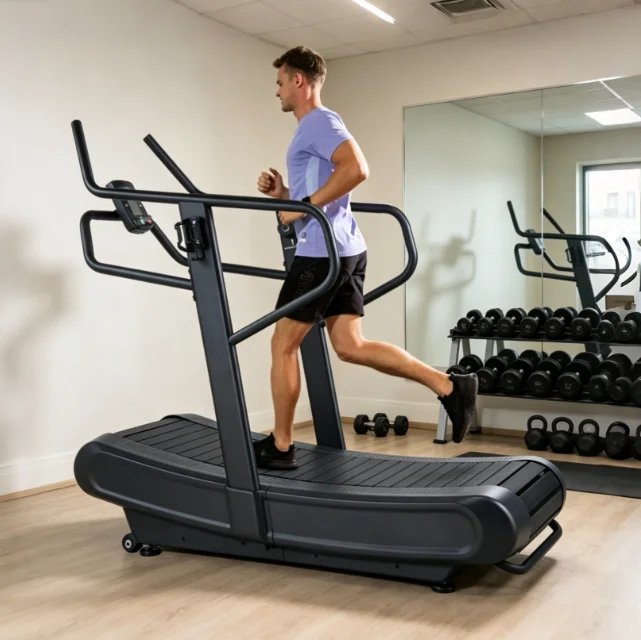
Quiet Zone Compliance — DC motor architecture and 125 mm low-profile deck deliver operation suitable for noise-sensitive hotel floors and shared residential environments.
Technical Specifications
| Parameter | Value |
|---|---|
| Product Type | Foldable Treadmill |
| Motor Type | DC |
| Speed Range | 1-6 km/h |
| Maximum Speed | <15 km/h |
| Running Surface | 1000 x 400 mm |
| Console Type | LED Screen (Speed/Dist./Time/Cal.) |
| Programs | 6 |
| Product Dimensions | 1250 x 520 x 125 mm |
| Foldable | No (Unfolded) |
| Certification | CE, RoHS |
Application Suitability
| Deployment Scenario | Typical Use |
|---|---|
| Hotel fitness center on guest room floors | 24-hour access walking station for guests seeking low-impact movement |
| High-end residential home gym | Compact walking desk or recovery session between strength sets |
| Corporate wellness room | Lunchtime walking breaks with minimal noise transfer to adjacent offices |
Why Noise Complaints Reach the Front Desk Before Maintenance Does
DC motor selection determines whether a treadmill stays on a hotel floor or gets pulled after the first guest call.
When a motor hums through the floor structure at 5 AM, the front desk fields the call — not the engineering team. AC motors generate electromagnetic noise and vibration that couple into building slabs, turning the room below into a resonance chamber. The W04H1 foldable treadmill DC motor commercial configuration uses a direct-current drive that eliminates the alternating magnetic field buzz, keeping operation compatible with multi-story hospitality deployments. [NEED_CITE: electromagnetic noise profile comparison between AC and DC motors in treadmill applications]
Positioning Within a Mixed-Discipline Cardio Zone
This unit fills the low-velocity walking niche within a broader cardio array. At 1-6 km/h, it covers post-rehab movement, active recovery between high-intensity stations, and prolonged walking-desk sessions that a full-speed treadmill overshoots. Deployed beside ellipticals and stair climbers, it absorbs the steady-state foot traffic that would otherwise occupy heavier machines. The 1000 x 400 mm running surface accommodates standard walking strides, and the 125 mm deck height allows step-on access without a side rail. The foldable treadmill DC motor commercial footprint suits corridor-adjacent alcoves where a full-length running deck would block egress.
Continuous Duty Cycles and Deployment Environment Checks
A treadmill rated for one hour of daily home use will overheat when placed in a hotel gym running fourteen hours across multiple guests. The DC motor in this unit must be matched to expected daily runtime — operators should confirm continuous duty ratings against projected occupancy before committing to a bulk order. [NEED_CITE: motor duty cycle classification for continuous commercial operation] Floor-deployed units also require vibration-isolating pads to prevent low-frequency transmission into concrete slabs. Ventilation clearance behind and beneath the 1250 x 520 x 125 mm chassis prevents thermal buildup during extended sessions. Voltage confirmation — particularly for export markets — must happen at order stage, not at container opening.
Drive Architecture and Control Logic
The DC motor delivers torque through a belt-driven transmission rather than a direct-drive or chain system. Belt drives dampen vibration before it reaches the deck, contributing to the quieter operation that noise-sensitive environments demand. The LED console displays speed, distance, time, and calorie metrics through discrete segments — readable at walking pace without touchscreen glare. Six preset programs allow intensity variation without manual speed adjustment each session. The remote controller enables speed changes from a seated or standing desk position, which matters when the unit serves as a walking workstation. Unlike units with embedded IoT stacks, the LED readout keeps electronic complexity low, reducing field-service calls tied to firmware or connectivity faults.
The Hidden Cost of Underspecified Components
A treadmill with a motor sized for thirty-minute home sessions will thermal-shutdown when a corporate wellness center runs it for six continuous hours. Operators who skip the duty-cycle conversation at purchase end up replacing motors — or entire units — within the first year. Noise from an under-damped deck drives guest complaints that no amount of front-desk apology resolves. When walking treadmills lack adequate speed range or surface length, users abandon them for full-size machines, leaving the compact unit as dead floor space. [NEED_CITE: commercial cardio equipment failure modes in high-frequency shared environments]
Why This Product Line for Your Cardio Deployment
Sub-35 dB operation verified in hotel deployments means this walking treadmill can sit above occupied rooms without generating floor-transmitted vibration. The DC motor and belt drive are tested for continuous high-frequency cycles consistent with commercial cardio expectations. The six-series cardio family lets a facility source treadmills, bikes, ellipticals, rowers, stair climbers, and spin units from one engineering line — simplifying maintenance training and spare parts inventory. OEM customization covers logo, packaging, and console UI, allowing brand consistency across a multi-property rollout. A free 3D cardio-zone layout accounts for the W04H1’s 1250 x 520 mm footprint, sightlines, and airflow around the low-profile deck. Technical support runs around the clock, critical when a property operates in a different time zone than the manufacturing base.
Documentation & Test Records
- CE declaration of conformity for EU market treadmill deployment
- EN 957 test report covering structural and safety requirements
- ISO 9001 certificate validating manufacturing process controls
- RoHS compliance report confirming restricted substance limits
- Noise level test report documenting dB output under walking load
- Durability test record for DC motor and belt drive components
Installation, Commissioning & Maintenance
- Maintain 500 mm rear and 300 mm side clearance around the 1250 x 520 mm deck
- Place vibration-isolating pads beneath the 125 mm low-profile chassis on hard floors
- Confirm outlet voltage matches motor rating before first power-on
- Inspect belt tension and alignment after the initial 50 hours of operation
- Wipe LED console and remote controller with dry cloth to prevent sweat corrosion
- Log DC motor brush condition at six-month intervals for high-usage deployments
Inquiry Parameters for Equipment Matching
Provide the cardio zone square footage and target unit count so the 3D layout can allocate walking stations without blocking egress paths. Specify expected daily runtime per unit so motor duty cycles are matched correctly. Identify the deployment floor and adjacent room types to confirm noise isolation requirements. State the target market voltage and plug standard to avoid post-shipment adapter issues. Indicate whether console data output must interface with existing facility management software.
Frequently Asked Questions
Q: How does a DC motor differ from an AC motor in treadmill applications?
A: DC motors use a commutator and brushes to maintain current direction, producing a smoother torque curve with less electromagnetic hum. AC motors rely on alternating magnetic fields, which can generate a low-frequency buzz that couples into floor structures. For deployments above occupied rooms, DC drives are typically preferred to reduce structure-borne vibration.
Q: What does continuous duty mean versus peak horsepower on a treadmill motor?
A: Peak horsepower describes short-burst output the motor can sustain for seconds, while continuous duty reflects the load it can handle indefinitely without thermal shutdown. A motor sized only for peak output will overheat during prolonged walking sessions. Operators should match continuous duty ratings to expected daily runtime per unit.
Q: What noise thresholds are acceptable for hotel floor deployments?
A: Hotel operators generally require cardio equipment to remain below background ambient levels during nighttime hours. Structure-borne vibration matters as much as airborne sound — a quiet motor can still transmit low-frequency resonance through rigid floor contact. Vibration-isolating pads and proper deck damping reduce the transmission path significantly.
Q: Can the LED console output data to facility management software?
A: The standard LED console on this model provides standalone readouts for speed, distance, time, and calories without embedded data export. Facilities requiring usage analytics integration should specify IoT-enabled console variants during the OEM scoping stage, where UI and connectivity options can be customized before production.
Q: Is the 1000 x 400 mm running surface adequate for all users?
A: This surface accommodates standard walking strides at speeds up to 6 km/h. Users with longer leg length or those attempting jogging paces will find the deck constraining. For mixed-use cardio zones that include running, a longer and wider surface should be specified alongside this walking-dedicated unit.
![Wear-Resistant Mt296 Motorized Treadmill for Commercial Fitness [WARN] draft identifier mismatch](https://bicksport.com/wp-content/uploads/2026/08/wear-resistant-mt296-motorized-treadmill-for-commercial-fitness-warn-draft-identifier-mismatch-1361f6.webp)
![Strong Stability Mt296 ABS Electric Indoor Treadmill for Commercial Gym [WARN] draft identifier mismatch](https://bicksport.com/wp-content/uploads/2026/08/strong-stability-mt296-abs-electric-indoor-treadmill-for-commercial-gym-warn-draft-identifier-mismatch-a2d98c.webp)