
![Hsm Durable Electric Walking Treadmill with Remote Controller and Transport Wheels [WARN] draft identifier mismatch](https://bicksport.com/wp-content/uploads/2026/08/hsm-durable-electric-walking-treadmill-with-remote-controller-and-transport-wheels-warn-draft-identifier-mismatch-672fe0.webp)
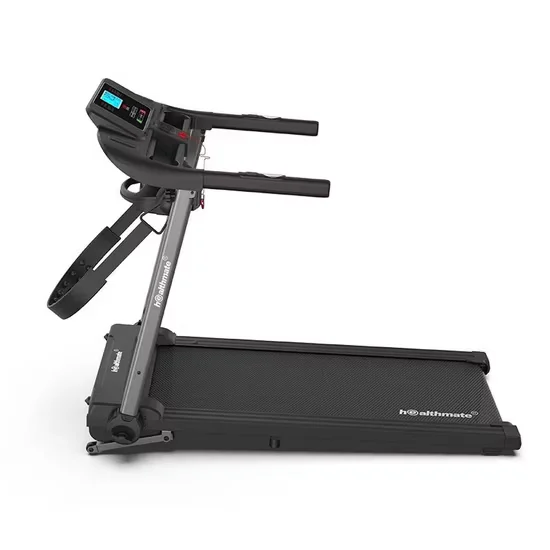
Quiet Operation & Space Efficiency — The W04H1 foldable treadmill electric walking platform pairs a low-noise motor with a 1000×400 mm runway, keeping residential and shared-space deployments complaint-free.
Technical Specifications
| Parameter | Value |
|---|---|
| Designation | W04H1 |
| Product Type | Foldable Treadmill |
| Function | Multifunctional, Single |
| Motor Type | DC Motor |
| Speed Range | 1–6 km/h |
| Maximum Speed | <15 km/h |
| Running Surface | 1000 × 400 mm |
| Programs | 6 preset programs |
| Console Type | LED Screen (Speed / Distance / Time / Calories) |
| Foldable | Yes |
| Product Dimensions | 1250 × 520 × 125 mm (folded) |
| Transport | Equipped with transport wheels |
| Certification | CE, RoHS |
| Origin | Ningbo |
| Production Capacity | 3,000 units/month |
Application Suitability
| Deployment Scenario | Typical Use |
|---|---|
| High-end residential home gym | Daily walking and light jogging in compact living spaces |
| Corporate wellness room | Employee walking breaks between meetings |
| Community activity center | Senior and rehabilitation walking sessions |
| Hotel guest floor fitness alcove | Low-noise walking for guests in shared corridors |
Why Foldable Treadmill Noise Still Reaches the Room Next Door
A compact footprint means nothing if the motor hum travels through the floor slab.
I’ve watched property managers pull entire batches of walking pads from serviced apartments after the second noise complaint in one month. The issue usually isn’t the belt slap—it’s the motor resonance transmitting through an uninsulated deck into the concrete below. When a foldable treadmill electric walking unit runs night after night on a guest floor, the cumulative low-frequency vibration becomes a management problem, not just an engineering one [NEED_CITE: structural vibration transmission in multi-story residential fitness deployments]. Deploying any walking treadmill above occupied rooms demands verified motor isolation and deck damping, not just a folded profile that fits under a bed.
Positioning the W04H1 Within a Mixed-Use Cardio Layout
This unit fills the dedicated walking and recovery zone where full-size treadmills would overwhelm the square footage. Its 1000×400 mm runway targets steady-state walking and light jogging at 1–6 km/h, complementing higher-intensity ellipticals and bikes in a shared cardio area. The foldable treadmill electric walking format lets operators park it against a wall between peak hours, freeing floor space for group movement. It suits users of average build who need consistent, low-speed movement rather than sprint intervals.
Continuous Run-Time and What the Environment Demands
A walking treadmill at 6 km/h draws less peak current than a running unit, but duty cycle still matters when members cycle through it all day in a corporate wellness room. The DC motor inside the W04H1 is sized for intermittent to moderate continuous use; running it past eight hours daily without rest intervals risks thermal buildup. Floor deployment matters too—place it on a vibration-damping mat over hard tile to keep low-frequency hum from coupling into the structure. Ensure a dedicated power circuit matching the local voltage standard before commissioning, and confirm whether the deployment site needs usage data logged through a facility management system before assuming the LED console can export it [NEED_CITE: DC motor thermal limits under continuous light-commercial duty cycles].
Reading the Motor, Deck, and Console Specs Honestly
The DC motor driving the W04H1 is typical for foldable walking platforms: lighter than an AC equivalent, adequate for 1–6 km/h walking loads, but not engineered for back-to-back running sessions. The 1000×400 mm runway gives enough length for a natural walking stride while keeping the folded envelope at 1250×520×125 mm—compact enough for apartment storage or tight wellness alcoves. The LED console displays speed, distance, time, and calories in a simple loop, which means zero data-interface complexity but also no app sync or biometric export. Six preset programs give users structured pace variation without needing to build custom intervals. Transport wheels let one person tilt and roll the unit into a closet or corner, a practical detail that matters daily in residential settings.
What Cutting Corners on a Walking Platform Actually Costs
I’ve seen residential developers buy the cheapest walking pads available, then face wholesale replacements within a year because the motors weren’t rated for the daily run-time a shared amenity space demands. Noise complaints compound—first one guest, then a floor, then a management decision to rip out the entire cardio alcove. A deck with insufficient damping transfers vibration into the slab, and no amount of rubber feet fixes that after installation. On the data side, an LED-only console in a corporate wellness room means zero usage tracking, leaving facilities managers blind to whether the investment is even being used [NEED_CITE: equipment utilization tracking gaps in corporate wellness deployments].
Why This Product Line Earns Its Place
The W04H1 sits within a six-series cardio family, meaning a facility can source its walking platforms, full treadmills, bikes, and rowers from one engineering lineage. The motor and deck on this unit are validated through the same 10,000-hour durability protocol applied across the range. For hotel deployments, the sub-35dB noise benchmark that applies to the commercial lineup sets the acoustic target this foldable model is measured against. OEM customization covers logo, color, and packaging—useful when a residential developer needs the unit to match an interior palette. The 3D cardio-zone layout service extends to compact spaces too, planning sightlines and clearance around a unit that folds flat to 125 mm. Post-installation, 24/7 technical support covers firmware questions and replacement part logistics.
Documentation & Test Records
- CE declaration of conformity covering the W04H1 electrical safety scope
- RoHS compliance record for restricted substance limits
- EN 957 test report validating mechanical and structural safety
- Motor specification sheet with duty-cycle and thermal data
- Noise level test record under standard walking load
- Installation, commissioning guide and spare parts list
Installation, Commissioning & Maintenance
- Maintain clearance on all sides equal to the 1250×520 mm footprint for safe mounting and dismounting
- Place on a leveled surface with a vibration-damping mat to isolate the DC motor resonance
- Confirm voltage match and connect to a dedicated circuit before first power-on
- Verify LED console readouts for speed, distance, time, and calorie accuracy at commissioning
- Inspect belt tension and apply silicone lubricant to the 1000×400 mm runway per the maintenance schedule
- Wipe the deck and console after each session to prevent sweat corrosion on the LED housing
Planning Your Deployment Inquiry
Share your cardio-zone square footage and equipment list so a 3D layout can confirm how the W04H1 fits alongside other units. Specify daily expected run-time so the motor duty cycle is validated against actual use. Note the deployment floor and adjacent occupied rooms to confirm acoustic requirements, and state the target market voltage and plug standard. Indicate whether usage data needs to feed into a facility management platform, since the LED console on this model is a standalone display.
Frequently Asked Questions
Q: What is the difference between continuous and peak horsepower on a walking treadmill?
A: Peak horsepower describes the motor’s maximum output during brief acceleration, while continuous rating reflects what it sustains during steady operation. Many walking platforms advertise a peak figure that sounds impressive but doesn’t represent real walking loads. Always ask for the continuous duty specification and match it to your expected daily run-time before committing to a purchase order.
Q: Is a foldable treadmill suitable for high-frequency commercial gym use?
A: Foldable designs prioritize compact storage and residential convenience, which typically means lighter frames and smaller motors than fixed commercial units. For a gym floor running twelve hours daily, a fixed-frame treadmill with a higher duty-cycle motor is the correct choice. Foldable models fit better in corporate wellness rooms, residential amenities, and hotel guest-floor alcoves where use is intermittent.
Q: Can the LED console on this treadmill sync with a facility management system?
A: The W04H1 LED console displays speed, distance, time, and calories locally but does not include data-export connectivity. If your deployment requires usage logging or member app integration, you will need a model from the lineup that offers an IoT-enabled console with the appropriate communication protocols. Clarify this during the specification phase.
Q: How often does the running belt on a walking treadmill need lubrication?
A: Lubrication intervals depend on usage intensity and ambient humidity. Under typical residential walking loads, a silicone-based lubricant applied to the deck-belt interface every two to three months maintains smooth operation. In higher-use corporate or hotel settings, inspect monthly. Neglecting this accelerates belt wear and increases motor strain, shortening the unit’s service life.

![HSM Household Fashion Treadmill with Manual Incline for Home Gym Use [WARN] draft identifier mismatch](https://bicksport.com/wp-content/uploads/2026/08/hsm-household-fashion-treadmill-with-manual-incline-for-home-gym-use-warn-draft-identifier-mismatch-4650f7.webp)
![MT296 Anti-Tipping ABS Incline Electric Treadmill for Aerobic Exercise [WARN] draft identifier mismatch](https://bicksport.com/wp-content/uploads/2026/08/mt296-anti-tipping-abs-incline-electric-treadmill-for-aerobic-exercise-warn-draft-identifier-mismatch-a52682.webp)