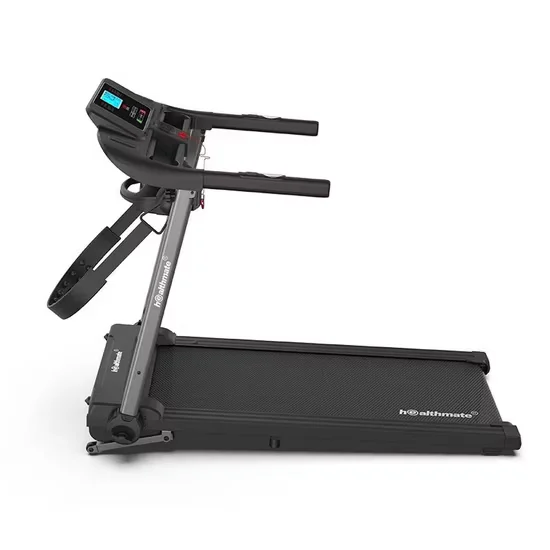
![Healthmate T12F1 Motorized Foldable Treadmill with LCD Screen [WARN] draft identifier mismatch](https://bicksport.com/wp-content/uploads/2026/08/healthmate-t12f1-motorized-foldable-treadmill-with-lcd-screen-warn-draft-identifier-mismatch-f5795e.webp)
Quiet Deployment — The T12F1 targets noise-sensitive residential and hospitality spaces with a belt-driven motor platform and compact foldable footprint.
Technical Specifications
| Parameter | Value |
|---|---|
| Designation | T12F1 |
| Motor Power | 1.0HP (peak or continuous not specified in source) |
| Speed Range | 1-12 km/h |
| Running Surface | 1000 x 400 mm |
| Console Type | LCD Screen (Speed / Distance / Time / Calories / Pulse) |
| Programs | 12 preset programs |
| Foldable | Yes |
| Product Dimensions | 1228 x 615 x 1100 mm |
| Net Weight | 23.0 kg |
| Certification | CE, RoHS |
Application Suitability
| Deployment Scenario | Typical Use |
|---|---|
| Hotel fitness center on guest room floors | Low-noise cardio for guests accessing equipment during early morning or late evening hours |
| High-end residential home gym | Foldable motorized treadmill LCD console home commercial deployment where floor space is shared and noise travels between units |
| Light-commercial wellness studio | Moderate daily use in boutique environments requiring compact cardio equipment with basic workout tracking |
| Corporate wellness room | Employee fitness spaces with moderate traffic requiring straightforward LCD feedback and easy storage after shifts |
Why Noise Complaints Reach the Front Desk Before Maintenance Does
Belt-driven transmission inherently runs quieter than chain systems, keeping vibration off structural floors.
Foldable treadmills deployed on hotel guest floors or in shared residential buildings generate noise complaints long before mechanical issues surface. The transmission path matters: belt-driven platforms isolate motor vibration from the deck, preventing low-frequency hum from transferring into concrete slabs and adjacent rooms. Light-commercial facilities often overlook this until guests call the front desk at 6 AM. [NEED_CITE: noise transmission standards for cardio equipment on multi-story residential floors]
Deployment Density and Cardio Zone Complement
The T12F1 fits cardio zones where floor space is constrained and equipment must serve varied user profiles. In boutique hotel fitness rooms or apartment wellness spaces, this foldable motorized treadmill LCD console home commercial unit complements stationary bikes and ellipticals by providing belt-based walking and running modes without requiring dedicated square footage when idle. The 1000 x 400 mm running surface accommodates walking and light jogging for users within moderate weight ranges, while the 12 preset programs cover basic interval and steady-state needs.
Continuous Operation and Environmental Constraints
Daily run-time expectations must align with the motor’s duty classification. Facilities anticipating continuous back-to-back use should verify whether the 1.0HP rating reflects peak or continuous output before committing to high-density deployment schedules. Noise-sensitive environments benefit from placing the unit on level floors with vibration-dampening pads to minimize structural transmission. LCD console data output should be checked against any facility management ecosystem requiring usage tracking. [NEED_CITE: motor duty cycle classification for continuous commercial operation]
Reading the Drive and Console Specifications
Belt-driven systems trade raw power transmission efficiency for reduced operational noise and lower maintenance frequency compared to chain drives. The distinction between peak and continuous horsepower determines whether a motor sustains load without thermal degradation during extended sessions — peak ratings describe momentary output while continuous ratings reflect sustainable thermal limits. LCD consoles displaying speed, distance, time, calories, and pulse provide individual workout feedback but typically lack wireless connectivity for syncing with external training platforms or facility management dashboards. Heart rate monitoring through handlebar pulse sensors offers baseline tracking, though accuracy may drift during high-intensity intervals compared to chest strap telemetry. The foldable frame design reduces stored footprint but requires users to deploy and lock the deck before each session.
The Hidden Cost of Specification Compromises
Home-grade motors installed in light-commercial environments experience premature thermal failure when daily run-times exceed design assumptions. Noise complaints in shared residential buildings often force operators to replace entire equipment batches with quieter models within the first year. Console data that cannot integrate with facility management software leaves usage patterns invisible, preventing maintenance scheduling based on actual run-time accumulation. Voltage mismatches discovered after container arrival generate costly rewiring or transformer procurement. [NEED_CITE: common causes of treadmill motor failure in commercial deployment]
Why This Product Line Addresses Deployment Pain Points
The T12F1’s belt-driven platform targets environments where noise complaints drive equipment replacement decisions. Our manufacturing facilities conduct extended durability testing on motors and bearings to validate continuous operation assumptions. The foldable design allows deployment in multi-use residential and boutique studio spaces where dedicated cardio square footage is unavailable. OEM customization extends to console UI adjustments for facilities requiring branded interfaces. Deployment planning includes 3D layout consultation addressing spacing requirements, sightlines, and airflow around compact cardio equipment. Technical support remains available around the clock for commissioning and troubleshooting.
Documentation & Test Records
- CE declaration of conformity covering T12F1 electrical safety and EMC compliance
- EN 957 test report validating stationary training equipment safety requirements
- ISO 9001 certificate demonstrating quality management system adherence
- RoHS compliance documentation for restricted substance limitations
- Noise level test report documenting operational decibel output under load
- Durability test record for motor and belt drive system lifecycle validation
Installation, Commissioning & Maintenance
- Verify 1228 x 615 x 1100 mm footprint allows clearance behind and beside the T12F1 for safe mounting and dismounting
- Place vibration-dampening pads beneath the unit to reduce structural noise transmission on upper floors
- Confirm local voltage matches T12F1 power requirements before connecting to dedicated electrical circuits
- Calibrate LCD console speed and distance readings against measured belt travel during initial commissioning
- Schedule periodic belt lubrication and tension inspection based on weekly usage hours accumulated at your facility
- Wipe LCD screen and handlebar pulse sensors daily to prevent sweat residue from degrading sensor contact
Requesting a Deployment Consultation
Provide your cardio zone square footage and equipment count to receive a 3D layout addressing T12F1 spacing, sightlines, and ventilation requirements. Specify expected daily run-time per unit so motor duty assumptions can be validated against your traffic patterns. Indicate deployment floor level and adjacent occupied spaces to confirm noise isolation adequacy. State your target market voltage and plug standard to prevent post-shipment electrical mismatches. Clarify whether LCD console data must integrate with existing facility management or member tracking systems.
Frequently Asked Questions
Q: What is the difference between peak and continuous motor horsepower, and why does it matter for my facility?
A: Peak horsepower describes momentary output the motor can achieve briefly, while continuous horsepower reflects sustainable output without thermal degradation. Facilities with back-to-back users need continuous ratings matching expected load. Deploying based on peak ratings alone risks premature motor burnout when daily run-times exceed design assumptions. Always verify which rating applies before purchasing for commercial environments.
Q: How does belt-drive transmission affect noise levels compared to chain-drive systems?
A: Belt drives operate noticeably quieter than chain systems because rubber or polyurethane belts absorb vibration rather than transmitting metal-on-metal contact noise through the frame. This makes belt-driven foldable motorized treadmill LCD console home commercial units suitable for hotel guest floors and shared residential buildings where structural noise transfer triggers complaints from adjacent occupied spaces.
Q: Can the LCD console data be integrated with gym management software or member apps?
A: The T12F1 LCD console displays speed, distance, time, calories, and pulse for individual workout tracking but does not inherently include wireless connectivity for external system integration. Facilities requiring usage data export to management dashboards or member apps should verify data output compatibility or explore OEM console customization options during the specification phase before production.
Q: What noise level should I expect, and is this treadmill suitable for hotel guest floors or shared residential buildings?
A: Actual noise output depends on motor load, belt condition, and floor surface. Belt-driven platforms inherently reduce low-frequency vibration transfer compared to chain systems. Request a noise level test report documenting decibel measurements under representative loads to validate suitability for noise-sensitive deployment environments like guest room floors or apartment wellness spaces where complaints arise quickly.
Q: What maintenance does a foldable motorized treadmill require, and how often should the belt be lubricated?
A: Regular maintenance includes belt lubrication at intervals matching accumulated usage hours, tension inspection to prevent slippage, and sensor cleaning for accurate pulse readings. Foldable mechanisms require periodic hinge inspection to ensure locking engagement. Facilities should establish maintenance schedules based on actual daily run-time rather than calendar months to align service intervals with mechanical wear patterns.